
Following Directions
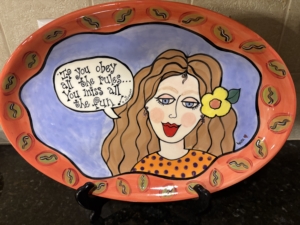 Following Directions by Debra H. Goldstein
Authors are always told to exactly follow submission guidelines lest they give an editor an easy way to reject their submitted pieces. At the same time, authors are told to think outside the box or to present an idea that is high concept. While tracking every aspect of a submission guideline makes sense, wouldn’t you agree that thinking outside the box may mean breaking with something considered a norm or genre trope?
Lately, I’ve been giving a lot of thought to when one should follow a specific direction. My thoughts have been generated by the voice of my GPS. Here are the facts:
• I park in a high-rise deck.
• When I pull out of my parking space and begin my four-floor descent, I drive straight and then have to make a series of lefts before I reach the gate to get out.
• As my GPS guides me to my destination, it acknowledges that I need to go straight after leaving my fourth-floor parking space.
• As I reach the first left turn in the deck, the GPS tells me to “Make a right.”
• Sounds logical because that is how I will go when I leave the deck. It doesn’t recognize that I’m simply at the end of the upper level of the parking deck. Rather, it gives me a pointed direction that if I followed it, might be an immediate end to my story and the journey to wherever I had planned to go.
My conclusion: my GPS is unreliable in a parking garage.
Writers who break norms often incorporate an unreliable element. Two examples that come to mind are the major twists in Agatha Christie’s The Murder of Roger Ackroyd and Paula Hawkins’ The Girl on the Train.
Can you think of other instances where authors (or your life) haven’t followed the equivalent of submission guidelines?


Oh, this is clever. My GPS once almost sent me into the Holland River. Thankfully I realized it was a body of water and not a road! And is it just me, or does the GPS voice sound annoyed when saying “recalculating.”
As for authors breaking tropes — I think one of the reasons Gone Girl was such a smashing success was that it was one of the first examples (maybe the first, but not sure) that told the story from not one, but two unreliable narrators. Great post, will share!
Thank you for the share. Glad you didn’t end up in the Holland River.
Interesting analogy, Debra! But then there’s the driver (usually male) who insists the GPS is wrong and completely ignores its directions. Possibly another unreliable narrator?
possibly.
I’ve been parking on the 4th floor of the same high-rise garage for years. Some time later, we bought our first car with a talking GPS. The first timeI I was about to exit in the new car, the GPS blurted out, “Warning, train tracks ahead!” Startled, I slammed on the brakes, and narrowly missed being rear ended by the car behind me, only to realize that the bot had recognized the metro system newly installed on the street the garage opened onto. Not a train in sight. Bots can’t seem to get the hang of life in the big city.
I can’t get the hang of big-city life when I’m in Seattle!
Or at times in small towns.. my sister and I were driving and it kept saying go left – which was into a cemetery – not exactly there short cut I had in mind.
I argue with GPS a lot, and sometimes I win. I sometimes ignore the guidelines that say “no simultaneous submissions.” My thought is I don’t have hundreds of years to live, so why should I wait for an agent or editor to take months to respond to a query?
But how do you handle an acceptance?