

A Barn That Won’t Sag; A Story I Can’t Hear
A Barn That Won’t Sag; A Story I Can’t Hear
Several years ago, I enrolled in a charcoal sketching class. I loved the simplicity of creating and bringing an image to life with shades of black and gray—seeing the face of a young girl staring back at me; a black-crowned night heron perched on a creek bank, waiting for a meal to swim by; a moored rowboat bobbing in the water.
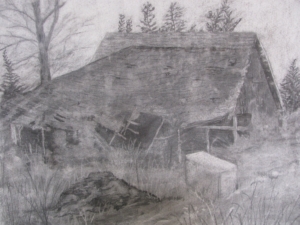
Learning to project a 3-D image onto a 2-D sketch pad was challenging.
In time, I got the hang of using light and shadow to create a 3-D effect, but in detailed sketches, it didn’t always work for me. It was as if my brain were stuck in a 2-D world and refused to budge. The good thing about sketching with charcoal is that you can erase easily with a soft, kneaded eraser. So I would sketch, erase, sketch, erase, and hope something would happen.
I shared an atelier with my art teacher and several other artists.
After a couple of hours of sketching, we’d stop to evaluate each other’s work. But on occasion, I had the studio to myself, sometimes for an entire afternoon. I loved the solitude, but I often needed the other artists in the room to push me when I was stuck.
One day I tried unsuccessfully to draw the sagging roof of an old barn from a photo I’d taken. I’d sketched and erased so many times that I’d worn a hole in the paper. Something had gotten lost between my eyes and my hand. I placed a clean sheet on the easel and sketched the barn’s framework, but still couldn’t capture its sagging roof. Then I took a deep breath and closed my eyes. I relied on my sense of sound, imagining the wind blowing through the rafters, rattling the loose shingles, and creaking the old hay loft door. I drew a few lines and imagined my hand pushing into the paper as if I were pushing the roof down.
The imaginary sounds grew more intense, and when I opened my eyes, the 3-D image I’d envisioned leaped off the paper, revealing a barn with a roof about to cave in.
That’s how it is with writing sometimes. I know what I want to write, but the words don’t always come. When they do, they feel flat and forced. I need them to jump off the page and become a 3-D image, or, in this case, a visual story. So I write, delete, write, delete. When nothing happens, I realize what I’m doing wrong. I’m not listening. I’m not letting my characters tell the story. Like hearing the old barn come alive in that quiet studio, I have to be quiet to hear my characters talking to me.
I have to remember that I’m writing their story, not mine.
I have to close my eyes, let go, and surrender to these imaginary people.
I have to trust that they will keep talking.
After fifteen published books, two on the way, and three more in the works, my main characters- Sydney Lockhart, Kate Caraway, PI Ted Kendrick, Inspector Wiggy, and Police Chief Toni Hejl- never let me down.
Kathleen Kaska writes three award-winning mystery series: the Sydney Lockhart Mystery Series, the Kate Caraway Animal-Rights Mystery Series, and the Classic Triviography Mystery Series. She wrote The Sherlock Holmes Quiz Book. She founded The Dogs in the Nighttime, the Sherlock Holmes Society of Anacortes, Washington, a scion of The Baker Street Irregulars. Her blog post, “Growing Up Catholic in a Small Texas Town,” is on her website.
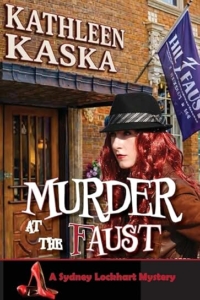
Her latest Sydney Lockhart mystery, Murder at the Faust, has just been released! It’s available on Amazon, Barnes & Noble, and at your local bookstore upon request.
Latest Release




What a beautifully written piece. So accurate. When we don’t listen to the characters they sag. Exactly what I needed to read today.
Kathleen, I’m very impressed with your charcoal barn. Charcoal is one of the hardest mediums to master, and you’ve certainly accomplished that in the execution of the barn. Loved the analogy, as well!
Surrendering to the characters–what a great way to describe the writing process!
First of all, I love the sketch. So glad you conquered it. And your analogy to writing is spot on!
Thanks, Saralyn.
Persistence pays off. Thanks for reading, Gay.
Kathleen, I’m in awe of your sketch. What talent! And I love the parallel with writing. So true! Two lessons there – in letting go in order to hear the characters. And in keeping at it… Happy writing and thanks for a wonderful post!
Thanks, Mary Lee, for reading and for your kind words.