

Inspiring First Lines by Saralyn Richard
According to Stephen King, “An opening line should invite the reader to begin the story. It should say: Listen. Come in here. You want to know about this.” Much has been written about the importance of the first line of a novel. And lists of the best first lines grace the internet with abundance.
Here are a few that top lists regularly:
- Pride and Prejudice: It is a truth universally acknowledged, that a single man in possession of a good fortune, must be in want of a wife. (This line sets the tone for the book, which is witty and dry. The book is going to be fun.)
- One Hundred Years of Solitude: Many years later, as he faced the firing squad, Colonel Aureliano Buendía was to remember that distant afternoon when his father took him to discover ice. (The line suggests setting, particularly time, and invites the reader to invest in the story of a criminal who faces a firing squad.)
- Anna Karenina: Happy families are all alike; every unhappy family is unhappy in its own way. (The dichotomy of happy and sad families reads like a truism, setting up the reader to enter the life of an unhappy family.)
- Gravity’s Rainbow: A screaming comes across the sky. (The mixture of sound imagery—screaming—and the visual of the distant sky, too far to hear any screaming anyway, creates a puzzle that the reader wants to solve. What is causing the screaming, and what must be done to stop it?)
- 1984: It was a bright cold day in April, and the clocks were striking thirteen. (April is not typically cold, and clocks can’t strike thirteen, so what is going on in this world?)
- Invisible Man: I am an invisible man. (How did you become invisible, and what strange adventures will you take me to?)
- Miss Lonelyhearts. The Miss Lonelyhearts of the New York Post-Dispatch (Are you in trouble? Do-you-need-advice? Write-to-Miss-Lonelyhearts-and-she-will-help-you) sat at his desk and stared at a piece of white cardboard. (The word, “his,” knocks this opener into a light and humorous setting and character.)
- The Metamorphosis: One morning, as Gregor Samsa awoke from anxious dreams, he discovered that during the night he had been transformed into a monstrous bug. (The foreign-sounding name, anxious dreams, and monstrous bug build tension and raise the reader’s level of concern from the ordinary to the horrible.)
- The Nightingale: If I have learned anything in this long life of mine, it is this: In love we find out who we want to be; in war we find out who we are. (The author offers wisdom from experience, and the story will be partly about love and partly about war. We suspect the war parts will test us, and we brace for the difficult ride ahead.)

Photo by Kaptured by Kasia on Unsplash
What makes these first lines notable? Each one carries a heavy load. In a few words, it sets the stage and the tone for the story to come. It hooks the reader’s attention, sometimes with an unusual or surprising statement. It provides information, but it raises more questions than it answers. For example, “I am an invisible man,” sets up questions about how the narrator became invisible, what it is like to be invisible, and where this unlikely narrator is going to take us.
The opening line sets up the reader’s first impression of the book. A tentative reader might read the opening line to test whether to commit to reading the entire book. It’s like taking a tiny bite of an unfamiliar food. If the smell, taste, and texture are pleasant, the taster will likely swallow the bite and ask for more. Similarly, if the first line is clever, pithy, emotionally welcoming, or memorable, it bodes well for the reader’s consumption of the whole book.
A strong opening line plants the seed of curiosity and puts the reader in touch with the writer. For example, “One morning, as Gregor Samsa awoke from anxious dreams, he discovered that during the night he had been transformed into a monstrous bug,” startles the reader (because this has never happened to anyone in real life that we know of), and takes him into a fantasy world where people have anxious dreams and face disgusting realities. The reader wonders how this could have happened to Gregor Samsa, and how he is going to reverse it. The reader suspends his disbelief and allows Kafka to lead him into the harsh world he has built.
I’ve done a lot of study about first lines, and this is what I’ve learned. They are really hard to write! The pressure to create something appealing and effective, to introduce the setting-plot-character-tone, and to instill questions in the mind of the reader is often overwhelming.
Here are a few of my first lines:
- Quinn’s family often joked about death, but this summer, death stopped being funny. –BAD BLOOD SISTERS
- Naughty? Me? I’m just a sheepdog pup who wants to have fun. –NAUGHTY NANA
- Late summer had painted the Brandywine Valley green, and dawn was coming up orange, but this early Monday morning in August ushered in the blues—the baby blues. –MURDER OUTSIDE THE BOX
- Late summer had painted the Brandywine Valley green, and dawn was coming up orange, but this early Monday morning in August ushered in the blues—the baby blues.
- Sundays usually meant good luck. –MURDER IN THE ONE PERCENT
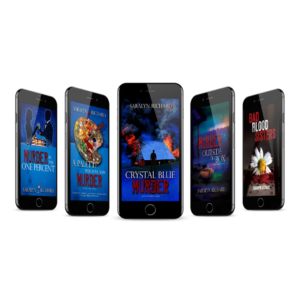
Each one of these sentences probably took me at least five hours to write. I often say it’s easier to write a whole book than it is to write an opening line.
What do you think? Do the sample opening lines carry the heavy load they need to? What is your favorite or most memorable opening line?
Saralyn Richard (https://saralynrichard.com) is a multiple award-winning author of seven mystery novels, a children’s book, and numerous short stories, poems, and essays published in anthologies and magazines. She edited the book, Burn Survivors, which was published by the University of Texas Medical Branch in both English and Spanish.
Saralyn is an active member of Mystery Writers of America and International Thriller Writers, where she leads an international writers’ critique group. She has taught literature and creative writing to high school students and to adults through the Osher Lifelong Learning Institute. Saralyn and her husband live in Texas in the house she grew up in.