Is There Another Way?

We are at war. Again.

I am old enough to remember the 1970 song “War” and its iconic refrain: “War, huh! What is it good for? Absolutely nothing!” And yet—here we are. Again and again and again.

I have lived through the Vietnam War, the Gulf War, and the post‑9/11 “Forever Wars” in Afghanistan and Iraq, along with numerous interventions in Lebanon, Grenada, Panama, Somalia, Bosnia, and Syria, and now Iran—another moment in a long, familiar pattern.

And those are just the ones involving my lifetime and my country.

This is not a simple or comfortable question—but it’s one we avoid at our peril.

What compels men to violence?

SEE MORE

The Forgiveness of Whales

In protest of the looming rollbacks to wetland and species protections, I am reposting this today with updates.

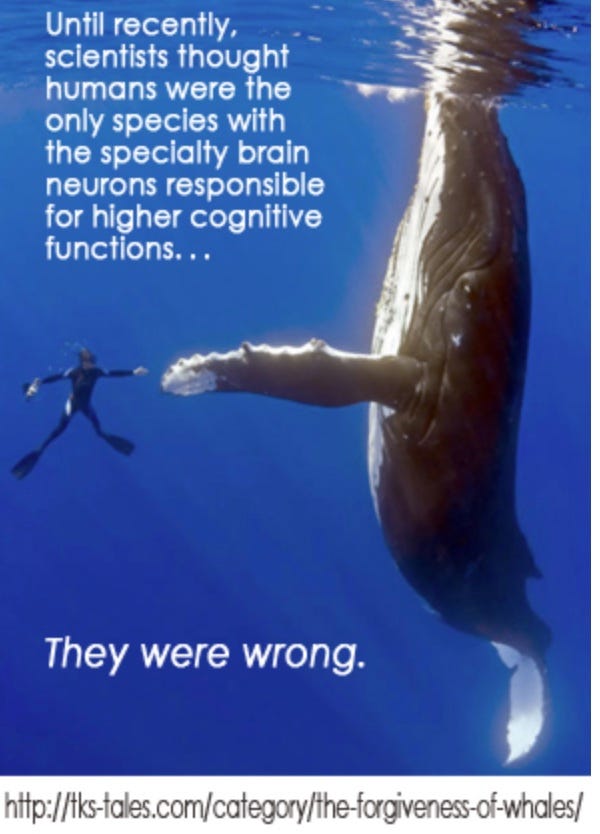
Until recently, scientists thought humans were the only species with specialized brain neurons responsible for higher cognitive functions such as self-awareness, compassion, and language.

They were wrong.

Fifteen million years before humans, whales began evolving these special glial cells, and now a strange phenomenon is occurring off the Baja coast of Mexico.

Humans have been slaughtering Pacific whales there for a long time, first with harpoons, now with sonar from Navy ships. Whales live a long time, up to a hundred years. Some whales alive today still bear the scars of harpoons. Many scientists believe that it is implausible to think that whales do not remember this or associate humans with death and anguish.

Yet, in the same area where humans hunted them nearly to extinction, then tortured them with sonar, whales are approaching humans and initiating contact. A  N.Y. Times article detailed the experiences of the reporter and the stories of locals who tell about mother whales approaching their boats, sometimes swimming under them and lifting them, then setting them gently down. Almost all the stories involve the whale surfacing, rolling onto its side to watch the humans–reminiscent of the surreal moment in the movie, Cast Away, when a whale rises from the night sea to regard Tom Hanks with an eye cupped with starlight, an eerie intelligence, and a gentleness that moves us, for we know the massive creature could kill the castaway with a nudge or a flick of a tail fluke.

These real grey whales off Baja swim close enough that people invariably reach out to touch them, and they allow it. One person, reflecting on the experience, said, “I have never felt more beheld.” It seems reasonable—given the position the whales place themselves in—that they seek the contact. In many cases, a mother whale will allow her calf to do the same. There is no food involved in these exchanges, only a brief interlude of inter-species contact and rudimentary communication:  I come as friend.

Why?

Where will humans be in another hundred years? I suspect we will be technologically advanced, but emotionally pretty much the same, even in a thousand years or ten thousand.

But what about a million years? Ten million? Can we evolve (if we survive) to a more sane, more rational, more loving species with a broader sense of our place in the universe and in life itself? Is it possible that these creatures with 15 million years of intelligent evolution on us might regard us as a young species, children who don’t really know better,  and grant us leeway for our mistakes? Grant us . . . forgiveness?

We have a need for that forgiveness, not only for our treatment of whales, but also for our treatment of each other. We have enslaved, tortured, raped, and slaughtered each other. We have recklessly used the resources of our planet.

Yet I read about humans risking their lives to free whales trapped in nets.

People offering aid to neighbors . . . to strangers.

Teachers, nurses, and soldiers whose daily lives are ones of giving.

We have much need for forgiveness, yes, but we are capable of great acts of cooperation, of kindness, love, and sacrifice. Perhaps that is what the whales see in us when they watch us use our clever hands to free them from heavy rope nets, nets that we have left carelessly in their domain, as children leave their toys strewn across the floor.

Even whales have enemies, and they do not hesitate to defend themselves when attacked and even take the battle to the enemy. Humpbacks have been observed defending not only their own against attacks of orcas, but other mammals, other whales, sea lions, fur seals or walruses. Interestingly, they only attack mammal-eating killer whales, not orcas that primarily feed on fish.

Perhaps they understand that—like the orcas—all humans are not the same.

Perhaps they are waiting for us to become our best selves, believing, or hoping we will evolve into worthy fellow creatures on this blue-and-cream jewel that is our world.

T.K. Thorne writes about what moves her, following a flight path of curiosity, reflection, and imagination.

Personal Note:

The basis of this piece was my first blog post several years ago. It has always haunted me, and I returned to it (with modifications) to share with you. Whales and dolphins have always fascinated me. One of my very early short stories involved a young autistic child and a dolphin who connected emotionally with her.

The special cells I mentioned, glial cells, may be responsible for imagination, creativity, and probably play a role in consciousness. Einstein’s brain had an abundance of these cells, especially in the area responsible for spatial awareness and mathematics. Mice injected with human glial cells became 4x smarter. Glial cells can communicate with each other (via calcium waves) and with neurons, even signalling neurons to fire. Although whales don’t have all the “levels” of a human brain (and so their thought processes are probably distinctly different), whales have a much higher ratio of glial cells to neurons than humans in the neocortex, the area thought to be responsible for intelligence.

Even more recently, using Artificial Intelligence, scientists have evidence of a whale language and are studying it. Maybe one day we will be able to have a conversation.

Hmmm.

The Future of Struggle by T.K. Thorne

“Struggle” is not a word I naturally embrace. I recently posted this:

My housekeeping style can be summed up in 7 words:

“There appears to have been a struggle.”

Okay, I stole that from a dish towel in a gift shop somewhere.

I like order around me, but housekeeping is, indeed, a struggle. The effort involved in making order happen seems like a waste of time. Why make the beds when we’re just going to get in them in a few hours? Why clean the floor we are constantly walking on?

Cleaning the house is a process on a spectrum. If you are too far on one end, you can eat off the floor, but you are a neurotic mess or a zombie. Too far on the other end, and the mice are eating off the floor. But the more interesting question is, why do we need order?

SEE MORE

People Are a Lot More

“People are a lot more than their political inclination.”

I read that statement today in a Washington Post article about an older man who found happiness in a wildly diverse group of coffee drinkers at a local café. People came there every day to sit and talk about everything, including politics, bringing pointedly different views. But they were respectful of each other, and they cared about each other.

I belong to a group sort of like that. We worked as policewomen in the same department…umm…decades ago. We’ve discussed enough politics to know we have differing perspectives. Our backgrounds are different. Our lives have taken us down different paths, but we find a way to meet about once a month, and we’re important to each other.

To keep the peace….

SEE MORE

Who Are We, Again? by T.K. Thorne

Yes, I’ve been obsessed with this question. I totally understand if you are rolling your eyes. But I think it is the key to unlocking a door that has been locked for a long time, maybe since humanity’s first glimmers of consciousness stirred. The story we tell ourselves is that we are the same from moment to moment, but that only feels true because we are the weavers of the story, just as we are the weavers of the tale about reality outside ourselves. The world we perceive is just a fiction.

SEE MORE

When Truths Collide — by T.K. Thorne

At times, the need arises to hold two concepts in opposition as true. This is discombobulating.

My mind craves order and simplicity. I blame that on evolutionary biology. Our most basic level of brain development is reptilian—edible/not edible; fight/flight, sleep/wake, the red team/the blue team. It doesn’t get simpler than that. So, the brain fights the notion of something as difficult to resolve as contradictory truths.

SEE MORE

Do Anti-Zionists Hate Jews?

I never do this. But I am doing it.

Rabbi Jonathan Miller wrote a piece titled “Do Anti-Zionists Hate Jews.” It was not a statement or position about Israeli policy but rather about an important principle. I found it made a lot of sense and helped clarify my own thoughts, so I am sharing it, with his permission, precisely as he penned it in his own newsletter.

Continue Reading

Slash & Burn: Or Just Rearrange a Few Words?

I stared at it, bracing myself.

It was a headline. It was subtle and chilling, and I couldn’t help wondering if I was complicit.

READ MORE

“The 72” by T.K. Thorne

How Concerned White Citizens Marched in Selma Before Bloody Sunday

A small thing made all of human civilization possible. It is often overlooked and undervalued, but it is so much a part of our lives that we don’t pay much attention to it. We did it even before we developed language, and we still do it. It is a deep part of who we are as a species, and it is so powerful that it can change everything.

What is it? What made human civilization possible?

READ MORE


Sisterhood of the Traveling Book

Today we’re traveling to meet T.K. Thorne!

 

T.K. Thorne wanted to make first contact with aliens. When that didn’t work out, she became a police officer. Although most people she met were human, some were quite strange…. Retiring as a precinct captain, she writes full-time. Her books include two award-winning historical novels (Noah’s Wife and Angels at the Gate); two nonfiction civil rights era works (Last Chance for Justice and Behind the Magic Curtain: Secrets, Spies, and Unsung White Allies of Birmingham’s Civil Rights Days); and then she turned to crime with murder and magic in the Magic City Stories trilogy (House of Rose, House of Stone, and House of Iron). Read below to find out where her books have traveled.
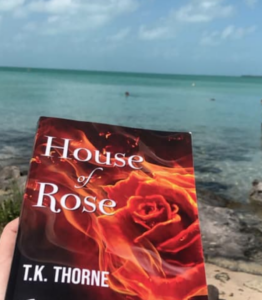
 

Belize or Bust!

A reader sent this picture from Belize! It was special to me because my husband had picked Belize as a place he wanted to go for our 20th anniversary. We stayed in a grass cottage in the heart of a tropical jungle. Howler monkeys woke us the first night at 3 a.m. We thought the world was ending! If you have never heard howler monkeys, horror movies used the sound for zombies!

One day, we climbed a steep Mayan temple for a breathtaking view over the jungle canopy. My husband had gotten a breathtaking view of my butt climbing ahead of him and thought it would be funny to take a picture. No, they never grow up, and no, I am not posting it!

The resort staff surprised us with a romantic anniversary dinner for us on board a pontoon boat and left us to float on the deserted lagoon by ourselves. Above, stars gleamed against a deep black sky like crystal dust. More than I have ever seen. I felt I could reach up and grab a handful. Then, our boat (which we had no way to steer) bumped into the shore and a mass of thick vegetation. Remembering the crocodiles we had seen on a previous night’s tour, we called for extraction.

How Deep Did You Say?

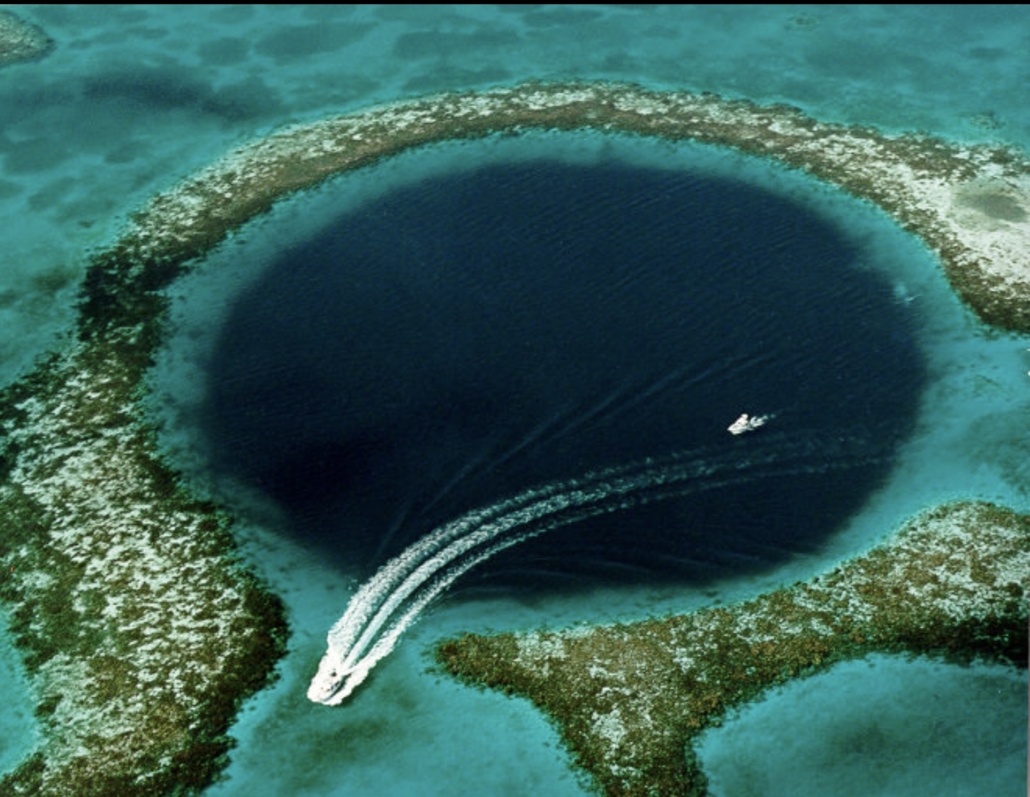
A few days later, we transferred to Ambergris Caye. At home, before the trip, my husband and I had gotten certified in scuba diving, planning to dive into the Belize Barrier Reef. It’s the largest reef in the Northern Hemisphere, but it’s accessible with only about a 40-50-foot dive. However, before our trip to the reef, an opportunity arose to dive the famous Blue Hole, which would mean going down 150 feet, way deeper than we’d ever been.

The Hole is over 400 feet deep and wide enough to be seen by satellite! I had cold feet, but by the following morning, I decided this was a once-in-a-lifetime opportunity, and I would regret it if we didn’t go. We had to scramble to get headlights (it’s dark that deep down!) and make the group cast off.
 

Screenshot

At the Hole, we donned our gear and started down. I could feel the pulse beating in my temples as we went deeper and deeper. Strangely, there was no sensation of increasing pressure, but we were accompanied by a circling escort of sharks I only later learned were harmless nurse sharks. However, I also later learned that hundreds of divers have died in the Blue Hole, something I guess the sharks were aware of. . . .

Stone Teeth

At about 150 feet, we encountered the top of the underwater caves and swam around a three-foot-wide stalactite that plunged below us like a gigantic stone tooth, disappearing into the darkness. Not only had we descended into the water’s depths, but we had traveled through time. During the last Ice Age (about 10 – 19,000 years ago), the sea was below the cave floor, meaning  400 feet below the current sea level!

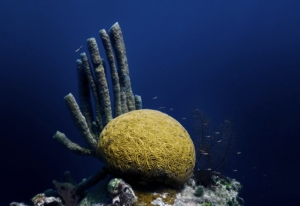
Though there was a tense moment regarding air supply, we made it back to the surface without becoming shark food. The next dive was the Reef, which was, in a different way, as dramatic as the Blue Hole. To my left, every square foot was crammed with diverse, colorful coral and marine life. I was mesmerized and could have stayed in one spot the whole time! To my right, the deep, almost black blue vanished into infinity.
We had other adventures, but too much to tell. So, when a reader sent the picture of my book as her beach read in Belize, it was a treat to learn Rose (the heroine of House of Rose) had also traveled there. I doubt her trip was similar to mine, but Rose had stuff to deal with:

When rookie patrol officer Rose Brighton chases a suspect down an alley, she finds herself in the middle of every cop’s nightmare—staring down at a dead body with two bullet holes from her gun . . . in his back.

He’s dead and now she has to explain it, which is going to be a problem because what happened was so strange, she doesn’t understand it herself. Rose must unravel the mystery of what happened and who she really is—a witch of the House of Rose. If she doesn’t figure it out fast, there will be more bodies, including her own.

House of Rose, set in the Deep South city of Birmingham, Alabama, is the first book of the Magic City Stories.
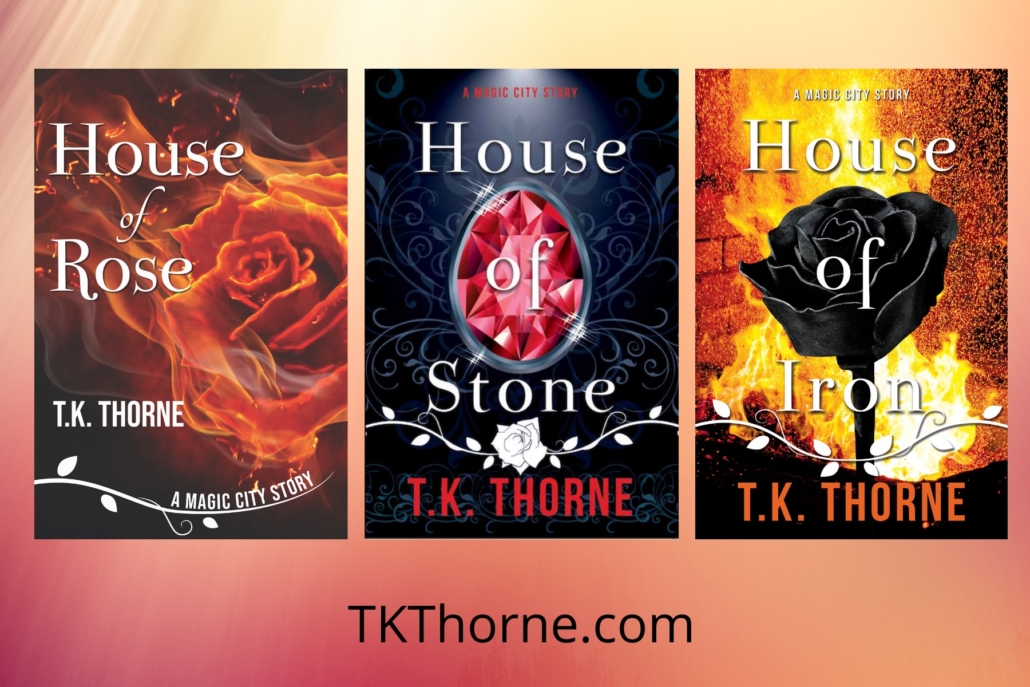
Also available as Audio Books on Amazon or Audible.com

What Folks Are Saying:

“Thorne delivers a spellbinding thriller, an enthralling blend of real-world policing and other-world magic.—Barbara Kyle, author of The Traitor’s Daughter

“A deftly crafted and riveting read.”—Midwest Reviews

“Thorne, a retired captain in the Birmingham PD, grounds the fantasy with authentic procedural details and loving descriptions of the city and its lore. Readers will look forward to Rose’s further adventures.”—Publishers Weekly

“T.K. Thorne is an authentic, new voice in the world of fantasy and mystery. An explosive story that will keep you on the edge of your seat. Pick up this story—you’ll thank yourself over and over again.” —Carolyn Haines, USA Today bestselling author of the Sarah Booth Delaney, Pluto’s Snitch, and Trouble the black cat detective mystery series

 “Although House of Rose is speculative fiction, a kind of fantasy, T.K. Thorne is so knowledgeable about Birmingham and law enforcement that it is also, truly, a police procedural and a thriller—something for everyone. “House of Rose” is the first of a series which should be a hit.”—Don Nobles, reviewer for Alabama Public Radio