Road Research
By Barbara J. Eikmeier
My favorite place to find details for a story is on a road trip.
My regular job is presenting programs about quilts to small and regional quilt guilds. Bookings take me off the main highways to “Blue Roads”, through tiny communities and sometimes even down dirt roads. Ninety percent of the time I travel alone.
Once my GPS is set for my destination and snacks and water bottle are within easy reach, there is one last item to put in place before hitting the road – my notebook.
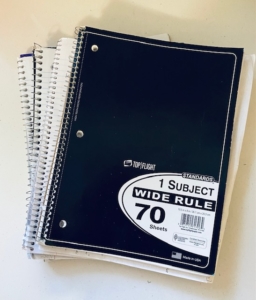
Over the years I have filled great piles of these notebooks with lecture notes, story starters, to-do lists, quilt patterns, rough drafts and travel notes. I don’t journal daily, although I admire those of you who do. I just make notes. My notebooks are sloppy. I seldom keep the script on the line but if I’m striving to hit the line, I prefer wide-rule over college rule so I have plenty of space for the letters that loop below the line. I really love letters that loop below the line. I have a memory from kindergarten of writing my name in the proper upper right hand corner of the paper. I started with a B and ended with an A but in between I used all sorts of letters – especially g and j because they looped below the line. My teacher didn’t think I knew how to write my name. I did. It’s just that it was so long and only used three letters repeated over and over, yet there were so many fantastic letters to choose from on the ABC chart that wrapped around the classroom. As an adult I opted for Barbara J. Eikmeier as my legal name because with all those letters in my long name, only my middle initial loops below the line!
When heading out on a trip, my notebook, wide rule or college rule, it doesn’t matter because I won’t be using the lines, is positioned on the passenger seat. As I drive I notice landmarks, brown sign historical markers, the names of rivers and creeks: Bee Creek, Wolf Creek, The Mississippi River!
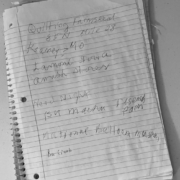
Keeping my eyes on the road, I write without looking: Kalona Creamery, MO mile marker 48 – look up round barn.
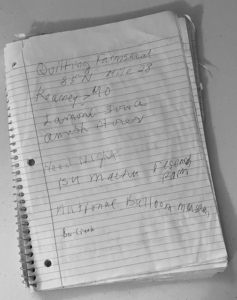
My notes include clever place names that I can use in my stories: The name a of a beauty shop in western Kansas became the name of the diner in my current novel.
When I stop to rest or get fuel I take my notebook inside with me. I’ve sat in McDonald’s, Subway restaurants and truck stops making notes about the man with snow white hair cut as if a bowl had been place on his head, the young kid behind the counter who was overly friendly – acting as if I liked him enough I might take him with me, and the trucker with the huge tattoos up and down his muscular arms that spelled out PUGSLEY in great Gothic lettering. What does Pugsley mean? It doesn’t matter – I can make something up as long as I have a note to jog my memory.
I record snippets of conversations, especially local dialects and topics like the old guys discussing the price of beans over coffee and a breakfast burrito at their local gas station where three cafe tables line the wall along the windows – the only breakfast eatery for miles. And I’m a huge fan of local bulletin boards with notifications of missing pets or persons, items for sale, local fundraisers, estate sales and funeral announcements. A writer can extract a lot of interesting details from a bulletin board in a gas station!
Periodically I will skim through a notebook or two and re-write or type an entry. I usually remember what I’ve written about, (and where it was and when) when re-reading my scribbling that either runs sideways in bold print, or neat script with lovely loopy letters. A psychologist in a writing class once said it was a hand/brain correlation that helps us remember things we’ve written.
The back to school supplies are dwindling. Soon the notebooks, folders and 12 packs of #2 pencils will be relegated to the office supply aisle until next year. It’s my reminder to stock up on another stack of spiral bound notebooks.
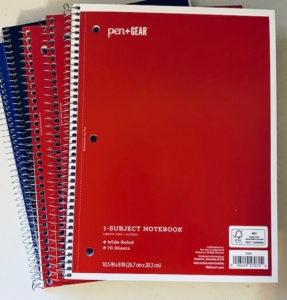
How do you keep track of tidbits you notice on a road trip? Do you also love spiral bound notebooks?
Barbara J. Eikmeier is a quilter, writer, student of quilt history, and lover of small-town America. Raised on a dairy farm in California, she enjoys placing her characters in rural communities.



 For a fiction book:
 Sparkle Abbey’s latest story (written in first person) is a short but fun one. If you’ve not yet