Tag Archive for: writing

Writing and the Pursuit of Happiness — T.K. Thorne
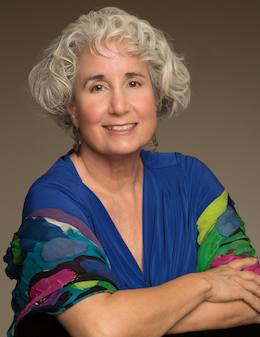


      Writer, humanist,
          dog-mom, horse servant and cat-slave,
       Lover of solitude
          and the company of good friends,
        New places, new ideas
           and old wisdom.


Life, Liberty, and the Pursuit of Happiness.
Thomas Jefferson felt those three things of such importance,
he wrote them into the Constitution of the United States and dubbed them “unalienable
rights.”
But what do they mean? 
“Life” isn’t a hard one. I like breathing as much as the
next person. “Liberty” may be more nuanced, but we know, at the least, it means
freedom from tyranny. But the “pursuit of happiness” has always kind of
confused me.
For most of my life, the desire of my heart was to have a
horse. My poor parents had to endure the steady entreaties of my obsession,
begging that did not wait for gift-giving holidays.  If only I had thought of it, I could have
declared it was my right as a U.S. citizen to have a horse because that was the
only thing that would grant me happiness.

My sharp mother would have most certainly pointed out that
having the horse was not my right, only pursuing it, which I was doing.
Still, the questions remain. 
What is happiness and why do I have a right to pursue it and just how do
I pursue it? This is not a frivolous question. Please bear with me for a tiny
bit of history.
Thomas Jefferson was a self-declared Epicurean. Epicurus was
a Greek philosopher who lived from 341 BC and 270 BC, about 2300 years ago.  He emphasized pleasure as the highest goal of
mankind. The word today conjures up words such as hedonism, luxury, and sensual
pleasure, all with a negative judgment attached. This misinterpretation may be
laid at the feet of the early Catholic Church who declared Epicurean philosophy
a pagan challenge to the Church and, therefore, heresy.   Very bad things happened to heretics.
The original teachings of Epicurus lifted up pleasure not in
the sensual, temporary sense, but in the long-term acceptance of oneself and
one’s nature that leads to serenity and inner peace. The journey toward that
goal actually called for temperance and moderation.  The Greek word worked its way through Greek
and Latin into English as “pleasure,” but perhaps in modern terms the word “happiness”
is truer to the original meaning.
For the sake of simplicity, let’s distinguish “pleasure” and
“happiness.”  Pleasure is the temporary
chasing and fulfilling of desire. [I must have a horse, now, or I will forever
be miserable.] Happiness is a state of inner peace and balance where life is
lived for the most part in the present. [I love and appreciate horses but if I
don’t  have the Black Stallion in my
backyard, I will still be a complete and fulfilled human being.]
Go tell that to my ten-year-old self. Ha! . . .Obviously, it
takes maturity to find happiness.
Where were we? 
So happiness is something way deeper than pleasure,
something so important and basic that it is our inalienable right to seek it.
Wow.
What does this have to do with writing?
Again, bear with me for a short backing up.  One of the components of finding happiness is
the ability to live, for the most part, in the present. We humans come with a
brain that has evolved with the capacity to plan.  That is a big deal and definitely made a
difference in our ability to survive.
Planning is not necessarily limited to humans. Squirrels
hide nuts for the winter. (I always thought ants stored food too, but unless Aesop was talking
about the Messor aciculatus species,
that was just a fable.) What we don’t know is if the squirrel is aware that the
tasty nut he hides will feed him come winter or if he just acts on instinct,
but whatever.  The important thing is
that we humans are wired to plan. In ancient days, we sought a cave for when it
got dark and dangerous or rained or snowed. We smoked meet to preserve it. We
learned to grow and store crops. Now we shop at the grocery store but usually for
at least a week’s worth of food.
That’s the good side of concern and subsequent rational
planning, but there is an evil twin lurking. 
Her name is “worry” on a light day, and “anxiety” on a dark one. Our
minds can go into hyper drive about the future or the past. Angst and regret
are children of the mind’s tendency to dwell in a time that is not the present.
[How’s that for mixed metaphors? *sticking
out tongue
* It’s my blog and I can do it if I want.]
Memory can be a friend that saves us from repeating mistakes
and gives us direction for decision making. 
Or it can be a pleasant companion. It can also be a special hell on the
road away from happiness. [See above.]
The answer according to Buddha and Epicurus is to find a way
to live in the present because that is the only experience that is real, that
is truth. There are other aspects of this, but let’s stay with this one—living
in the present, also known as mindfulness. 
Step One used by Eastern seekers of happiness is meditation.  There are lots of ways to meditate, but the
primary goal is to practice bringing the wandering mind (lovingly) back to the now.
We writers are rarely in the now.  We are dreamers.  Our mind wanders as easily and naturally as
breathing.  [Sitting down to dinner and
noticing silverware while guests talk about politics of the day: How would I hide that knife in my clothing
if I were kidnapped—though I put up a brave fight and a breathtaking chase on
my black stallion—and a prisoner in the castle of an evil man who wanted to
marry me against my will?
]
The present?  Very
funny. Impossible.
Writers spent a great deal of our lives dreaming and
“living” with characters and situations in made-up worlds, so engrossed that
the real world, the present, and the passage of time are completely unnoticed.  [Really. 
Ask my husband.] We are not in the here-and-now. You can’t get more
“elsewhere.”
That makes us failures at Step One, right?
Not so fast. 
Meditation is not an end of itself.  It’s a tool. We exercise and eat well in order to have a healthy body that can
do the things we want to do—walk, run, swim, not be in pain.  Unless you are a monk, meditating all day is
not the goal. The goal is happiness. 
Mindfulness is a state of attention that is conducive to the path or way
of being happy.
Wait.  Did you catch
that?  Directing our thoughts to what we’re engaged in. 
A potter absorbed in the feel of wet clay shaping in his
hands is living in the present. An
artist focused on the task of mixing the perfect color is likewise living in
the present. A child at play. A reader absorbed in a story. A parent intent on helping his child hold a bat. An athlete in the zone. A fruebd truly listening.
The purpose of meditation is to exercise our focus, so that
we can bring our full attention to the moment–to a scene of beauty, a moment of
sorrow . . . a task.
When I am writing, lost in the creating or the shaping of what
I have created, I am happy. I am not “aware” of my happiness. I just am. I am
not judging, not thinking about or worrying about the future or the past. I
just am.  It’s my inalienable right.

A retired police captain, T.K. has written two award-winning historical novels, NOAH’S WIFE and ANGELS AT THE GATE, filling in the untold backstories of extraordinary, yet unnamed women—the wives of Noah and Lot—in two of the world’s most famous sagas. The New York Post’s “Books You Should Be Reading” list featured her first non-fiction book, LAST CHANCE FOR JUSTICE, which details the investigators’ behind-the-scenes stories of the 1963 Birmingham church bombing case. Coming soon: HOUSE OF ROSE, the first of a trilogy in the paranormal-crime genre. 

She loves traveling and speaking about her books and life lessons. T.K. writes at her mountaintop home near Birmingham, Alabama, often with two dogs and a cat vying for her lap. More info at TKThorne.com. Join her private newsletter email list and receive a two free short stories at “TK’s Korner.

Sock Stories by Debra H. Goldstein

SOCK STORIES by Debra H. Goldstein
Have you ever
noticed the socks a person wears? Like the words a writers put on paper, each
pair tells a story or evokes images or feelings.

For example, my
husband wears dark socks to his office because he has bought into the theory that they look more  look more professional than gym socks, but his disinterest in how he dresses is reflected by his
unwillingness to take the time to match the color of his socks to the shade of his slacks.
He’s just as likely to wear black with brown as he is to grab a pair of brown
socks. Joel is most comfortable in gym socks and sneakers. To my chagrin, his yucky
looking tube socks and an old pair of slip-ons are the image indelibly pressed
into our neighbors’ minds when they seem him going outside every morning to
retrieve his precious newspaper.

A young man I
know tells a different story through his sock choices. He considers himself to
be a player. Consequently, he coordinates the sharpest socks I’ve ever seen
with tailor made suits and shirts, as well as specialized pocket handkerchiefs
or patterned ties.

Personally, I’ve
always been fond of wearing socks that tell a story or bring a memory back to
me. I wear Chanukah, Mah jongg, and other holiday socks to make a statement for
the moment, much as one does with a Christmas sweater. On a bad day, I choose
between the comfort afforded by two pairs of warm soft fuzzy socks.

Last week, when
we took a family cruise to Alaska, the socks I ended up wearing not only
created a story for the moment, but became part of memories I will pull up in
the future.

The ages in
our group ranged from five to seventy-five. I wasn’t the oldest, but I easily
was the group’s cattle herder. Before we sailed, I reminded everyone to bring
passports, cold weather and rain gear (and of course our coldest day was 72
degrees and the only time it rained was once while we were sleeping), and other
essentials. I chided, sent e-mails, and while packing managed to leave my air
pushed out of it plastic bag of socks on the dining room table.

I arrived on
the ship with only the striped sneaker socks I was wearing, but never fear,
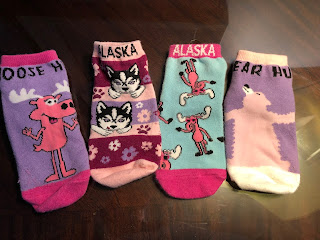
cruise ships sell everything. That is why I am now the owner of pink and purple
socks that all say Alaska and have moose heads, full sized mooses, bears, and
something I’m not sure of on them.

Each morning,
as I pulled on a pair of these socks, they reminded me I was sharing Alaska with
people who matter to me more than anything else. The animals, background
mountains, and whatever it was on one pair that I wasn’t sure of, also made a statement
that this would be a day of new experiences and beautiful terrain.

Our most
varied day was in Juneau. For us, it was the day of the glaciers. Joel and I
took the most sedate way of seeing them – busing and hiking to lookout points,
but even from a distance, the beauty of massive pieces of ice broken from the
main glacier fascinated me. What I saw and the ranger’s movie made me ever so
much more aware of global warming because of how the glacier itself has
receded. My daughter and her husband kayaked out to the glacier; my two sons
took a float plane into the glacier area; and our five year old grand-daughter and
her parents visited a dog camp and rode a dog sled. Everyone came back to the
ship impressed by what we experienced.

From now on,
whenever I put on a pair of my Alaskan socks, I will remember the looks of
happiness everyone had while telling me about their day.

My initial
anger at forgetting my socks has been replaced by the stories my new ones will
always unlock. Whenever I see the pink moose or either “Moose Hug” or “Alaska” on my socks, memories and
scenes from the cruise will be triggered – much as words create mental images
in a good book, short story or poem.

Selected Readings

by Bethany Maines

This week I’m going to take part in a live reading event
called Noir at the Bar.  It’s a fun event
that focuses on crime tales and the forties pulp-fiction style.  I’m excited to participate, but as usual it
throws me into a tizzy of what to read. 
Short stories come in all shapes and sizes but reading for an audience
is quite different.  Not every story
translates well to an audience that’s slurping their way through cocktails and
appetizers. I would, of course, love an audience to hang breathless on my every
word, but even when an audience comes specifically to see an author it’s very
hard to get that level of studiously quiet audience participation. 
Through the variety of readings that I have experienced I’ve
developed the theory of “joke” short stories for readings.  Not that a reading has to be funny, but that
it should be constructed like a joke.
There is the set-up. 
A man walks into a bar
at the top of a rise building.  It’s a
swanky place, but there’s a guy in a suit and glasses slumped at the bar.

The tale. 
I can’t believe this
view,” says the man, looking out the window.
“Yeah, but you’ve got
to look out for the cross-winds.  They’re
killer,” says the drunk guy, brushing a curl of dark hair off his forehead.
“What are you talking
about?” asks the man.
The drunk guy stumbles
off his bar stool.  “Here I’ll show
you.”  He opens the window and steps out,
but the winds sweep in and he simply hovers in air and then steps back into the
bar.
“Holy cow,” says the
man.  “I can’t believe that.”
“Give it a try,” says
the guy in glasses.

The pay-off.
The man steps off the
building and plummets to the ground.  The
bartender looks up from polishing the glasses as the drunk guy sits back
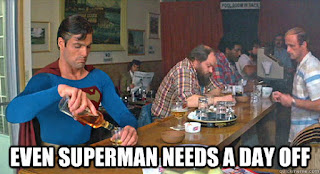
down.  “Jeez, Superman, you are mean when
you drink.”


The story has to have a pay-off or the audience sort of
stares at you like cows in a field.  It
doesn’t have to be a funny pay off, but there has to be some sort of solid finish
that gives an audience a feeling of conclusion.  Usually, it’s some sort of twist that reveals the truth or that gives the audience the
key to understanding the story. I’ll be reading a condensed version of a short story from my Shark Santoyo story.  Hopefully, Noir at the Bar enjoys what I’ve selected for
them.  Wish me luck!


Bethany Maines is the author of the Carrie Mae Mystery Series, Tales
From the City of Destiny
, San Juan
Islands Mysteries
, Shark Santoyo
Crime Series
, and numerous short stories. When she’s not traveling to
exotic lands, or kicking some serious butt with her fourth degree black belt in
karate, she can be found chasing her daughter or glued to the computer working
on her next novel. You can also catch up with her on YouTube,
Twitter and Facebook.

Post-Publication

By Bethany Maines
Me Before Publishing:
I just love writing and I would never bother anyone to buy my books.  In fact, I prefer not to talk to people at
all.  I’ll just stay in my writing cave
over here and type some more.
Me After Publishing:
BUY MY BOOKS!!!  REVIEW MY BOOKS!!! I
NEED A STREET CORNER AND A BULLHORN STAT! 
WHY DON’T YOU LOVE MEEEEEEEEE!!
You would think that the amount of sales affected that
post-publishing sentiment, but they don’t. 
Not a bit. Publishing a book, or presenting any piece of artwork for
public consumption, is to lay bare some piece of the soul in a very public
way.  It’s very difficult to maintain any
sort of equilibrium as reviews from readers trickle in.  Some of the reviews can be wonderful and have
you floating high in the sky and others have you raging and stomping around the
house.  But even the angry-makers are a
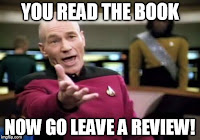
validation of a kind.  Someone read my
book and cared enough to leave a review! 
Yes, they thought my main character was snarky, but they cared enough to
comment, damn it!  The worst is
silence.  You, you invisible people, you
bought the book!  I know you did.  It’s right there in the sales report.  You didn’t read it?  You read it, but didn’t love it?  Why don’t you love meeeeeee? 

And we’re back in the loop.
Which is when it’s important to take a breath, step away
from the computer and go for a walk.  Or
talk to the dog.  And Kato says that it’s
time for a walk, so off I go.
Erm… by the way, have I mentioned I have a new book out (and book 1 is still ¢.99)?

Bethany Maines is the author of the Carrie Mae Mystery Series, Tales
From the City of Destiny
, San Juan
Islands Mysteries
, Shark Santoyo
Crime Series
, and numerous short stories. When she’s not traveling to
exotic lands, or kicking some serious butt with her fourth degree black belt in
karate, she can be found chasing her daughter or glued to the computer working
on her next novel. You can also catch up with her on YouTube,
Twitter and Facebook.

Checking Out Some Great “How To” Writing Guidelines

by Paula
Gail Benson


Lately,
I’ve been coming across a number of online articles that express succinctly how
certain forms of genre fiction should be written. Here are a few I’ve
discovered:


Dennis
Palumbo wrote “
Taking the Mystery Out of How
to Write a Mystery” (https://www.writersstore.com/taking-the-mystery-out-of-writing-mysteries/).
He lists three important elements: : “1) establishing the unique character of
the protagonist, 2) making narrative use of the world in which the story takes
place, and 3) planting clues (remember, only a few) that derive from the
particular aspects of that world.” Palumbo recommends that writers consider
what makes them unique and their own backgrounds in developing their
protagonists and settings.


Chuck
Wendig provides “25 Things Writers Should Know About Creating Mystery” (http://terribleminds.com/ramble/2012/05/08/25-things-writers-should-know-about-creating-mystery/).
He describes a mystery as an incomplete equation. Even though readers know the
answer will be revealed by the end, “[a] good story traps us in the moment and
compels us by its incompleteness.” Readers want to be part of the process. “[S]ometimes
creating mystery is not an act of asking a question but the deed of providing a
clearly incorrect answer. Let the audience seek the truth by showing them a
lie.” And, it’s important for plot and character to be intricately intertwined.
“Plot, after all, is like Soylent Green — it’s made of people.”


Ginny Wiehardt gives us the ten “Top Rules for Mystery Writing” (https://www.thebalancecareers.com/top-rules-for-mystery-writing-1277089).
Her article is written about mystery novels, but the suggestions are easily
adapted to short stories. She points out that people read mysteries for a “particular
experience.” They want the opportunity to solve the crime and they expect all
to turn out well in the end. Reading many mysteries to see how “the rules” have
been applied in those stories will be helpful to a writer, and understanding “the
rules” in order to better meet reader expectations will help a writer craft a
better mystery story. Among her recommendations are to introduce the detective,
culprit, and crime early and wait until the last possible moment to reveal the
culprit.


Peter
Derk explains the “
The 8
Keys to a Good Heist Story” (https://litreactor.com/columns/the-8-keys-to-a-good-heist-story).
“A good heist has a planning stage, execution stage, and an escape. They can be
in different proportions, but if your story is missing one of the three, it
won’t pass muster.” Derk says there must be complications and a reason to root
for success. Also, he suggests taking care in putting the team together and
having a reason behind the operation that is greater than monetary gain.


Dr.
David Lewis Anderson gives a good description of “Time Travel in Science
Fiction” (http://andersoninstitute.com/time-travel-in-science-fiction.html).
He offers a historical analysis of science fiction stories that have used time
travel, but he also explores the elements writers have developed through those
stories.


In his “6 Secrets to Creating and
Sustaining Suspense,” (http://www.writersdigest.com/online-editor/6-secrets-to-creating-and-sustaining-suspense)
Steven James evaluates how to add suspense in mystery,
thriller, and literary stories. He suggests the key is to give readers
something to worry about, then explains how to do that.


Finally,
Jan Ellison offers “9 Practical Tricks for Writing
Your First Novel” (http://www.writersdigest.com/online-editor/9-practical-tricks-for-writing-your-first-novel).
Two of her recommendations that I found interesting were to set writing goals
that are completely within your control and keep working on a poem while
writing your novel. The poem allows you freedom of expression and provides a way
to get started with your writing.


Have you read any
writing “how to” articles lately?

Back to Basics by Diane Vallere

I’m delighted to have Diane Vallere, prolific writer and past-president of Sisters in Crime’s national board guest blogging for me today. Diane juggles well, but occasionally even she needs to go back to basics. – Debra
Back to Basics by
Diane Vallere
It
should come as no surprise to learn that fiction authors sometimes have
conversations with our characters. I once set up several chairs in my living
room for each of the suspects in my then-work-in-progress to interview each
character about his/her motives for murdering the victim. Silly? Yes. Made the
neighbors doubt my sanity? Sure. Effective? Absolutely. I zeroed in on the
killer and wrote the ending. But PANTY
RAID
gave me a different problem. I couldn’t even find the story.

A
few background facts for context: 

1.    
I’m
a pantser.

2.    
I
start with a title and the loosest of concepts.

3.    
PANTY RAID is book 8 in an
ongoing series.

Heading
into the first draft of this book, I knew it would feature the lingerie market,
and it would take place in Paris.

My
routine is to work Monday through Friday and write 2500 words/ day, but after
weeks of working on the draft, I admitted there was a problem. I told one of my
writer friends that my character was not cooperating, and my friend suggested I
ask her what was wrong. I did, and details of that conversation are in this YouTube video. But the separate issue that I didn’t address
there was this: I tried to plot that book.

We
pantsers hear it all the time: you can write faster if you plot and know where
you’re going. I’m always interested in improving how I do things, so I invested
in a plotting course and gave it a shot. I even went so far as to break down
four favorite movies into bullet points to better understand their structure.
And still, I trudged, word by word, with a manuscript that was filled with “GO
BACK AND CHANGE END OF CHAPTER 2” and “SOMETHING HAPPENS HERE—WHAT???”

I
went for long walks. I dictated plot points into my phone. I deleted and
rewrote and have entire sections of a manuscript that I love but that didn’t
fit with what came before or after them. Of the seventeen days I spent working
on that draft, I only hit my word count goal on three. 23,922 words of garbage.

On
March 22, I stopped working on that draft.


On
March 23, I had a conversation with my character.


On
Marcy 24, I started writing a new version of PANTY RAID and bumped my daily
word count goal to 3,000.
On
April 15, I wrote The End.

In
those nineteen days of writing, I discovered a whole story I never expected to
tell. And I exceeded my new word count goal eleven of the nineteen days.

Do
I regret trying to plot? No. If I hadn’t tried to, I’d never know my system
works for me. Do I hate knowing I have a file of 23,922 words of a story with
parts I love that may never get used? Yes. It goes against everything in my
Capricornian nature to abandon projects mid-way. Is there a lesson in there?
Absolutely. Sometimes you have to give up control in order to end up on top.

~ ~ ~ ~ ~

After two decades working for a top luxury retailer, Diane Vallere traded fashion
accessories for
accessories to murder. In addition to the Samantha Kidd Style
and Error Mysteries, she is responsible for the Madison Night Mad for Mod,
Sylvia Stryker Outer Space, and Lefty Award-nominated Costume Shop and Material
Witness series. She started her own detective agency at age ten and
has maintained a passion for shoes, clues, and clothes ever since. 

LINKS:

ABOUT PANTY RAID:

When amateur sleuth Samantha Kidd is assigned to cover the
lingerie show in Las Vegas, her excitement is more visible than panty lines.
Events in her hometown have made her a celebrity, and a romantic getaway with
fiancé Nick Taylor is timely. But when a lingerie model—engaged to a college
friend of Nick’s—is found dead outside their hotel room, their escape turns
brief. Cheeky designers, high class hookers, and secrets from Nick’s past that
don’t add up make this gamble her most dangerous one yet. When push-up comes to
shove, Samantha bares everything in order to save her future.

BUY LINKS:

In Praise of Prologues

By AB Plum

Do you skim prologues?

Dislike them?

Shrug when you finish and begin Chapter 1 (the real story)?

Feel “manipulated” when you finish the book?

Prologues stir up a lot of discussion among writers and readers. Personally, I like them if they’re more than hype. Winding up a seven-book series, I decided to use seven prologues in the final book. 

Crazy? Maybe. But. I think they work. Because they satisfy introducing unanswered background story questions from the previous books. 

Each of the min-prologues layers into the subsequent plot—though in one instance, the reader may get a surprise at the twist. In length, they range from three lines to one page. Two different backstories emerge. Ultimately, they tie the whole series together. 

Each mini-prologue falls under the general heading of Prologue. I used lowercase Roman numerals to distinguish each one.

Would I try this structure again?
Right now, I’ll say yes. As a writer, I really enjoyed the challenge. 

What about you? Would you take one look at those Roman numerals and throw the book against the wall? Would you read them and then delete the book from your eReader?

************
The Whole Truth marks a resting place for AB. Sliding down the slippery slope of writing noir has opened up a lot of ideas. This summer she plans to read more for pleasure, dance more for fun, walk more for health and write more about love.


Chapter by Chapter

by Bethany Maines

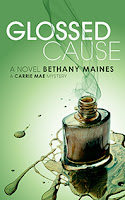
I recently read a review on Goodreads of my book GlossedCause. 
I love this series from
Bethany Maines! Such a funny and interesting read throughout and makes you want
to keep reading! This series is definitely best read in order, short stories
included! A few nitpicky things that I didnt like were titled Chapters that was
a theme for the chapter. (I like a simple number or location & number) and
I’d love another book where Carrie Mae played a bigger role.
The reviewer gave me a good number of stars and overall that’s
a pretty dang good review.  So, thanks!  But I find myself flummoxed by the comment on
chapter numbers.  I just… I mean… Chapter
numbers?
First of all she’s completely blowing my theory that no one
reads my chapter titles.  The truth is,
and this is a deep dark secret regarding the chapter titles in the Carrie Mae
series.  They’re really just for me.  I mean, I hope the rest of you who bother to
read them enjoy them too.  But really
they’re a secret code while I’m writing that means I can glance at the table of
contents and remember what’s going on in each chapter. Also, they’re usually
song titles which means at the end of the book I have a pretty nifty playlist.  (Check out this one from Bulletproof Mascara
chapter titles on the Carrie Mae YouTube channel.)
I’m not sure what lesson is to be learned from this, other
than I should stop reading reviews, but I’m sure I’ve definitely learned
it.  Maybe.  Or maybe next time I’ll do chapter titles
with latitude and longitude and possibly three character names and a
unicorn.  We’ll just have to wait and
see.


Bethany Maines is the author of the Carrie Mae Mystery Series, Tales From the City of Destiny, San Juan Islands Mysteries, Shark Santoyo Crime Series, and numerous
short stories. When she’s not traveling to exotic lands, or kicking some
serious butt with her fourth degree black belt in karate, she can be found
chasing her daughter or glued to the computer working on her next novel. You
can also view the Carrie Mae YouTube
video or catch up with her on Twitter and Facebook.

Advanced Generalist

by J.M. Phillippe

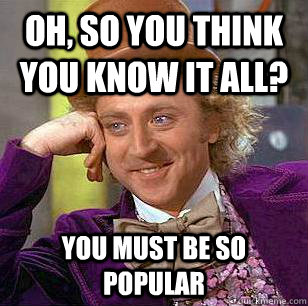
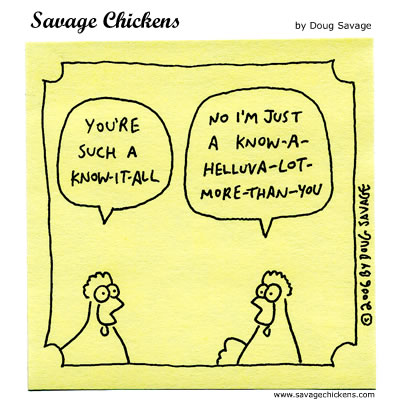
I am a know-it-all. This is not a confession I make likely, because being called a know-it-all when I was growing up was not a positive experience.

And yet, I couldn’t help myself. I liked knowing things. I still like knowing things. It goes deeper than needing something to feel superior about (I know something you don’t!). Knowing things was how I held on to an objective reality when my personal reality was constantly being challenged when I was growing up. 
Feelings, I learned early on, lied. They did such a good job of lying they could rewrite the past, shape the present, and make the future seem like destiny. If things were good, they had always been good and would always be good. More often than not, if things were bad, they had always been bad and always would be bad. I needed something I could depend on to hold on to. And that’s when I discovered facts — things that were undeniably true. Things that surpassed emotions. Things that I could use as anchors so that my life could make some sort of sense.
My hunger to know things, really know things, also meant a huge reluctance to accept that the things I knew were wrong. My family had invested in a set of encyclopedias when I was a child, and I went to them on a regular basis. These days I use the Internet to verify that I do in fact know what I know (and that it is knowable), using skills garnered in my years as a journalist to test sources and information. Fact-checking, once a part of my job as a reporter, has become part of my daily life. To this day, I go into an emotional tail spin if a fact I have held on to is questioned — how could I get something wrong? What is actually knowable? Will life ever make sense?
It is with old-fashioned journalistic confidence — the confidence of someone who has done the fact checking — that I can say that when I know something, I know something. I have spent more time than is probably healthy looking it up and verifying its veracity, or else I will be light in my presentation of said fact, using “I think I read somewhere that…” instead of stating it as something actually true. Being a know-it-all is not something I take lightly — I try very hard to accurately share what I know. 
I have also had a lot of different jobs. In my years attempting to be a freelance journalist (which I was never great at because selling my writing was always harder than doing the writing), I took a lot of day jobs, and in fact, spent a great deal of time being a temporary employee. Being a temp suited me since I have always been able to learn fairly quickly, and because I like being helpful. And since I was a temp, there was only so much filing I would have to do before getting (or asking for) a new assignment. Eventually, I became one of those people who knew at least a little bit about a lot of different things. I was a generalist, in the old terminology.
So it greatly amused me when I found out that one of the methods I could study in social work was “advanced generalist.” An advanced generalist social worker can work in multiple systems and at multiple levels, from direct services to policy. Advanced generalists are considered part of the mezzo or middle level of social workers (with strictly clinical social workers at the micro level, and those working on policy or high admin levels considered more macro level workers). As such they get training both in clinical work and in administrative work, learning how to diagnose individual clients as well as assess communities and organizations. 
It matches my know-it-all spirit to be an advanced generalist. I have worked in various jobs in various fields, including journalism, public relations, marketing, administrative work, English and math tutoring, teaching, office management, case manager, social worker, and now, therapist. And I have learned a ton of different things both formally and informally (including that time I took a class called “acting for the nonprofessional” and that other time I learned how to waltz). In fact, lacking any other language to describe my particular brand of know-it-all-ness (I know at least a little bit about a really large number of subjects), I often refer to myself as an advanced generalist outside of the field of social work.
So I was very pleased to discover that my particular brand of know-it-all-ness is not something unique to me, and in fact has a (relatively) brand new name: multipotentialite. According to Wikipedia, In 1972, R.H. Frederickson described a multipotentialed person as people who: 

“When provided with appropriate environments, can select and develop a number of competencies to a high level.”

Emilie Wapnick coined the term multipotentialite to help unite folks who fall under this general definition into a single community. Essentially, it’s a fancy term for generalist, which Wapnick talks about in a TED Talk about why not everyone has “one true calling.” Which would explain my multiple jobs, two distinct careers, and constant need to learn new things. 
I have never been the best at anything, but I have managed to pull off “pretty darn good” in a lot of areas. 
The only time I get use use all my know-it-all-ness — without penalty — is when I engage in writing, particularly creative writing. I suspect every author I know is in some way a multipotentialite, and certainly every one has done a ton of research on a variety of subjects (including various ways to kill people or cover up having killed someone). In a way, I think every creative writer is — or is forced to become — an advanced generalist. 
Which puts a whole new spin on the old adage: “write what you know.” If you don’t know it, learn it, and then write about it.
***
J.M. Phillippe is the author of the novel Perfect Likeness, Aurora One and the short stories, The Sight and Plane Signals. She has lived in the deserts of California, the suburbs of Seattle, and the mad rush of New York City. She works as a clinical social worker in Brooklyn, New York and spends her free time binge-watching quality TV, drinking cider with amazing friends, and learning the art of radical self-acceptance, one day at a time.

A Typo Honesty

by Bethany Maines 

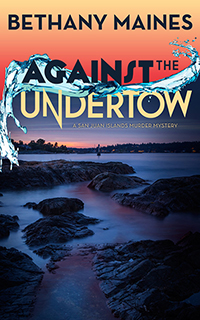
Recently, I was going over the edits from a beta reader on my forthcoming mystery novel – Against the Undertow (sequel to An Unseen Current). I was excited to read over the notes because the reader had been pretty enthusiastic verbally about the book and I was looking forward to easy edits (for once).  Beta readers usually give critiques on story elements, spot plot holes, and generally let an author know if something is working or not. They can do line edits and spot typos, but frequently that’s a separate gig because the mental focus for each job is quite different. Because of that, I usually tell my beta readers to treat typos like terrorists on the train in New York – if you see something, say something – but don’t go looking for them. Which is why I laughed when I got to this note:

I didn’t take note of typos except for one I thought I’d mention: on p. 76 you meant perennial and instead wrote perineal. 

That is indeed a typo worth mentioning and I promptly laughed and shared it with about eight people. But it got me to thinking about some of my other slips of the fingers. Here’s a couple that I thought worth noting.

He knew he would get some carp for it. Yes, because fish are often given as a sign of disapproval.

Stalking feet. Because he has those feet that just will not stop violating restraining orders.


I’m going as troll. Many problems here. Including missing the word “for” and a misplaced space around the S. But if you want to go for a stroll as a troll, apparently I will let you. Gotta look out for those trolls.

Desserted is not, repeat not, the same as deserted. I wish it was. I wish I could be desserted ALL the time. But cake is not a healthy breakfast choice.

As I continue to write, I’m sure I will make many more typos. I hope that at least a few are as good these ones. What about you? Have you spotted any awesome typos lately?


Bethany
Maines
 is the author of the Carrie Mae Mystery Series, Tales From the City of Destiny, San Juan Islands Mysteries, Shark Santoyo Crime Series, and numerous
short stories. When she’s not traveling to exotic lands, or kicking some
serious butt with her fourth degree black belt in karate, she can be found
chasing her daughter or glued to the computer working on her next novel. You
can also view the Carrie Mae YouTube
video or catch up with her on Twitter and Facebook.