Tag Archive for: writing

Killing Your Darlings

RIP Darling!
By Shari Randall
Of all the writing rules out there – and there are a lot – the one every writer knows is “Kill your darlings.” Stephen King expanded on this advice from William Faulkner (at least he did according to Google) and said “Kill your darlings, kill your darlings, even when it breaks your egocentric little scribbler’s heart, kill your darlings.” 
Darlings. Those lines of dialogue, those descriptions, those witty one liners that we writers love, that make us proud. That make us think, “that’s a good one. That’s writing!” The chapter that makes us laugh, or shudder as we sit at the keyboard. The character we enjoy so much we’d like to take him out to lunch. 
The problem is, well, there could be lots of problems, and the biggest is my reluctance to hit the delete button on those darlings. Stephen King is right – killing my darlings does break my egocentric little scribbler’s heart. I find myself arguing with, well, myself about the fate of those darlings:
The dialogue doesn’t ring true to the characters. But it’s funny…
The description is too long. But it’s sheer poetry!
That chapter is so exciting. But it doesn’t further the plot…
That character is so much fun to write. Does the world really need another homicidal prom queen?
But, but… I love my darlings, especially some of my characters. So I’m going to bid them a fond farewell here before I hit DELETE.
A fond pat on the head to Spumoni, the loveable mutt from Fairweather Farm.  Scrappy and loyal, tail always wagging, Spumoni was a little too good for his own good. I needed a farm pet that would get into trouble. So bye-bye Spumoni and hello Hairy Houdini, an irascible miniature goat who never met a pen he couldn’t escape.
The police department of my tiny Connecticut town had too many named characters, so thank you and farewell Officer Moskovitz, enjoy your retirement in Florida.
Ah, Lu Fairweather, slender and dark, with a strip of gray highlighting your artistic brow (probably because I was reading that biography of Susan Sontag while I was writing you). Au revoir. ! I will miss your feminine mystique, your dangling Elsa Peretti earrings, your French press coffee and no filter cigarettes, your air of disdainful sophistication. 
Have you had to kill any darlings lately? Feel free to give them a shout out below.
Shari Randall is the author of the Agatha Award winning debut, Curses, Boiled Again. Her latest book is Drawn and Buttered.
How to Craft a Mystery

by Bethany Maines
Step One:  Read the paper and/or listen to your weird uncle
to learn about strange ways people have died recently.  This usually involves blurting out something
like “ooh, another dead body!” while snatching up the paper in the middle of
the busy hour at a coffee shop. 
Bonus Points: If
someone shuffles away from you at the coffee shop, collect an additional 20 Murderer Alert points!
Step Two: Having
decided on your method of death it’s time for research! Start googling all
sorts of things that will help you cover up your crime.  Also, go on a vacation to the place that you
plan on putting your dead body. 
Bonus Points: If
you can say “This is a good place to kill someone!” in an aggressively cheerful
manner to the person at the tourist bureau who just wants to help, collect an
additional 20 Walking Sociopath points!
Step Three: Sit
down and write the book.  This is the
boring bit, but it does come with fun voices in your head to talk to.
Bonus Points: If
you finish the manuscript, collect an additional 20 I Have No Life points!
Step Four:  Realize that there is a plot-hole in your
book and go back to step three.
Bonus Points: If
you don’t become an alcoholic, collect an additional 20 At Least I’m Not an Asshole Like Hemingway points!
Step Five: Get
your book back from the editor and give back your Hemingway points while you
try to get over the stupid, stupid, stupid edits.
Bonus Points: Look,
you’ve got a complete book at this points, you shouldn’t need stupid bonus
points, but hey, if that’s what keeps you going, then take 5 I Need a Cookie points.
Step Six: Release
the book into the wild and realize that you are a winner!
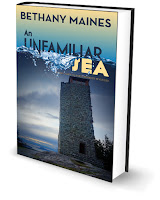
An Unfamiliar Sea will be available on 1.21.20
Tish Yearly just opened a wedding venue on Orcas Island in
Washington State and one of her employees just drowned in four inches of water.
Now it’s up to Tish and her grandfather Tobias Yearly, the 79-year-old ex-CIA
agent and current private investigator, to find out who could have wanted the
sweet waitress dead. 

AN UNFAMILIAR SEA:
PRE-ORDER NOW! 


**

Bethany Maines is the award-winning author of the Carrie Mae Mysteries, San Juan Islands Mysteries, Shark Santoyo Crime Series, and numerous
short stories. When she’s not traveling to exotic lands, or kicking some
serious butt with her black belt in karate, she can be found chasing her
daughter or glued to the computer working on her next novel.
You can also catch up with her on Twitter, FacebookInstagram, and BookBub.

Statistics

by Bethany Maines

Recently, I’ve been experimenting with some partnered
writing.  This goal of this partnership
is to write a novella and turn it into a screenplay.  As this will only be the second screenplay
I’ve written, I’m guessing at some of the mile-markers that let me know if the
project is meeting our goals or if we’ve wandered completely off-track.  As a result, I’ve become slightly obsessed
with the statistics of the work.  I’m
tracking how long chapters are, the character’s vital information (age,
occupation, relationships, descriptions), how often each character appears in
scenes and how long the screenplay is in comparison to the novella.
Some interesting statistics have emerged.  From a forty-thousand-word manuscript it
looks like we need to achieve a twenty-thousand-word screenplay.  For those familiar with basic math that’s
HALF!  That has forced some necessary contractions
in the story.  Some characters have
merged, some scenes got trimmed, and an entire sub-plot got deleted.
But as the process has progressed, keeping a sharp eye on
the length has given me insight into where the story is running long and where
it was going to need to be cut. 
This has been an interesting tactic for writing because knowing that
you’re writing something that’s going to be cut later makes motivation a bit
hard.  However, it does free me to write
more elaborately and descriptively then perhaps I might ordinarily for the
novella since I know that scenery description is not generally included in a
screenplay.
In all, writing for a specific goal has streamlined the
process in many ways, but also created some interesting  constraints. 
Hopefully, with information gleaned from this project my next attempts
at screenplay writing will be easier still.
***

Have a Netgalley account?  Interested in reviewing Bethany’s upcoming book?  Sign up to be part of the review team!  All readers & bloggers welcome!  Or  add it to your TBR list on Goodreads! Pre-Order on Apple iBooks also available.

➡️ Pre-Order: Apple Books: https://apple.co/32sL3vV

***
Bethany Maines is the award-winning author of the Carrie Mae Mystery Series, San Juan Islands Mysteries, Shark Santoyo Crime Series, and numerous
short stories. When she’s not traveling to exotic lands, or kicking some
serious butt with her black belt in karate, she can be found chasing her
daughter or glued to the computer working on her next novel.
You can also catch up with her on Twitter, FacebookInstagram, and BookBub.

Writing

. . . by Dru Ann Love

I had an idea for a post and now I can’t remember.

It’s hard to write a post about writing since I’m not an author.

But if you visit my blog at dru’s book musings, I do writerly things on there, like my “day in the life” and my “get to know you” features. I also write up a list of upcoming books for the week and a monthly release blog. I also write-up information for cover reveals. I also write about the conventions I attend and miscellaneous reader events I attend as well.

Then there are my musings that I write. This year I slowed down on the number of musings I write – decided to go back to writing musings on books that I want to read as opposed to book other people want me to read and I think it’s working. I also try to give a shout-out on social media, okay Facebook, to books that I read but didn’t write a musing for. So, if you think about it, I guess I am a writer, as I write words and isn’t that what a writer does?

Can you believe the year is almost over?

I have two more conventions to attend, Bouchercon and New England Crime Bake. Anyone attending? Let me know and I’ll be sure to look for you.

Fifteen Minutes

by Bethany Maines
As I’ve mentioned in a previous post, this year is all about
trying new things for me. From submitting to contests and magazines to trying
different kinds of writing I’m attempting to push myself into growth. I truly
want to understand not just what makes good writing, but how to construct a
story. One of the things I’ve discovered is that forcing boundaries onto a work
can actually improve the work itself. 
From outlawing specific words (swear words, oh how I miss you!) in some
pieces to declaring that certain elements must be included (there has to be a
dog, OK?) by working against/with a constraint it forces creativity. But one
boundary that I consistently seem to be rubbing up against these days is time—I
don’t have enough. Particularly since the birth of my daughter, the effort to
carve out extended periods of time to be creative is monumental.
I have managed in some cases to do this by ignoring other
areas of my life (Dishes? What dirty dishes?) or through the understanding of
my husband who swoops in and carts our kid off while I’m furiously typing up
some scene or another.  But on many days,
there is no “vast, unbroken slab of time.” Which is why I found this article
about What You Can Achieve in 15-Minute Bursts of Creativity to be an interesting articulation about the approach
I’ve developed. Working on a project in smaller chunks does allow the project
to always stay fresh in my mind and churning away in my subconscious. It also
forces me to stop waiting for the perfect time to think or do something. I had
not realized that the “perfect time” was such an illusion or that I clung to
the illusion so much until I switched to a “do it now” approach. The
accumulation of tiny chunks of time allows for a productivity that would have
seemed impossible to me before the process was forced on me. This bit by bit
approach does work. It may be a constraint I didn’t want, but like many of the
other boundaries, it has forced me to come up with creative solutions that I
might not have otherwise discovered.
So if you’re out there despairing of finding the few hours
you want to do something – don’t give up. 
Take your fifteen minutes and do the thing (whatever the thing is) now.
It doesn’t have to be perfect. You can undo half of it tomorrow if you like,
but it’s still more than you had before.
**

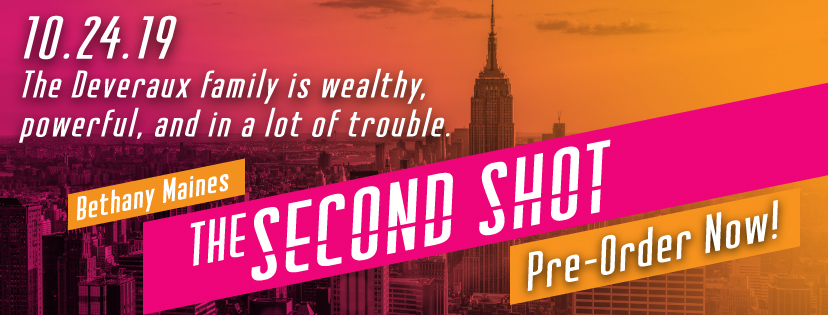
Check out the most recent accumulation of fifteen minutes. (Cover reveal coming in September!!)

The Second Shot:A drunken mistake in college cost US Marshall Maxwell Ames the love of Dominique
Deveraux. Six years later, he’s determined to fix the slip-up, but there’s just one tiny problem – someone wants the Deveraux family dead. Now Max must make sure that the only one getting a second shot at Dominique is him.

Join my mailing list to be alerted when additional platforms become available or pre-order now on Apple

**

Bethany Maines is the award-winning author
of the Carrie Mae Mystery Series, San Juan Islands Mysteries, Shark Santoyo Crime Series, and numerous
short stories. When she’s not traveling to exotic lands, or kicking some
serious butt with her black belt in karate, she can be found chasing her
daughter or glued to the computer working on her next novel.
You can also catch up with her on Twitter, FacebookInstagram, and BookBub.

Clicking Our Heels – Writing or Reading Long or Short?

Writing or
reading long or short? The Stiletto Gang members confess their personal
preferences when writing and when reading. They also share what each are
reading behind closed doors.

Linda
Rodriguez

I prefer to write long and to read long. I’m a
novel reader as well as writer. I admire the artistry of good short story
writers, but whenever I come up with short story characters and situation, so
much more starts to unfold for me. I’m just a natural teller of longer stories.
And when I read, I want to be immersed in the entire world. This is something
novels give me. I’m currently reading to Fear a Painted Devil by Ruth
Rendell, Playing in the Dark by Toni Morrison, and The Collected
Poems of Muriel Rukeyser
.

Judy Penz
Sheluk

– Long, definitely long. I can write short, and love to read it, but it’s hard
for me. Maybe because I’m such a pantser? Currently reading Laura Benedict’s The
Stranger Inside
.

Shari Randall – I like writing and reading both! My current
read is One Night Gone by Tara Laskowski, who does fine short
stories and now novels.

T.K. Thorne
– For me, short stories are harder than a novel. Not sure why. Perhaps I feel
more that I need to have the story laid out prior to beginning it,  and
with a novel, I am more interested in who the character is and having the space
to explore that. As a reader, I like having a thick, juicy book and the
anticipation of more to come with a series.

Julie Mulhern – I am a short writer and prefer reading
shorter books. Right now I’m reading Caimh McDonnell’s Dublin Trilogy (there
are four of them). McDonnell also works as a stand-up comedian.

No surprise,
his books are funny and raunchy and filled with memorable characters.

Kay Kendall
– I’m like the baby bear in the children’s book who tried two beds–one too
hard, one too soft–before she hit the third one that was just right. The story
I’m reading or writing should take up just as many pages as it needs. It should
not be so wordy that it goes way too long, whereas conversely sometimes a story
can be too laconic and I want to read (or write) more detail.

What I’m reading now is the multi-award
winning historical mystery,
THE WIDOWS OF MALABAR HILL
by Sujata Massey. At 400 pages (hardback version) it is just right.

Bethany Maines – I have been working on writing short. 
I feel like so much of my early writing was packed with details that were
important for me to know, but not necessarily important to either the story of
the reader.  So I’ve been steadily trimming my word count on my first
drafts which is making editing easier!  But in general I prefer novel
length over short stories in both my reading and writing.

Dru Ann LoveRight now I’m reading an ARC of Forgiveness
Dies
by J.J. Hensley.

Debra H. Goldstein – “I love the one I’m with” because I write
both long and short and my reading reflects that. Presently, I’m reading Fishy
Business
, an anthology of short stories by members of the Guppy Chapter of
Sisters in Crime and Murder On Cape Cod by Maddie Day.

Lynn McPherson – I like both. Right now, I’m reading a
really fun book called Survival of the Fritters by Ginger
Bolton. 

Mary Lee
Ashford
I
write short because I write a lot of dialogue my first draft. I think that’s
because I’m mainly interested in the people in the story. I tend to have to go
back and make sure I’ve included the right amount of setting and description.
In reading, I also am mostly interested in the story people and so I prefer
books that are very character driven. As far as reading, I read both short and
long. I’m currently reading a non-fiction book called Atomic Habits by
James Clear. 

 J.M. Phillippe – I do enjoy a single-sitting book (when I
get those rare “spend the day reading” days). I think I tend to write
something that I hope can be experienced in the same way — something you get
so into you don’t want to put it down. 

Cathy Perkins – I prefer writing novels because subplots that enhance the main plot are fun to develop and reveal so much about the characters. Those subplots plus the usual twists and turns of a mystery generate word count. I recently finished A Man Called Ove and really enjoyed it.

Can Writing Motivate Writing?

by
Paula Gail Benson

When
your day job requires extensive writing, can the well run dry? Do you come home
from work and avoid the computer or laptop, just ready to let the words flow
over you from the closest television or other viewing or listening device? Do
you wake reserving your word skills for the workplace rather than spending an early
morning hour on a fiction project before heading to the office?

As a
legislative attorney, I’m constantly working with language. It’s always
fascinating to try to explain a concept with brevity, clarity, and
comprehensiveness. Like working on a puzzle, it’s usually a matter of figuring
out how to put the pieces together to create a picture everyone can see, appreciate,
and understand.

However,
after a full day of writing and rewriting, sometimes it’s difficult to convince
myself that I need to put in a few more hours at home, even if it’s on a
project I’m truly devoted to completing. I convince myself I need a break. And,
once I give myself permission to relax (to be ready for what tomorrow brings),
then it’s easy to keep depending upon that rest period.

So,
I began thinking about how to use my work writing to energize my fiction
writing.

Last
year, I started “bullet journaling” to organize my schedule and keep notes. I wrote
a message about it here at The Stiletto Gang. The official website was
established by Ryder Carroll, who now has a book called The Bullet Journal Method. Because bullet journaling is adaptable
to each practitioner, the ways to set up a journal may differ. I have used my bullet
journal not only to track appointments, work projects, and daily
accomplishments (like a mini-diary), but also for fiction. With everything in
one easy to carry notebook, I can capture ideas, phrases, bits of dialogue, and
other things I want to remember to explore in a story. For example, at dinner
one night, I had an incredible view overlooking the city. I wanted to capture
what I was seeing and wrote a description while I waited for the meal. Now, I
have the words to remember the image I found so intriguing. Maybe I’ll use it
in a story or maybe it’s just for my benefit, but it exercised those writing
muscles and that is always a good thing. Having the bullet journal made the
writing possible.

The
hand-written aspect of the bullet journal allows me to “think on the page” in a
different way from typing. In addition, because the bullet journals I use have
a “dot grid,” I’m not restricted by lined pages. I can write at an angle if I
want or use drawings to help illustrate what I mean. (I wonder if I should try
drawing legislative concepts?)

Another
“exercise” I’ve found myself using lately is to retell familiar stories from a
single character’s perspective. In particular, I’ve worked on a series of fairy
tales, starting with the prince’s viewpoint, then progressing to secondary characters,
and finally villains. I write examples on my personal blog, where I limit each
entry to 100 words (a drabble), forcing myself to make every word count and
meaningful, just like with writing legislation. It’s been a good motivator,
allowing me to focus on character traits and motivations rather than plot. For
one group (the villains), I used rhyme, another variation from my day job.

What I’ve concluded
is that filling that blank page, whether with a to do list or a story idea,
helps lead to more writing. In the bullet journal, I give myself the freedom to
let thoughts lead me. Sometimes, the road is a dead end. At other times, it’s a
great adventure. That’s the life of a fiction writer with a writing day job!

No More Changes

by Bethany Maines
Recently, I took a workshop on how to convert a novel to a
screenplay. It was a fascinating workshop that gave practical tips on how to
deconstruct and then reconstruct a novel into a new format. Plot, structure and
character development are all core elements of any story telling method and it
was interesting to see how a different mode of storytelling could affect a
story.
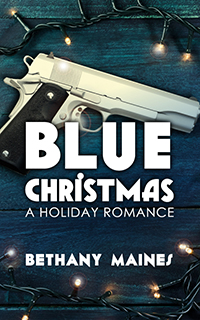
I chose to experiment on my 2018 Christmas novella Blue
Christmas. Blue Christmas is about a down on her luck college student, Blue
Jones, who is determined to do whatever it takes to pay off her grandmother’s
medical bills – including burglary. So obviously it’s a romance and there are
diamond thieves and a dog.  Because… Christmas?
As I worked my way through my story, I saw several things
that I would like to improve. And it was not so very long ago that I loved
every bit of that story!  What the heck
happened to my perfect little morsel of criminal Christmas?! Why is it that an
author / creative person can’t stop improving on a work?  I mean, we all hate George Lucas for going
back and adding special effects and scenes to Star Wars, don’t we? When are we,
or should we, be forced to say walk away? 
My personal feeling is that once a work is in the public, then except
for correcting typos or other blatant errors, that an author should not make
any “improvements”. People end up loving specific works and changing even a
sentence or two can affect someone’s perception of a work.
Of course, none of that prevents me from making those
changes in my screenplay.
**
Buy Blue Christmas from Amazon * Barnes & Noble * iBook * Kobo

Blue Jones just stole Jake Garner’s dog. And his heart. But technically the French Bulldog, Jacques, belongs to Jake’s ex-girlfriend. And soon Jake is being pressured to return the dog and Blue is being targeted by mysterious attackers. Can Jake find Blue and Jacques before her stalkers do? For Blue, Christmas has never been quite so dangerous. For Jake, Christmas has never been quite so Blue.

**
Bethany Maines
is the author
of the Carrie Mae Mystery Series, San Juan Islands Mysteries, Shark Santoyo Crime Series, and numerous
short stories. When she’s not traveling to exotic lands, or kicking some
serious butt with her fourth degree black belt in karate, she can be found
chasing her daughter or glued to the computer working on her next novel. You
can also catch up with her on
YouTube, Twitter
and Facebook
.

Wine & Murder

by Bethany Maines

I want to kill someone in public.
I don’t have a particular person. Just someone.
Last weekend I volunteered for my business districts wine
walk event.  It was a fun event that
paired artists and wineries with local businesses.  Visitors bought a ticket which guaranteed them
ten tastings from the wineries of their choosing and then they walked to the
various locations ogled the art, tasted the wine and walked to the next
stop.  This puts visitors inside local
businesses, exposes an audience to new wines and gives everyone a chance to
enjoy a fun fall outing.  It’s also a
large crowd with people going every which way, no one is really paying
attention, and half the crowd is a wee bit tipsy.  That seems like a great place for a murder!
Could I slip something in their tasting glass? Could I stab
them quietly in pop them in a business’s back room while no one was looking?  Leave the body in their car apparently “sleeping
it off”?  Or is it better to kill them
and then stick around as a surprise witness. 
Oh my God? someone’s killed Kenny! 
And… surprised face.
It’s a bold move to go for a public murder, which makes it probably unpremeditated.  My motivation would have to be strong.  Lots of money or a truly horrible victim.  And then, perhaps the small town police chief could solve the mystery?  And bam, we’ve got a novel plot.  Although, in general, I should probably not tell anyone what I think about at
these events.  I’m going to end up on
someone’s list…
**
Bethany Maines is the author of the Carrie Mae Mystery Series, San
Juan Islands Mysteries
, Shark Santoyo
Crime Series
, and numerous short stories. When she’s not traveling to
exotic lands, or kicking some serious butt with her fourth degree black belt in
karate, she can be found chasing her daughter or glued to the computer working
on her next novel. You can also catch up with her on YouTube,
Twitter and Facebook.

Running and Writing

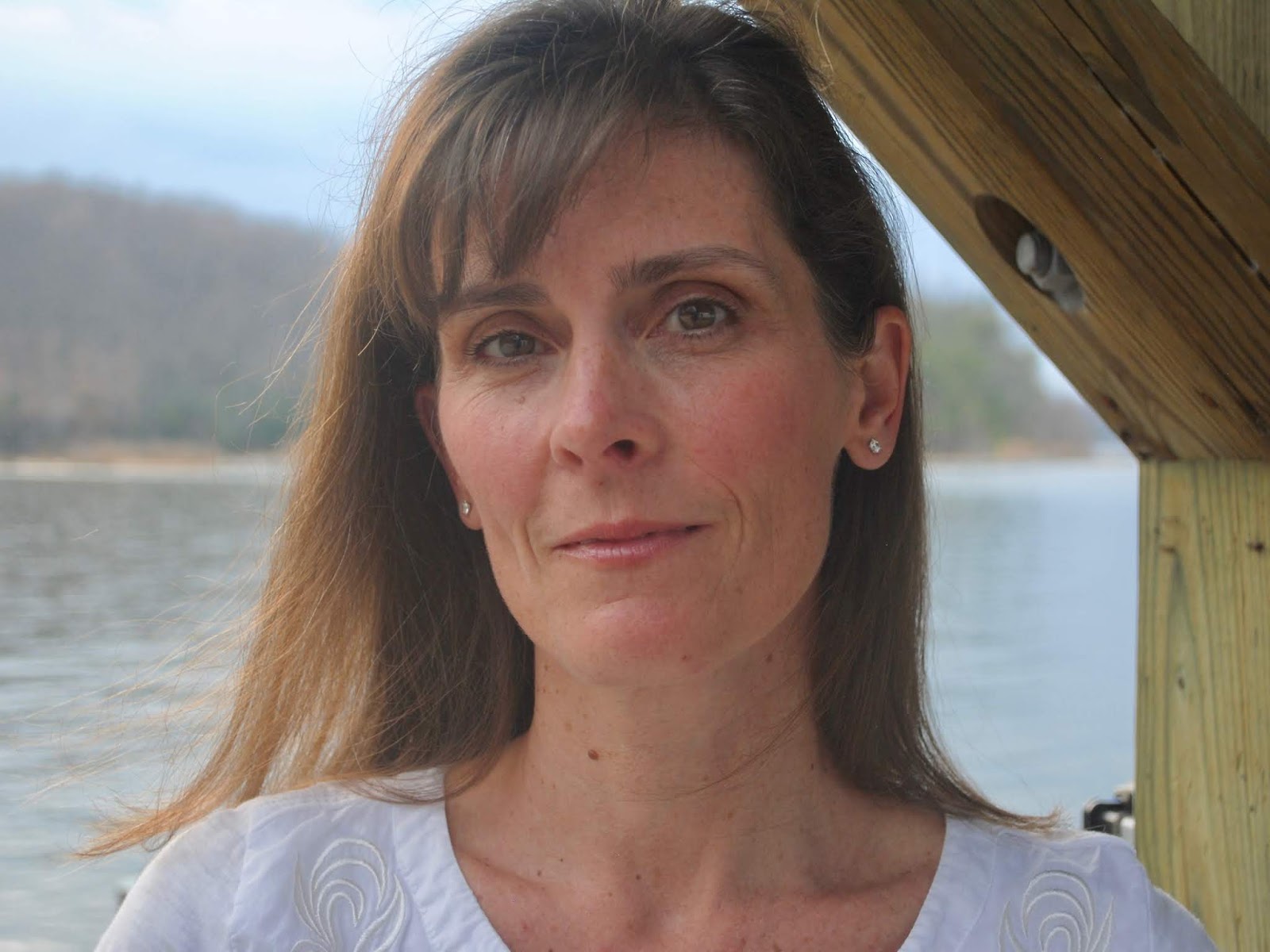
       By guest author, Jennifer Klepper

     I love the name of this group of writers: The Stiletto Gang. It’s sexy and fierce, and while the Stiletto Gang probably doesn’t actually wear stilettos while they’re writing their books (do they?), I can easily imagine them traipsing about in their spiked heels and drinking martinis after they’ve put their keyboards away for the day.
Seeing the sparkly stiletto on the page made me think of my own newest pair of shoes–purple and orange (yikes!) Brooks trail running shoes. They have a grabby sole for traversing unfriendly ground cover, they’re sturdy to help keep the ankles from twisting, and they are frightfully clunky-looking. Pretty much the opposite of stilettos.
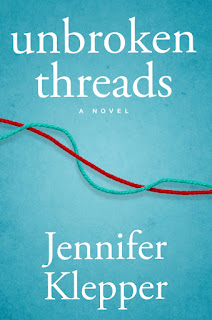
The reason I even have these trail shoes is my writing. Next week, my debut novel, Unbroken Threads, officially releases. So of course I signed up to run my very first trail race and my very first 10k three days prior to launch. Why in the world would I do that? (I’ve asked myself this numerous times, including the day I sprained my ankle on an errant broken branch.) 
As any writer can attest, you have to sit on your duff to write. Not just that, but you have to sit on your duff an awful lot for an awful long time to write, revise, and edit a novel. Let’s just say my muscle tone hasn’t kept up with my word count.
Scheduling a virgin run right ahead of my launch was tactical. I knew my summer would be nerve-wracking, with the prospect of my book baby being thrown to the wolves–I mean, world–in August. Having a goal, one totally and completely different from writing and publishing a book, seemed a mentally healthy diversion. Plus there was that muscle tone thing.
What I’ve learned in the ensuing weeks is that…running and writing? Not necessarily totally and completely different. Runners on the whole might look better in yoga pants, and writers might be better at Words with Friends, but the process and the experience of each have at least a few important things in common. 
1.     Writing and running are both solitary endeavors. Both activities require you to be in your own head, pursuing your own goal. Neither is typically a team sport. No one can run your hills for you and no one can cut 10,000 words from your draft for you. 
2.     And yet, writing and running both benefit from their supportive communities. Ah, the writing community! I love it so much and have gained friends and knowledge and good vibes. I’m starting to see the same in the running community. Established runners have been enthusiastic in their support and patient in their advice, whether it’s recommending I use bag balm on my feet (since I have to run through a river, of all things) or assuring me it’s perfectly acceptable to walk part of the race (I will).
3.     There’s always a “better.” Running and writing start small–first mile, first chapter, but no matter the achievement, there’s always another shiny goal glinting in the distance. Did you finish a marathon? Well, how about winning your age group? How about running fast enough to qualify for Boston? Did you write a complete manuscript? How about getting a multi-book deal with a Big 5 publisher? How about making the NY Times bestseller list? The pursuit can be exhausting and never-ending–the shiny horizon will always stay out of reach.
4.     And yet, just doing the thing–finishing the race, writing The End on a first draft–is a tremendous achievement. I will not forget that. Ever. None of us should. No matter how far you get (qualify for the Boston Marathon or get a multi-book deal with St. Martin’s Press), that first achievement of finishing a race or finishing a draft is what got you there in the first place, and it’s much farther than most people to begin with.
5.     Finally, each activity needs another activity for balance. Any activity that taxes the body or mind needs a complementary activity to keep us fresh. Just as strained muscles and tendons need a break, so do word-wrestling brains. Allowing ourselves to focus on a different aspect of ourselves, to exercise a different aspect of ourselves, permits recovery as well as growth.

            So, within a week (if all things proceed as planned), I will have finished my first 10K and published my first book. And then I will continue working on my second book. Maybe I’ll train for a 15K, who knows? No matter what, though (and I know I won’t be able to run for as many years as I’ll be able to write), I’ll maintain some balance and try to ensure that I always have good shoes while I’m doing it.