Point of View by Saralyn Richard
Next to voice, the hardest thing to teach, practice, and master is point of view. When I first taught creative writing to high schoolers, things were much simpler. First person, major or minor character. Third person, omniscient or limited.
By the time I started teaching creative writing to seniors at the Osher Lifelong Learning Institute, things had changed. Authors were combining first person with present tense to create a more immediate “put the reader in the scene now” vibe, and a “deep” third person had come into vogue, in which one character’s thoughts and feelings were plumbed to the exclusion of others’.
I asked some other authors how important POV is and why. Here’s what they told me:
“POV is one of the most important tools we use to flesh out character and to bring the reader close. The three girls who are separately taken in TRAFFICKED are written in first person present to intensify their situations, while the rest is in third.”—Peg Brantley
“In DEATH AT BROOKHAVEN, first person POV, told by a narrator at a crossroads in her life, enriches the story.”—Nancy Polk Hall
“The entire Old Los Angeles series is defined by Maddie Wilcox’s voice. Her perspective and the way she tells the stories bring a modern audience into a past reality. The series would not work without her.”—Anne Louise Bannon
“I leaned into the power of multiple POVs with BEYOND THE CEMETERY GATE when I realized that a straight mystery wasn’t working, and I needed multiple POVs (turning it into a suspense novel where the reader knows more than the main character). The other two POVs are supporting characters . . . the dad/victim (which is a different timeline as he dies in the first chapter) and the watcher character, which give a sense of foreboding and the friend or foe? question.”—Valerie Biel
“In OLD HABITS DIE HARD Sister Bernie and AJ navigate a 50-year age gap as they investigate the death of Bernie’s neighbor. I wrote the book in close third person from each of their perspectives to showcase the generation gap and to reveal how their methods of examining clues differed. POV can help writers keep secrets from characters without keeping readers out of the loop. It can also give readers a glimpse into a character’s thoughts and biases and emotions. I stuck to third person because I wanted their sides of the story to sound specific to Bernie and AJ.”—Melissa Westemeier
“In the first three Whipped & Sipped books, the protagonist told the story in close third person, but in POUNDED the story is told from three perspectives. This allowed me to delve into each of the characters’ personalities instead of just describing them or seeing them through the protagonist’s eyes.”—G.P. Gottlieb
“I love writing my Sydney Lockhart mysteries in first-person POV. It feels like I’m visiting my good friend. All I have to do is write down what she says. Our most recent visit: MURDER AT THE FAUST.” —Kathleen Kaska
“I write in many different POVs, but I find that when I write a short story from the POV of a child (“The Girls in Cabin Three,” “Forensic Magic,” or “The Night They Burned Ms. Dixie’s Place,” first person POV works best to help readers see through the eyes of ‘innocence.’”—Debra H. Goldstein
“When I wrote “Triangle” for the Jewish Noir 2 anthology, the editor and I spent a long time trying to get it to work and just couldn’t. Finally, I decided to try it as a first instead of third person narrative, and that’s what it took to make the story effective.”—Rabbi Ilene Schneider
“POV is hugely important, because it determines not just who tells the story, but how the reader experiences it. In FINAL CUT, Joey Jessop’s close third-person POV lets readers see the strange, high-pressure world of a Hollywood movie set through the eyes of someone who knows it intimately, as a workplace. What she notices, what she misses, and how she interprets the people and events around her become part of the mystery. For me, POV isn’t just a craft choice—it shapes the entire story.”—Marjorie McCown
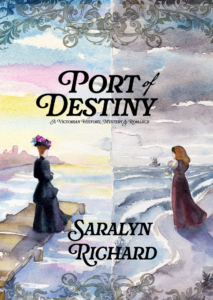
There you have it, point of view significance from various authors’ points of view! By the way, my new release, PORT OF DESTINY: A Victorian History, Mystery, & Romance, is told in the POVs of the three main characters, all of whom immigrated to the U.S., but at different times and under different circumstances. The collision of their stories at the Port of Destiny, Galveston, Texas, in 1905, will stay with you forever.
Purchase at
What are your views on point of view? How important is it to you when you’re reading?


 And to top it all off, some of the best parts of the conference are those conversations (and hugs) in the lobby, the bar, the restaurant, or even the hallway. It’s a chance to catch up with people who are a big part of our writing journey and talk – about books, about writing, about publishing. And life. There’s just nothing like it.

 Sparkle Abbey

 AUTHORS HELPING AUTHORS








 My reading speed also made reading rewarding for me. I would race through the summer reading program award minimum in a few days and then quickly read enough books to guarantee winning whatever prize I desired. Reading also made it possible for me to endure boring junior high and high school classes – it wasn’t unusual for me to check out a book before school, read it during the day, and take a different one home to read at night. A good book always helped me relax during college exam days, when traveling for work, on vacation, or for a few minutes before bed.
 My joy in reading changed when I opted to make writing a career. The pressure of deadlines and wanting to write meant my reading time became more limited. It also became less enjoyable.