The Devil’s in the Details
Even though we write fiction, authenticity matters. It’s the details that make our stories authentic and create an immersive world for the reader. As a crime fiction writer of a series that is legal adjacent, I believe my responsibility is to get the details correct.
My second book has a scene involving a corrections officer and an in-person family visit with an inmate. This scene was necessary to establish relationships that were key to the plot. While I’d been inside that particular jail many times in the past as an attorney, I’ve never been there as a visitor.
Like most authors today, my first stop was the internet. I was dismayed to discover that family and friends could only have remote video visits. Well, that wasn’t going to work. That had to be wrong.

TAIT Radio with BOB
I called the jail directly, not expecting to get anywhere. After numerous transfers, I finally connected with a counselor who was willing to speak with me. No, the only in-person visits were on special holidays such as Christmas or Father’s Day. Worse yet, these visits were in a group setting. It looked like I had to go back to the drawing board.
Then the counselor asked why I wanted to know. I explained I was an author writing crime fiction— a fact they could verify since my name appeared on their caller id—and described the scene.
The counselor spoke to another person in the room. After a brief consultation, the other person, who was in charge, got on the phone. “You’d have to put in a motion and get a court order. Then we’d arrange a contact visit.” She laughed. “But you’d have to find a judge that would do that.”
Since I had a fictional judge in my fictional pocket, that wouldn’t be a problem. I thanked the counselors profusely for solving my plot problem.
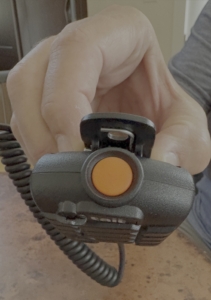
Close-up of BOB
My scene also required the corrections officer to leave the room when an incident occurred in the jail. In the first draft, a radio squawked out a code. Something about that scenario didn’t feel right, so I decided to call a lifeline — my neighbor, Tom, whose company provides radio systems to prisons and jails.
Just like the counselors, Tom was glad to help. He brought over a demo radio. When I described the scene, he immediately disabused me of codes and messages that inmates can hear. I learned that guards carry their radio in a leather holster on their duty belt along with two sets of cuffs and a couple cans of CS spray, a.k.a. tear gas. A speaker mic, connected by a curly cord resembling an old telephone cord to the radio, clips on the guard’s collar. The guards listen to the radio through a corded earpiece that could be stored in the speaker mic.
These radios are more than glorified walkie-talkies. Each one has a screen that displays a unique id such as a badge number or an officer’s call sign. The radios have accelerometers much like the Apple watch feature that detects a fall. If the radio accelerates, goes on its side, or is in a horizontal position, a “man-down” is issued. If an incident occurs, the guard pushes BOB (Big Orange Button) located on the speaker mic. If BOB is held down for three seconds, an emergency is broadcast.
Wow! Did I have a wrong detail in my jail scene! A small detail, but nonetheless, an important one for authenticity. Armed with my new information, I fixed my faux pas.
I learned a valuable lesson. Research on the internet doesn’t always deliver the goods. Whenever possible, seek out a person with the right experience.
And don’t be afraid to ask.


 USA Today and Amazon bestselling and award-winning author



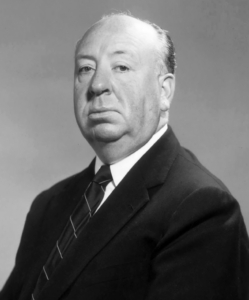





 In my new act, I could deliver zingers about the idiots who, after scraping tidbits from my website and other urls where my author info resides, still get it wrong. Yes, “Rachel,” I did once work at a prestigious film organization, but it was not the American Academy of Dramatic Arts.
 All of this seemingly unceasing, unscrupulous, and pitiful effort to scam unsuspecting authors is big a waste of time, especially my time, when I could be working on my next book instead of having to daily flush this spam down the toilet. Anyone with a working idea of how to eliminate the constant barrage, please let me know. There may even be a free book in it for you.
 … and
… and 
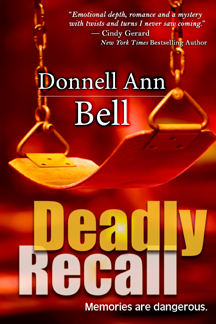
 What did he know? I remained steadfast in my belief I’d chosen the right antagonist for my story. Yet as my page count increased, reality intruded on my pipedream. I was a brand-new author; Donald Maass was an expert. I remember the precise moment I flipped the script and changed my killer’s identity. It was near the end of the book. To this day, I credit Donald Maass’s advice. Thanks to him Deadly Recall became a more cohesive and suspenseful story.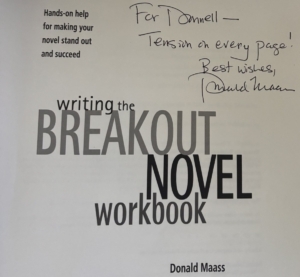

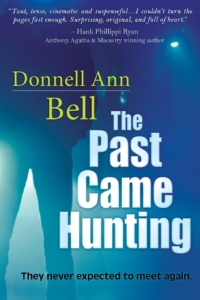 Deadly Recall while you’re at it.” I’ll never forget when BelleBooks sent me an offer letter for both books. I had huge respect for Debra Dixon and Deborah Smith, both legends in publishing, and decided to accept. As a courtesy I wrote the New York editor with whom I’d submitted Walk Away Joe. All my rejection bruises seemed to fade when she wrote back, “Congratulations. This is our loss. I love Melanie and Joe.” FYI, Melanie and Joe are characters from the WAJ manuscript that BelleBooks/Bell Bridge Books subsequently renamed The Past Came Hunting.