

Down the Rabbit Hole
By Donnell Ann Bell
I’m glad I only blog once a month on The Stiletto Gang. Mainly because when I stumble on a topic I’d like to discuss, that’s how long it takes to condense the mushroom cloud in my brain into a few cohesive paragraphs.
Case in point, I recently read an ad in American Police Beat Magazine for a device called the MX908 mass spectrometer. This handheld gadget is portable, and because of its cost, (close to $60K per unit) is currently being used by elite first responders.
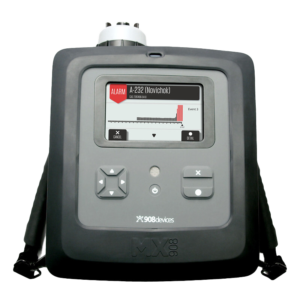 What does it do? The MX908 mass spectrometer is capable of detecting real time chemical identification (such as explosives, HazMat operations and priority drugs such as fentanyl, methamphetamine, cocaine and more). 908 Devices – YouTube
I can’t tell you how happy I was to learn about this advancing technology. During ridealongs and citizens academies, I’ve learned that while cops live daily with the knowledge they may take a bullet, they and their fellow first responders, face a greater risk known as exposure.
Exposure to explosives, chemicals and toxic drugs. I’m excited about the advancement of this mass spectrometer. I believe it will save innumerable lives.
I didn’t mean my blog to be an ad for the MX908, however. My original intent was to pinpoint how and when the technology may have evolved and how fiction authors (in particularly science fiction authors) may have contributed.
That idea proved fruitless and of little merit.

DeForest Kelly as Dr. McCoy Source: Public Domain
Lois Winston and I are critique partners, and I told her about the device and quipped something like Gene Roddenberry, screenwriter and creator of Star Trek, would be proud. If you recall Roddenberry created Star Trek in 1964. One of his characters, Dr. Leonard McCoy, aka Bones, used a medical scanning device on patients to determine illness or injury.
Still, Gene Roddenberry can’t take credit for the spectrometer. As I dove further down the rabbit hole, I learned the first mass spectrometer was invented in the 19th century and before that Issac Newton and others were delving into the color spectrum, telescope, microscope and myriad other devices. Did you know Newton is responsible for calculus?
And please don’t get me started on Benjamin Franklin!!!
I did learn quite a bit about science fiction authors while I was researching but I’ll save that for another blog. There are some amazing authors I’d like to include.
Also, during my explorations, I discovered I was attempting to engage in what is known as Synoptic philosophy, which comes from the Greek word συνοπτικός synoptikos (“seeing everything together”). Add synoptic to the word philosophy, it means the love of wisdom emerging from a coherent understanding of everything together.
Obviously, although my curiosity knows no bounds, I have much to learn.
Does your research lead you down the proverbial rabbit hole? Have you heard the term Synoptic philosophy?
About the Author: Donnell Ann Bell is an award-winning author who began her nonfiction career in newspapers. After she turned to fiction, her romantic suspense novels became Amazon bestsellers, including The Past Came Hunting, Deadly Recall, Betrayed, and Buried Agendas. In 2019, Donnell released her first mainstream suspense, Black Pearl, A Cold Case Suspense, which was a 2020 Colorado Book Award finalist. In 2022, book two of the series was released. Until Dead, A Cold Case Suspense won Best Thriller in 2023 at the Imaginarium Conference in Louisville, Kentucky. Currently, she’s working on book three of the series. Readers can follow Donnell on her blog or sign up for her newsletter at www.donnellannbell.net.


Oh, yes, Donell, I’m currently wandering through an entire rabbit warren with research on my next project. Your mention of synoptic philosophy clearly names the culprit. I’m not sure it helps me move forward, but least I have a diagnosis for what’s plaguing me!
Happy to help, Gay. I want to know e-v-e-r-y-t-h-i-n-g to avoid a mistake. Even AI makes mistakes; glad I’m human 🙂
I’ve never heard of synoptic philosophy before reading your post, Donnell, but I’m very familiar with the rabbit hole of research!
Ah, so glad I’m not alone. Research is mind boggling but a whole lot of fun!
I’ve been there! Rabbit holes can be so much fun but sometimes a wonderful writing avoidance technique. Synoptically speaking.
So THAT’S what it’s called! Thank you, Donnell for the gift of that term, which I’ve never heard of, but the fact that it exists means people have been trying to get there for a long time, longer than the term existed, I’m sure. I immediately thought of the word “synthesis” as related, and by golly, it is also of Greel derivation, although it entered our language through Latin, which means the Romans stole it first.
Oh my, T.K. my head hurts just reading your analysis. I shall have to study it in depth. It’s all Babylon’s fault for separating language in the first place 😉
Indeed, Brooke. See my response to Gay 🙂
Donnell, very cool. What an amazing device that MX908 is! I’d not heard of synoptic philosophy. But now I’m looking it up…
I think the MX908 is amazing. I salute the geniuses that created it! I am so glad I’m not alone re: synoptic philosophy!
I love that this is a thing…. Fascinating!
Me, too, Meagan. Technology has its moments!:)
Not only do I love going down rabbit holes in the name of research, I insist on getting there by first going into the weeds. Entertaining post and never heard that term before. I shall use it and pretend to be very smart!
By all means, Judy. Please do. The world needs to learn about synoptic philosophy:)
Thanks for the cool and diverse information in this post, my synoptic philosophical friend! Love it!
My synoptic philosophical pleasure, Saralyn!
Thanks for enhancing my vocabulary and giving me some new things to trigger a rabbit hole response in me. :).
Oh dear! Now I have to worry my blogs set off trigger warnings!!!
Donnell, this describes my writing / research process perfectly. Since I write mostly historical fiction, I spend a lot of time diving down rabbit holes, only to emerge days later with more facts and questions to explore. I’ve heard this called “research rapture” before, but I’ve never heard of Synoptic philosophy. I like it—an elegant name for my obsession.
Barbara, your work sounds fascinating. I can’t imagine how many rabbit holes you would discover in the past. Just my choosing one topic led to a plethora of diversion:)
The rabbit holes are VERY deep when I research for my Neanderthal books. I mean, I have boxes of magazines with pertinent articles, and tons of computer files, that are organized…well, as best I can. I, too, love rabbit holes. And I took a course in philosophy once, so this is a great new term–thanks!
Excellent Kaye! You must share this unfamiliar term to me. What is this word called organization:) I love the term synoptic philosophy!
Donnell, you certainly went down the ‘rabbit hole.’ I sure all of us have fallen down the hole and learned a great deal we might or might not have ever used. There is some good stuff here.
Lois Winston and you critique partners: sounds like a hecka combination for success.
George, I think writers make great Jeopardy contestants:) Great to hear from you, stranger! Yes, I feel very fortunate to have critiqued with Lois these many years. She’s an even better friend!
You enlightened me today, Donnell!
Kathleen, I don’t see that often happening. You’re brilliant.
Love this! Putting synoptic philosophy and Newton’s mass spectrometer on the cool things learned list!
I’m glad you enjoyed, Marie! So fun sharing it!