

By Donnell Ann Bell
I’m glad I only blog once a month on The Stiletto Gang. Mainly because when I stumble on a topic I’d like to discuss, that’s how long it takes to condense the mushroom cloud in my brain into a few cohesive paragraphs.
Case in point, I recently read an ad in American Police Beat Magazine for a device called the MX908 mass spectrometer. This handheld gadget is portable, and because of its cost, (close to $60K per unit) is currently being used by elite first responders.
 What does it do? The MX908 mass spectrometer is capable of detecting real time chemical identification (such as explosives, HazMat operations and priority drugs such as fentanyl, methamphetamine, cocaine and more). 908 Devices – YouTube
I can’t tell you how happy I was to learn about this advancing technology. During ridealongs and citizens academies, I’ve learned that while cops live daily with the knowledge they may take a bullet, they and their fellow first responders, face a greater risk known as exposure.
Exposure to explosives, chemicals and toxic drugs. I’m excited about the advancement of this mass spectrometer. I believe it will save innumerable lives.
I didn’t mean my blog to be an ad for the MX908, however. My original intent was to pinpoint how and when the technology may have evolved and how fiction authors (in particularly science fiction authors) may have contributed.
That idea proved fruitless and of little merit.

DeForest Kelly as Dr. McCoy Source: Public Domain
Lois Winston and I are critique partners, and I told her about the device and quipped something like Gene Roddenberry, screenwriter and creator of Star Trek, would be proud. If you recall Roddenberry created Star Trek in 1964. One of his characters, Dr. Leonard McCoy, aka Bones, used a medical scanning device on patients to determine illness or injury.
Still, Gene Roddenberry can’t take credit for the spectrometer. As I dove further down the rabbit hole, I learned the first mass spectrometer was invented in the 19th century and before that Issac Newton and others were delving into the color spectrum, telescope, microscope and myriad other devices. Did you know Newton is responsible for calculus?
And please don’t get me started on Benjamin Franklin!!!
I did learn quite a bit about science fiction authors while I was researching but I’ll save that for another blog. There are some amazing authors I’d like to include.
Also, during my explorations, I discovered I was attempting to engage in what is known as Synoptic philosophy, which comes from the Greek word συνοπτικός synoptikos (“seeing everything together”). Add synoptic to the word philosophy, it means the love of wisdom emerging from a coherent understanding of everything together.
Obviously, although my curiosity knows no bounds, I have much to learn.
Does your research lead you down the proverbial rabbit hole? Have you heard the term Synoptic philosophy?
About the Author: Donnell Ann Bell is an award-winning author who began her nonfiction career in newspapers. After she turned to fiction, her romantic suspense novels became Amazon bestsellers, including The Past Came Hunting, Deadly Recall, Betrayed, and Buried Agendas. In 2019, Donnell released her first mainstream suspense, Black Pearl, A Cold Case Suspense, which was a 2020 Colorado Book Award finalist. In 2022, book two of the series was released. Until Dead, A Cold Case Suspense won Best Thriller in 2023 at the Imaginarium Conference in Louisville, Kentucky. Currently, she’s working on book three of the series. Readers can follow Donnell on her blog or sign up for her newsletter at www.donnellannbell.net.
When I was a junior in college, as an English major, I was required to take a course in John Milton. Taught by a professor who had made Milton his life’s work and who strove to model himself after the legendary poet, the course had the reputation for being the hardest one on campus. I believed it at the end of the first session of class, when Professor Boyette gave us more than fifty topics to research at the library for homework.
The topics were as pedestrian as the Elizabethan world order, the cycle of sin and redemption, Christian allegory, Dante’s circles of hell, and many others I can’t recall. If the assignment were made today, the homework could be done in an hour or so, courtesy of the Internet, but then we had to trek to the library and find reference books, drag them to the carrels, read about the topic, take notes….you may remember those days, not so fondly.

Image by alison updyke at Pixabay
The research paid off, back then, and the Milton course became my most intellectually challenging and charming—a favorite. In fact, I chose to write and defend an honors thesis on Milton as a capstone course my senior year.
Not surprisingly, then, when I had an opportunity to visit England the summer after graduation, I became fixated on finding things that related to Milton. I saw his bust, but no grave, at Poet’s Corner in Westminster Abbey. I saw his famous mulberry tree on campus at Cambridge University. I asked around and nobody seemed to know where Milton was buried.
That shocked me. One of the most famous Renaissance poets in the world, and I couldn’t find out where he’d been interred. The British are essentially friendly to tourists, and almost everyone I asked had a theory. And every theory sent me on a wild goose chase all over London.
In the end, I had to leave England before finding out the truth. A few years later, my in-laws went to England. They asked me what I would like them to bring back for me, and I replied, “The location of John Milton’s grave.”
Sure enough, when they returned, they had brochures and pictures of themselves next to Milton’s grave, which is in the churchyard of St. Giles without the Cripplegate, Milton’s father had been the pastor of that church. Thus, a three-year treasure hunt came to a successful end, and I had my destination. (I was able to visit, myself, a few years after that.)
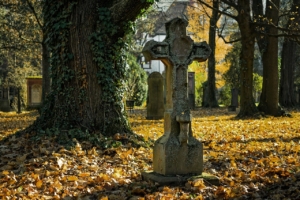
Today, just for kicks, I consulted findagrave.com and asked for John Milton’s gravesite. This is what it gave me in a matter of seconds:
John Milton Famous memorial
Birth
9 Dec 1608
Bread Street, City of London, Greater London, England
Death
8 Nov 1674 (aged 65)
London, City of London, Greater London, England
Burial
St. Giles Cripplegate Churchyard
London, City of London, Greater London, EnglandShow MapGPS-Latitude: 51.5187642, Longitude: -0.0938894
Oh, the power of the Internet, and how it’s changed our lives! One last example—I’m writing the historical mystery I started researching at the library when I was fifteen years old. The aftermath of the Great Storm of 1900 is a big part of the setting, and I had extensive notes taken from primary sources over a ten-year period. For various reasons, I was unable to complete that novel until now, and ta-da! The Internet is such a boon to the story-telling. For example, I can find out how many kopecks to a ruble or what a person could buy with five dollars in 1903 in a New York Galveston minute!
The experience makes me wonder—all the time—what we would do if we lost the Internet, the ability to ask Siri or Alexa, or even the ability to photograph objects for later use.
How about you? Do you have a favorite pre-Internet search to share? I’d love to hear about it.
Saralyn Richard is the author of The Detective Parrott mystery series, The Quinn McFarland mystery series, A Murder of Principal, and the children’s book, Naughty Nana. Subscribe to her monthly newsletter for contests, prizes, surveys, and other fun content at https://saralynrichard.com.


When you hear the phrase treasure hunt, you might imagine a chest of gold or a legendary artifact. But what if the treasure was a bird—and the hunter an ornithologist?
In the mid-1990s, I joined a field trip to Aransas National Wildlife Refuge on the Texas coast to see the endangered whooping crane. That experience changed my life. I became captivated by the crane’s story—and by the man who saved it from extinction. That fascination grew into a seven-year research journey and ultimately my book, The Man Who Saved the Whooping Crane: The Robert Porter Allen Story.
In the spring of 1941, the whooping crane population had dropped to just fifteen birds. Written off as doomed, the species survived because one man refused to accept extinction as inevitable. Robert Porter Allen, an ornithologist with the National Audubon Society, launched a conservation campaign unlike anything America had seen before.
Long before television or the internet, Allen ignited a nationwide media blitz. Posters flooded public schools. Children wrote letters to lawmakers. Radio stations tracked the cranes’ migration from their winter home near Austwell, Texas, to a mysterious nesting site somewhere in Canada. Life magazine published a rare photo of a whooping crane family, and even an oil company altered its operations to avoid disturbing the birds.
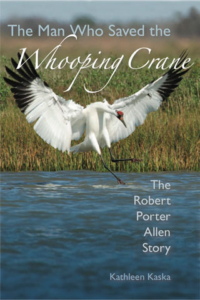
By 1947, fewer than thirty cranes remained. Their nesting grounds—hidden somewhere in northern Saskatchewan, possibly near the Arctic Circle—had never been found. Without protecting that site, the species would vanish. After two failed searches, Audubon turned to its most tenacious ornithologist: Robert Porter Allen, newly returned from World War II.
What followed was a real-life treasure hunt—one that helped save a species and changed the course of conservation history, ultimately paving the way for the Endangered Species Act.
The story of Robert Porter Allen is best described as Indiana Jones meets John James Audubon—and it remains one of the most inspiring conservation adventures ever told.
I wrote the book to pay homage to a man who was all but forgotten. My research led me on my own journey from Texas to Florida to Wisconsin and beyond in an adventure I like to call “On the Trail of a Vanishing Ornithologist.”
Excerpt:
It was April 17, 1948, in the early hours of a muggy Texas morning on the Gulf Coast. The sun at last burned away the thick fog that had settled over Blackjack Peninsula. The world’s last flock of wild whooping cranes had spent the winter feeding on blue crab and killifish in the vast salt flats they called home. During the night, all three members of the Slough Family had moved to higher ground about two miles away from their usual haunt to feed. The cool, crisp winter was giving way to a warm, balmy spring. The days were growing longer, and territorial boundaries were no longer defended. Restlessness had spread throughout the flock.
As Robert Porter Allen drove along East Shore Road near Carlos Field in his government-issued beat-to-hell pickup, he spotted the four cranes now spiraling a thousand feet above the marsh. He pulled his truck over to the roadside and watched, hoping to witness, for the first time, a migration takeoff. One adult crane pulled away from the family and flew northward, whooping as it rose on an air current. When the others lagged behind, the crane returned, the family regrouped, circled a few times, and landed in the cordgrass in the shallows of San Antonio Bay. It was Allen’s second year at the Aransas National Wildlife Refuge. He had learned to read the nuances of his subjects almost as well as they read the changing of the seasons.
In the days preceding, twenty-four cranes departed for their summer home somewhere in Western Canada, possibly as far north as the Arctic Circle. This annual event, which had occurred for at least 10,000 years, might be one of the last unless Allen could accomplish what no one else had.
The next morning, when Allen parked his truck near Mullet Bay, the Slough Family was gone, having departed sometime during the night. That afternoon, he threw his gear into the back of his station wagon and followed.
The Man Who Saved the Whooping Crane was published by the University Press of Florida in 2012. It’s still available in bookstores upon request, Amazon, Barnes & Noble, and University Press of Florida. It’s also from my website: Kathleen Kaska
Contact me at kathleenkaska@hotmail.com for information on my presentation of The Man Who Saved the Whooping Crane: The Robert Porter Allen Story

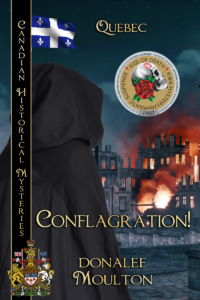 My second mystery novel, Conflagration!, is my first historical mystery. My publisher has a series of historical mysteries than span Canada from coast to coast. When she unexpectedly lost her Quebec writer, she offered me the opportunity to write the book and step back to 1734 when the colony of New France was ruled by King Louis XV. It was an opportunity I embraced. With trepidation.
At readings and book clubs, I joke that I am not from Quebec, I do not speak French as more than 80% of Quebecers do, and I do not write historical mysteries. So, of course, I said “yes” when my publisher offered me the opportunity to write Conflagration!. I am grateful I did.
What scared me most about the writing the book was getting something wrong. Misspeaking. Misunderstanding. Misconstruing. The foundation for Conflagration! (and for all historical mysteries) is accuracy. As a freelance journalist, I am used to writing on topics that I knew little (and somethings nothing) about. I have written articles on everything from buying cyber insurance to surviving a helicopter crash to paying the tooth fairy. I know how to research, how to interview people, how to find people to interview, and how to find accurate sources of information. For the most part though, the research I’ve done was contemporary or contemporary adjacent. It wasn’t from 300 years ago.
Conflagration! chronicles the arrest, trial, and subsequent execution of Marie-Joseph Angélique, an enslaved Black woman accused of setting the lower town of Montreal on fire. When the flames were finally squelched, forty-six homes and buildings were gone. The quarter, where the merchants lived and ran their businesses, was destroyed. Fortunately, no one died.
I had never heard of Angélique, had never read her story in the many history classes I took throughout school and university. I was not alone in this lack of knowledge. That is because Angélique’s story is also the story of slavery in Canada, and for centuries we have avoided the topic or rewritten the facts to shape the narrative. Fortunately,
Angélique’s story is more well known in Quebec, where a plaque has been erected in her memory in Old Montreal.
As I delved into the events of April 10, 1734, I discovered others had gone before me. There were books, websites, articles, documentaries, shorts. I embraced them all. Some of these sources also referenced court documents, meticulously recorded, albeit in French. One site translated those documents although translations from old French to modern English are not always clear and understandable. The golden rule in journalism is you must have at least two sources before you use any information. I also embraced this rule.
As nerve-wracking as ensuring my story accurately referenced the trial transcripts and sequence of events from the first flames to Angélique’s final breath, I discovered that the justice system was only one element of research required. At one point, I had my main character Philippe Archambeau, a court clerk assigned specifically to document Angélique’s case, get up early and make himself a cup of coffee. Then I asked myself, “Did they drink coffee in New France in 1734?” (They did, but tea was more common.)
This issue of everyday life came up in a myriad of ways. Philippe goes to put on boots. (Did they wear boots three hundred years ago? What kind?) His wife, Madeleine, is making supper. (How do you make supper when there are no stoves, no ovens, no electricity? What do you eat?)
The answers to these and a multitude of other questions were answered thanks to reliable sources on the internet, books written by authoritative sources, individuals knowledgeable about aspects of the story, the time, the history – and more.
I owe them all a debt of gratitude.