
Tag Archive for: Historical Mystery

Guest Noir Mystery Author M.E. Proctor
Noir Mystery Collaboration

By M.E. Proctor

A few days ago, a friend posted a picture of New York in the 1940s, all neon and jazz clubs with big names on the marquees, accompanied by this caption: I want a time machine! Ah, to be able to go back in time to see legendary performers on stage … Don’t we all have these kinds of fanciful thoughts? Like traveling to 1889 to see the Eiffel Tower go up and hear people complain that it ruins the view. Or a day trip to catch a chariot race in Rome. Was it really like in Ben-Hur, and did they have snack vendors?

Alas, the technology isn’t there yet …

But I would argue that we have the next best thing in easy reach.

I’m not talking about the corny AI renditions of ‘life in the days of yore’ that proliferate worse than kudzu on every social media platform. Have you noticed that everybody looks suspiciously neat and clean and the cars are all shiny?

That’s also one of my movie pet peeves, by the way. The jalopies without a speck of mud … (I guess the car collectors wouldn’t let Hollywood borrow them without a guarantee of white-gloved treatment.)

I’m interested in a different kind of virtual time machine. Every time I open a book, I embark on a trip to a different place or a different time. Fiction or nonfiction, my mind provides the soundtrack and the image reel. I might even catch a whiff of a scent or a hint of a taste.

For example, as I write this, I vividly remember the beginning of Hilary Mantel’s Wolf Hall. She took me to Putney in the year 1500. Her writing gave me a front row seat. Imagine how Hilary felt when she was writing the book, totally immersed in the times. I’m convinced she breathed the same air as Thomas Cromwell. She definitely traveled in time, without a flux capacitor.

Russell Thayer and I experience the same extraordinary feeling when we jump back seventy-five years to create trouble for our two favorite characters—Vivian Davis, aka Gunselle, a professional assassin (Russell’s creation), and Tom Keegan, my San Francisco PD homicide detective.

Our first writing collaboration, Bop City Swing, was published last year. That story revolved around a political assassination in 1951. The book was barely in the hands of the publisher when we decided to have another go at it. Tom and Vivian were playing well together; they deserved another walk in the spotlights.

Russell and I play well together, too. We’re comfortable with the way we build a narrative, through a mix of late night brainstorming sessions and improvisation on the page, supported by reams of documentation. We know all the good gin joints and dance clubs. We have maps, stacks of photographs, favorite cars. We know the price of a cup of coffee and what music plays on the radio. Most of all, we are comfortable with the two main protagonists and their complicated relationship.

If a Train Leaves San Francisco at Noon on Friday, May 2, 1952 …

For our second collaboration, Kansas City Breakdown, Russell chose the setting. He’d spent some time in KC and wanted to relocate Tom and Viv to Missouri. An interesting challenge. The stack of background documents grew. New maps, new photographs. New rabbit holes. Train schedules, in particular. How do you get from San Francisco to Kansas City in 1952 and how long does it take?

Flying is too expensive, driving takes too long, and there’s no direct train connection. San Francisco to Sacramento. Then Reno. Salt Lake. Change trains in Cheyenne. Head to Denver, arrive in Kansas City Union Station. Two days on wheels. A lot can happen. We had so many ideas and ended shelving them all. NeitherTom nor Vivian took that train. She was on another one and he found a clever way to beat her to the destination. Plots have a tendency to do that. They’re good at throwing curve balls.

I suspect a jaunt in a real time machine would meet with the same kind of unpredictability. You might not land exactly in the right spot or at the right time, like in one of my favorite books, Connie Willis’s Doomsday Book: Kivrin, a historian, travels to the 15th century. She’s prepared (or thinks she is). She wears the right clothes, she’s learned the language (but surprises are in store), and she knows the geography. The problem is that she misses the date mark and arrives as the Black Death marches across the land. Ouch.

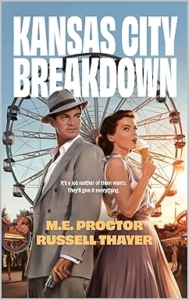
Virtual time travel is a lot safer. I’ll let my fictional characters deal with the turbulences. Tom and Vivian look pretty relaxed on the book cover of Kansas City Breakdown. Don’t let it fool you. These two are a pair of very cool customers.

Kansas City Breakdown

May 1952

Mobsters, molls, and muscle are meeting in Kansas City to carve out territory, make deals, assert influence. They come from Chicago, Dallas, New Orleans, Detroit … By plane, by car, and, in the case of mid-level heavy Mike Abati, by train from San Francisco. The FBI sees an opportunity. A chance to get close to the man, gather information, and have eyes and ears on the conference. A honey trap.

Tom Keegan, San Francisco PD homicide detective, knows the right woman for the job. She’s smart and cool. Seductive. Fearless. A rare and fiery combination of brass and sass. Would she agree to put her life on the line? If her cover is blown, she’s dead. Besides, Vivian Davis, aka professional assassin Gunselle, doesn’t do favors for cops. But Tom is doing the asking and it makes Vivian’s heart beat a little faster.

The job isn’t all it appears to be. It comes with a side of betrayal. Because, after all, a girl has to look out for herself.

Buy Link

~~~

M.E. Proctor was born in Brussels and lives in Texas. She’s the author of the Declan Shaw detective mysteries (Love You Till Tuesday and Catch Me on a Blue Day), two short story collections (Family and Other Ailments and A Book to Live By), and two co-authored retro-noirs with Russell Thayer (Bop City Swing and Kansas City Breakdown). Her fiction has appeared in various magazines and anthologies. She’s a Shamus Award and Derringer Award short story nominee. She can also be found on Substack.

Russell Thayer’s work has appeared in Tough, Roi Fainéant Press, Mystery Tribune, Bristol Noir, Shotgun Honey, Rock and a Hard Place Press, and Literary Garage among others. His novels include Bop City Swingand Kansas City Breakdown, co-written with M.E. Proctor. Russell received his BA in English from the University of Washington, worked for decades at large printing companies, and currently lives in Missoula, Montana. You can find him lurking on “X” @RussellThayer10.
Guest Author M.E. Proctor Bops into Historical Fiction Waters

Bopping in Historical Waters

By M.E. Proctor

When I was a kid, I wanted to be an archeologist. I had romantic notions about digging in the Valley of the Kings, excavating the ruins of Troy, or following Percy Fawcett in his search for the lost city of Z—David Grann’s book had not been published yet or I would have known that was a no-no … the critters … yikes.

Adventure books contributed to my vocabulary (quirky), grasp of world geography (off the beaten track), and crossword cracking (obscure). They also developed a long-lasting interest in history. To this day, these are the bookshop shelves I go to first. Logically, I should write historical fiction instead of contemporary crime.

I know why I don’t. The problem is twofold.

First, I’m an impatient obsessive. It’s not as contradictory as it sounds. A few months ago, I wrote a piece for an anthology. The story takes place in 1640 C.E. in Ireland. I spent two months hopping from one rabbit hole to the next, gathering documentation, deeper and deeper. All for what ended up being a 6,000 words story. That’s the obsessive in me. Imagine what would happen if I decided to write a book. My impatient self shivers at the thought. Forty months of research? Before writing the first line? The historical fiction writers reading this will probably say that it isn’t that bad, that once the material is assembled the sailing is smooth, or that I need to be more focused, more organized in the search.

That’s where my second problem kicks in. I’m curious. If something smells good in that rabbit hole, I’ll go for it. What happened in that place a hundred years before, or a hundred years later? What about this character? I don’t picture historical research as an academic pursuit. To me, it’s the most tempting of candy stores, a place of delights where I want to pitch my tent and stay. I might never put a line on paper.

And that’s why I will never write a historical fiction book.

Yet, Bop City Swing is out in the world.

I was tricked.

Russel Thayer contacted me last year and suggested we write a short story in collaboration. We had both published pieces set in California in the 1940s and 50s, classic crime, inspired by the ‘noir’ movies we both love. His recurrent character is gun-for-hire Vivian, nicknamed Gunselle, and I had stories with SFPD homicide detective, Tom Keegan. Let’s bring them together. We didn’t think it would turn into a book.

I didn’t consider 1951 ‘historical fiction’. It isn’t a hundred years old—the marker for antiques—and women’s skirts didn’t sweep the floor, a visual cue that says ‘costume drama’.

Russell and I talked about plot and locations, decided to build the story around a political assassination, didn’t know what would happen next, and started writing.

The need for research became obvious right away. We needed an election year in San Francisco. That set the date, 1951, when incumbent mayor Robinson ran for a second term. We also needed a realistic scene for the crime and chose the Palace Hotel, still standing downtown. A stroke of luck delivered period-accurate floor plans. We didn’t know it yet, but these plans would be critical for the plot. We also gathered city maps and photographs.

Compared to my excursion to the 17th century, none of the work done for Bop City Swing was time-consuming, and the rabbit holes were few. Because we let the plot and the characters dictate the story. When we bumped into an anachronism or a historical impossibility, we adjusted the narrative. Minor modifications: change of address, different music selection. Ironically, the trickier part was shedding some of the language flotsam movies left behind. In the final draft, period slang and hardboiled expressions that leaned too much into Chandlerian back alleys were cut. They’re period-correct, but 2025 readers might blink.

Bop City Swing is neither an homage nor a pastiche, its ambition is just to be a damn good crime story. Historical? Maybe.

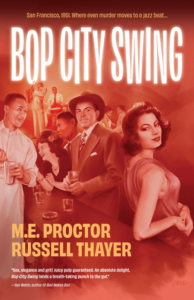
Bop City Swing

San Francisco. 1951.

Jazz is alive. On radios and turntables. In the electrifying Fillmore clubs, where hepcats bring their bebop brilliance to attentive audiences. In the posh downtown venues where big bands swing in the marble ballrooms of luxury hotels.

There the story begins, with the assassination of a campaigning politician during a fundraiser.

Homicide detective, Tom Keegan, is first on the scene. He’s eager, impatient, hot on the heels of the gunman. Gunselle, killer for hire, flew the coop, swept away in the rush of panicked guests. They both want to crack the case. Tom, because he’s never seen a puzzle he didn’t want to solve, no matter what the rules say. Gunselle, because she was hired to take out the candidate and somebody beat her to it. It was a big paycheck. It hurts. In her professional pride and wallet.

Buy links

M.E. Proctor was born in Brussels and lives in Texas. The first book in her Declan Shaw PI series, Love You Till Tuesday, came out from Shotgun Honey, with the follow up, Catch Me on a Blue Day, scheduled for 2025. She’s the author of a short story collection, Family and Other Ailments, and the co-author of a retro-noir novella, Bop City Swing. Her fiction has appeared in VautrinToughRock and a Hard PlaceBristol NoirMystery TribuneShotgun HoneyReckon Review, and Black Cat Weekly among others. She’s a Derringer nominee.

Website: www.shawmystery.com

Substack: https://meproctor.substack.com


Russell Thayer’s work has appeared in Tough, Roi Fainéant Press, Mystery Tribune, Close to the Bone, Bristol Noir, Cowboy Jamboree Press, Shotgun Honey, Rock and a Hard Place Press, Revolution John, Punk Noir Magazine, Expat Press, The Yard Crime Blog, and Outcast Press. He received his BA in English from the University of Washington, worked for decades at large printing companies, and lives in Missoula, Montana.


Setting a Perfect Mystery!

 By Lynn McPherson

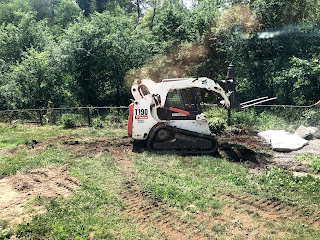
Summer has finally arrived and I’m here for it. The long, hot days have brought with them a flurry of activity in my yard because I’m getting a pool (hooray!). Watching the big machines and busy workers under the bright sunny skies has reminded me about the importance of setting in a story. Have you thought about the surroundings of each scene in your manuscript? If not, you should. Let’s talk about why.

Mood can make or break a story whether writing a psychological thriller or a cozy mystery. The right atmosphere is needed to bring your reader into a matching mindset. Is it dark or light? Hot or cold? Are your characters sitting in a busy cafe or standing on an isolated ledge? Each factor can contribute to how a reader visualizes the scene before them and is brought into the heart of the story.

Setting can also help establish the character of your protagonist. If your amateur sleuth lives in a small town in a modest house with a friendly pet, it will also evoke a different image than if they are centered in a modern condo in the middle of Manhattan.

Time is another factor the setting should take into account. If it’s 1952, a robin blue kitchen might be the cutting edge but considered a pre-reno nightmare in 1995. And what about the cars being driven or the styles being worn? Subtle clues used to describe when the action takes place helps the reader create a strong mental image. What might you use to make sure you establish accurate details that draw your reader in?

Setting is an important element in writing that we sometimes forget. Make sure you take time to create the world your characters exist in so your readers aren’t left with blank spaces or blurry details.

What are some of your favorite ways to establish setting?

Lynn McPherson has worked for the Royal Canadian Mounted Police, ran a small business, and taught English across the globe. She has travelled the world solo where her daring spirit has led her to jump out of airplanes, dive with sharks, and learn she would never master a surfboard. She now channels her lifelong love of adventure and history into her writing, where she is free to go anywhere, anytime. Her cozy series has three books out: The Girls’ Weekend Murder and The Girls Whispered Murder, and The Girls Dressed For Murder.  

The Mystery of Crime Fiction

By Lynn McPherson

Have you ever wondered what draws a reader to crime fiction? Is there not enough crime in the real world that the human psyche longs for even more? Today, let’s explore the possibilities behind the love and longing for books that focus on the darker side of humankind. There are several sub-genres within the crime fiction family. I’ve chosen three of my personal favourites to discuss.

I love cozies. I read them. I write them. I have a mental note of books as long as Santa’s gift list of those I still have yet to read. I never seem to tire of them. The greatest part of cozies is getting to know the town and the characters that make each series unique. It’s like visiting your hometown or settling in to a comfy lounge chair to watch your favourite movie for the umpteenth time.  There is a familiarity that readers rely on and expect that cozies must deliver, if they are going to be successful. The protagonist must be likeable and the town must be where you’d love to spend time, as well as a recurring set of characters that draw the reader in, making them want to come back and visit with each new story. Comfort, escape, and a whodunit to challenge one’s intellect make it a no-brainer.
What about suspense or psychological thrillers? There is no known path. The reader must race through the pages to see if the character in jeopardy is going to be okay or achieve what they need to in order to get things back to normal—or at least, a semblance of order. When I read The Girl With the Dragon Tattoo, I had heart palpitations. I raced through each page, gripping the paperback novel like the outcome depended on it. There were moments I thought I couldn’t take it and would have to jump to the end—just to stop my anxious musings. But I knew there would be an end and that gave me the comfort and patience required to get there without cheating. There was great satisfaction with an ending that tied together all the most relevant details of the case. A perfect example of why they are so captivating to read.
Finally, let’s talk about police procedurals. These books have a professional detective in the police force who must follow the proper rules in order to solve the assigned case. This presents challenges that the cozy or amateur sleuth novels do not have to deal with, such as sticking to the law and proper procedure. You won’t see a detective sneaking around a suspect’s home to see what they uncover—that is, unless they have a proper warrant (I never like that part). However, they are granted access to crime scenes that a regular citizen is not given. The reader gets to walk in a police officer’s shoes and see what they see, with the tools and training given out by the department. We are given a glimpse into the mind of a police officer while we ride along like the proverbial fly on the wall. It’s fun to try and figure out if we make the same decisions and reach the same conclusions as the professional protagonist. It is an intellectual challenge and a journey into a life that most of us never get a change to experience.
With each category above, there is a different style and attraction that draws a reader in. However, the similarities cannot be denied—there is a puzzle to solve, a defined end, and a chance to live vicariously through the protagonist’s lens. Crime fiction allows a reader to escape into a dangerous story, path, or situation in which one would likely not experience in real life. By the end of the book, the reader can put it down, feeling satisfied that the story has come to completion. This, in itself, may be the best part of all.


Lynn McPherson has worked for the Royal Canadian Mounted Police, ran a small business, and taught English across the globe. She has travelled the world solo where her daring spirit has led her to jump out of airplanes, dive with sharks, and learn she would never master a surfboard. She now channels her lifelong love of adventure and history into her writing, where she is free to go anywhere, anytime. Her cozy series has two books out: The Girls’ Weekend Murder and The Girls Whispered Murder.  

[Lynn’s Author Site] – [Buy Lynn’s Book]

If Austin Starr Could Talk to You *

By Kay Kendall

My
dear friend Larissa is in big trouble. She just called me long
distance to say she’s a suspect in a murder case. Good grief, it’s only been a
year since my husband David was suspected of murder, and now it’s Larissa. This
is too much. I’ll need to get a
trench coat and fedora—pretend I’m a private eye—if I keep getting pulled into
these cases on a routine basis. 


            Larissa wants me to fly across the continent
to give her moral support. The Mounties say she’s the one who killed the leader
of her women’s lib group. Of course she didn’t do it. The idea is ludicrous.
And, I know I owe her, big time, and want to help her, but I don’t see how I
can. Believe me, I’d leave right now if I could. But things have changed since we
talked.

            The
life-changing event is, well, I’m a mother now. Wyatt is three months old and
cute as can be. I can’t possibly take him with me because last time I went
sleuthing around, I was almost killed. However, I can’t go alone and leave Wy
at home either. David would have a perfect fit
if I asked him to babysit. Of course I
juggle Wyatt’s child care with my own courses work, but that’s expected. After
all, I mean, gosh, I’m the mom. Dads don’t do things like that—not much anyway.


Still, I cannot leave Larissa in the lurch. She’s the only real friend I’ve
made since I pulled up stakes and left my home and family in Texas to join my
new husband up here, in the Great White North, Canada. You know, it really was
kinda neat—how Larissa and I clicked right away. Usually I avoid anyone who is
petite like she is. They make me feel like such an oaf. Here I am at five feet
eleven, and Larissa is a good ten inches shorter. But she is so much fun, and smart
too. The two years difference in our ages seems like nothing. She just turned
twenty-one and is still an undergrad.

            I tell Larissa everything. For
instance, she’s the only one who knows I was being trained as a spy by the CIA
right before I married David. But I could never tell him that. He would not
approve, that’s for sure. But Larissa knows and keeps all my secrets. Here’s a
funny thing, though. Why didn’t she
confide in me she joined a women’s
lib group?

            Oh
my gosh, the more I think about it, I must
fly out to be with her during her time of trouble. I’ll have to put a plan in
place. She’ll call me back in an hour and ask if I’m coming.

            Hey,
maybe you can help me out. What do you
think I should do?
  

* Austin Starr is the amateur sleuth in Kay Kendall’s two mysteries. Here Austin sets out on her second murder case, Rainy Day Women, the sequel to Kay’s debut Desolation Row. Both are
published by Stairway Press.

Meet the author                                                                 


Kay Kendall is a long-time fan of historical
novels and now writes atmospheric mysteries that capture the spirit and
turbulence of the sixties. A reformed PR executive who won international awards
for her projects, Kay lives in Texas with her Canadian husband, three house
rabbits, and spaniel Wills. Terribly allergic to her bunnies, she loves them
anyway!
Her book titles show she’s a Bob Dylan buff too. Rainy Day Women  won two Silver Falchion Awards at Killer
Nashville in 2016.
Visit Kay at her website  http://www.austinstarr.com/
or
on Facebook 

SLEUTHING WITHOUT A LICENSE – Guest D.E Ireland

SLEUTHING WITHOUT A LICENSE – Guest D.E Ireland


Mystery readers have long been aware that some of the best
literary detectives are rank amateurs. Unlike private eyes, FBI agents, and
police officers, amateur sleuths must fit in crime solving along with their day
job. These part-time detectives not only break the rules, they’re often unaware
of what the rules are. Still, this doesn’t stop them from unearthing evidence,
tracking down leads, and nabbing the killer.
Of course, they do operate with a few drawbacks. For one
thing, most do not carry weapons. An amateur sleuth also can’t obtain a search
warrant or wire tap, which may lead them to breaking and entering – a crime. One
of the biggest risks of not being a professional is the possibility of arrest,
since law enforcement views an amateur with suspicion or irritation. If an
amateur does find evidence or clues, the resources of a forensics or crime lab
are not available. This is why so many cozy mysteries feature police officers
or FBI agents as continuing characters; these characters are often a family
member or a romantic interest of the protagonist.
What an amateur sleuth relies upon are the three ‘I’s:
intelligence, ingenuity, and intuition. And a private citizen interested in
solving crimes is not without resources. Scores of databases are available
online, such as tax assessor records, genealogical history, property records,
military service, etc. And if the sleuth knows the person’s social security
number, the prefix will tell them the state where the number was issued. County
records and newspaper archives also help flatten the playing field for the
non-professional detective. But the most valuable asset for an amateur is
gossip. Most people are wary or fearful of the police. If the person asking
questions is a friend who owns the local bakery, the answers may be more
forthcoming,
Cozy mysteries are frequently set in picturesque small towns,
and the amateur sleuth is usually a long-time resident. This allows them easy
access to all the juicy family secrets, and they know where all the bodies –
literally and figuratively – are buried. Such knowledge gives them an advantage
over an outside investigator.  Detectives
in cozies often own businesses such as tea shops, B&Bs, bookstores, and
vineyards. This constant influx of customers and visitors provides an ever-changing
pool of suspects and victims. The reader is also showered with lots of
fascinating details about the pr
otagonist’s business. 


Popular small business
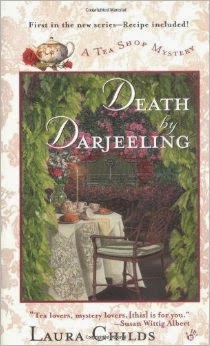
cozies include Laura Child’s Tea Shop Mysteries, JoAnna Carl’s Chocoholic
mysteries, and Susan Wittig Albert’s China Bayle’s Herb Shop series.
In real life, amateurs are sometimes sought out by law
enforcement. More than one police department has called in a psychic to help
them unravel an especially difficult case. These are sleuths who possess a
unique skill set rarely found in a forensics lab or police station. Not
surprisingly, mystery series have sprung up which feature paranormal
investigators. These detectives include not only psychics, ghost hunters, and
witches, but also actual supernatural creatures such as vampires and
werewolves. Perhaps the most famous in this subgenre is Charlaine Harris’s
Sookie Stackhouse books.
Readers might guess that placing an amateur sleuth in the
past – when investigative methods were minor or nonexistent – might be easier
to write. Not so. Cozy historical authors setting their stories in London must
be aware of how British ‘Bobbies’ came into service,  and that 1749 saw the founding of the Bow
Street Runners, the city’s first professional police force. In the American
colonies, law enforcement was the prerogative of constables, government
appointed sheriffs, and voluntary citizen “watches” who patrolled the town’s
streets at night. This leaves plenty of opportunity for amateur sleuths,
especially since the country’s first 24-hour police force did not appear until
1833 in Philadelphia. Books set during the early years of law enforcement
include the Bracebridge Mystery series by Margaret Miles, Maan Meyer’s Tonneman
books, and Patricia Wynn’s Blue Satan series set in Georgian London.

While there weren’t established police forces prior to the
19th century, there were lawyers. And it’s not only John Grisham and
Scott Turow who know that attorneys have access to both information and a wide
range of criminals. The practice of law has been a legalized profession since
the time of Roman Emperor Claudius in the first century. What a perfect
occupation for an amateur sleuth, as long as he doesn’t run afoul of the
ultimate arbiter of justice: the reigning monarch. And when the sleuth is the
monarch herself, as in the Queen Elizabeth I series by Karen Harper, then you
have the most powerful detective of them all.

Amateur detectives in historical settings must deal not only
with a budding police force. Ministers and officials could make things quite
dangerous for a sleuth, especially if that sleuth is an ordinary citizen
without wealth and powerful connections to back him up. And depending on the
time period, a wrongly accused victim did not have forensic science techniques
to help exonerate him. Fingerprinting wasn’t admissible in court until after
the turn of the 20th century, along with
photographs of the crime scene and victims. In both historical and contemporary
novels, amateur detectives have a hard time convincing police officials of
their theories. Even worse, the killer invariably targets the sleuth as their
next victim in order to avoid discovery.
Amateur sleuths also need a motive to get involved in a
murder investigation or else it wouldn’t make sense, given the inherent danger.
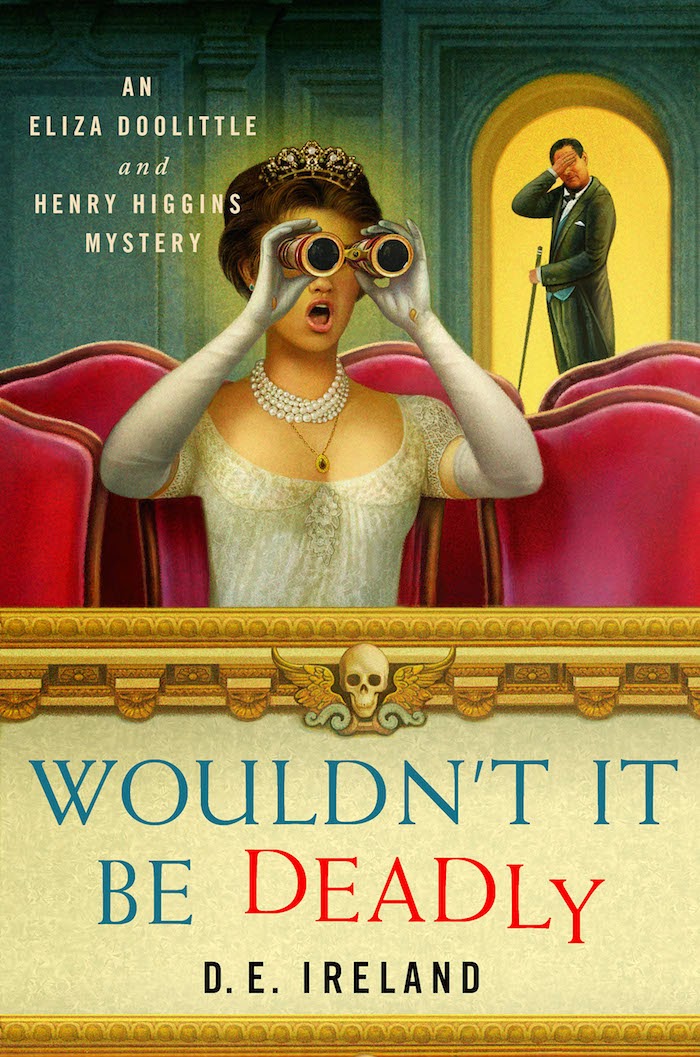
In our own debut mystery, Eliza Doolittle must prove that Henry Higgins is innocent
of murdering his chief rival; it is her friendship and loyalty to him that
spurs Eliza on. In Cleo Coyle’s first Coffeehouse mystery, the police believe
an attack on Clare’s employee was accidental; Clare believes otherwise and adds
‘amateur sleuth’ to her resume. And in Barbara Ross’s Maine Clambake series,
amateur sleuth Julia must rescue her family business while solving a murder on
its remote island premises.
Amateur sleuths take on a load of trouble when they decide
to chase after criminals. Luckily, they seem to be quite good at it.

Leave a comment to get your name in the drawing for a hard copy of Wouldn’t It Be Deadly.


D.E. Ireland is a team of award-winning
authors, Meg Mims and Sharon Pisacreta. Long time friends, they decided to
collaborate on this unique series based on George Bernard Shaw’s wonderfully
witty play,
Pygmalion, and flesh out their own
version of events post-Pygmalion.