
“Just One More Thing”

When you hear the phrase “just one more thing,” what comes to mind? If you were around in the 1970s, you probably remember Columbo, starring Peter Falk as Lieutenant Columbo of the Los Angeles Police Department. The series won 22 awards and received 68 nominations, with Falk earning four Primetime Emmy Awards. It aired on NBC from 1971 to 1978 and has since been rebroadcast on numerous networks.

What I liked most about the show was its structure: viewers knew the killer from the start and then watched Columbo patiently unravel the crime. Each episode featured a guest star as the murderer—Martin Landau, Janet Leigh, Ruth Gordon, Vincent Price, Roddy McDowall, Leonard Nimoy, even Johnny Cash, to name a few.

I recently rediscovered the series after making a practical—if slightly risky—decision: changing hairdressers after fifteen years. When I learned my husband’s barber had begun cutting women’s hair for less than half what I’d been paying, I decided to give her a try. I only needed a trim—no shampoo, no styling. The first visit took less than ten minutes, and I was pleased with the result.

On my most recent visit, I didn’t have an appointment. Four people were ahead of me, and I thought about leaving—until I noticed the television was tuned to Columbo. I stayed. The episode featured Ricardo Montalban as a matador in “A Matter of Honor.”

When Columbo arrives on a scene—hair rumpled, trench coat wrinkled, cigar in hand—he’s easy to underestimate. His suspects dismiss him as absentminded, even inept. But his polite, seemingly scattered questions are deliberate. Columbo is a meticulous strategist, noting every clue and quietly assembling the truth. He wears his suspects down with persistence, circling back again and again until—almost as an afterthought—he says, “Just one more thing.”

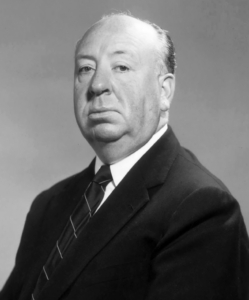
Alfred Hitchcock also used this technique in his movies Rope, Dial M for Murder, A Shadow of a Doubt, and Frenzy. His forte was suspense rather than surprise. The audience knows what happened as they watch the story unfold. Suspense builds tension, keeping the audience on the edge of their seats as they participate in solving the crime.

Back to my barber. I waited nearly an hour that day and didn’t mind at all. I was hooked as soon as Columbo began his investigation. I knew he’d solve the mystery, and I couldn’t wait to find out how he did it. Next time I need a trim, I may skip the appointment altogether. I’ll take a seat, request Columbo on TV, and bring my writing journal. I’ll study the master detective at work and take notes for the next mystery.

Have you ever written a reverse whodunnit?

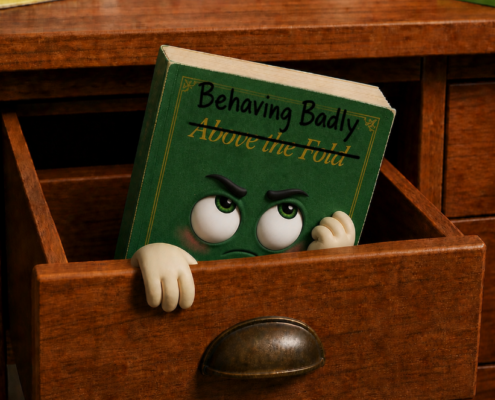
Behaving Badly: Out of the Drawer

Dear Stiletto Gang Readers: I am so proud to know today’s guest. Read on; I have no doubt you’ll understand why. ~ Donnell Ann Bell  

Out of the Drawer

By: Rochelle Staab

Author Rochelle Staab

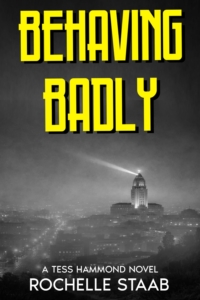
Most every writer keeps one or more unwritten novels somewhere in a drawer/file/box, waiting, hoping for the enthusiasm to finish. Most drawer stories wait forever. Some resurface then fizzle again. My new novel, Behaving Badly, spent ten years in the drawer before the escape. Inspiration didn’t reappear overnight. Unwittingly, my personal journey away from writing, fed into the story and setting and made me a better writer.

After a series cancellation and my frustration in trying to please an editorial team who liked me but not the ideas I pitched, I decided to write what I really wanted to write: noir set in depression/prohibition-era Los Angeles. Using a working title of Above the Fold, I created a gritty, recently widowed female crime reporter who chased front-page headline stories about crime and corruption in 1930s Los Angeles without the convenience of a cell phone or a computer.

I loved the idea. Like so many women who found and claimed their power through the 1920s into the 1930s, my heroine had guts. Tess—my protag’s name has always been Tess—had a character profile, a supporting cast, solid research, and a complicated abduction plot involving a silent screen star lookalike.

Seventeen chapters in, Tess claimed her ground. I deflated. My agent gave me a mediocre response when I pitched a historical noir mystery featuring a female reporter. I feared the same reaction from my editor. I needed to shake off rejection and self-doubt and do something to make me feel good about myself.

Rochelle Staab and hiking buddy Barbara Beck at Escondido Falls, Malibu, California

I had always felt less than because I didn’t have a college degree, something I knew I had the power to fix. I enrolled in the local community college to see if I had what it took to erase my insecurity. My major would be English, because, you know, writer? But a required history class seduced me. One more, and I became a history major. I graduated and moved on to Cal State Northridge to complete my credits. I read primary sources; I wrote essays about world history. I formed opinions. Despite being the oldest history major at CSUN, I did a summer internship at the Autry Museum. I built a blog on the history of chocolate and co-wrote a video about the history of Los Angeles State Historic Park. Without planning, the classes I took, like the history of Weimar Germany, added context to the world surrounding Tess. My Sunday hikes around L.A. gave me a sidewalk-up familiarity (setting!) with Los Angeles infrastructure during the city’s growing years, the city Tess lived and worked in.

During my last semester at CSUN, I had a casual conversation with an acquaintance at my gym, a man who read hard cover novels on his daily stationary bike routine. I told him I wrote three books. A week later I spotted him reading my first book, Who Do Voodoo? on the bike. Seeing him turn the pages of my book fired a spark. I wondered if I would ever have the courage and creativity to write another novel.

Two weeks before I graduated with Honors, the gym guy and I had dinner. He asked what I would be writing after I graduated.  Just so I could call myself a writer and still believe it, I told him about Tess, my 30s reporter. That night I opened the “drawer” in my computer and figuratively pulled out Tess and what soon became Behaving Badly.

I started editing the seventeen chapters I wrote ten years ago and fell in love with the story all over again. Worried about failing Tess one more time, I logged my daily word count but without specific goals. From then on, each day when my gym friend asked how the writing was going, I had an answer. I found my pattern. Editing the seventeen chapters gave me courage. From there, I tried to write a new chapter each week, building the rest of the story without pressure or deadline. My friends smiled at me with that patient “will she ever finish the damned thing?” look. Twenty-eight chapters later, and a much richer story, Tess tied up some loose plot ends, and I typed THE END.

I had promised myself that if my agent still didn’t like historical noir ten years later, I would take charge of my writing future, self-publish Behaving Badly, and reclaim my agency. When he told me that the historical fiction genre had no audience, and perhaps I should write about hiking instead, our gracious parting made me a publisher.

A chance meeting with another author while on a basement tour of speakeasys in downtown L.A.—where else would authors bond?—led to a self-publishing conversation. He offered to school me. I took him up on it, followed the process, commissioned a cover, formatted the document, and within weeks uploaded Behaving Badly to Amazon. The feeling of publishing my own book exhilarated me.

On April 30, Tess and Behaving Badly debuted at #14 on Amazon’s Depression History of the U.S. chart and hit #10 the next morning. Today Amazon named Behaving Badly the “Top New Release” in Depression History of the U.S. Tiny category, but fitting, I think, for a historian, noir mystery author and publisher with her 1930s drawer novel.

Never give up, fellow writers. Never give up.

About the Book:

In 1932 Los Angeles, crime has no consequences

Recently widowed crime beat reporter Tess Hammond turns grief into purpose when her editor assigns her a seemingly small missing-teen story that balloons into murder, corruption, violence, and white slavery in Depression-wrought, Prohibition-era 1932 Los Angeles. As the search for the young woman leads Tess from an underground speakeasy to a Poverty Row studio, from Hollywood Boulevard nightlife to a gambling ship at sea, she encounters a world of mobsters, corrupt cops and, eerily, the chain of duplicity and corruption that cost her detective husband his life and almost ends her own.

About the Author: Rochelle Staab is a Los Angeles mystery writer, avid hiker, trail blogger, and historian with a deep background in the radio and music industry. She returned to the writing community in 2026 after a seven-year hiatus to earn a BA in history with an emphasis on America and Los Angeles. Using Mother Nature as a tour guide, Rochelle has blogged about over 300 different hikes in the mountains, urbs, and burbs of Los Angeles, exploring L.A. from the ground up. Rochelle’s fourth novel, BEHAVING BADLY, the first Tess Hammond historical noir mystery novel set in 1932 Los Angeles, released in May 2026.  ~ https://rochellestaab.com/

Guest Noir Mystery Author M.E. Proctor

Noir Mystery Collaboration

By M.E. Proctor

A few days ago, a friend posted a picture of New York in the 1940s, all neon and jazz clubs with big names on the marquees, accompanied by this caption: I want a time machine! Ah, to be able to go back in time to see legendary performers on stage … Don’t we all have these kinds of fanciful thoughts? Like traveling to 1889 to see the Eiffel Tower go up and hear people complain that it ruins the view. Or a day trip to catch a chariot race in Rome. Was it really like in Ben-Hur, and did they have snack vendors?

Alas, the technology isn’t there yet …

But I would argue that we have the next best thing in easy reach.

I’m not talking about the corny AI renditions of ‘life in the days of yore’ that proliferate worse than kudzu on every social media platform. Have you noticed that everybody looks suspiciously neat and clean and the cars are all shiny?

That’s also one of my movie pet peeves, by the way. The jalopies without a speck of mud … (I guess the car collectors wouldn’t let Hollywood borrow them without a guarantee of white-gloved treatment.)

I’m interested in a different kind of virtual time machine. Every time I open a book, I embark on a trip to a different place or a different time. Fiction or nonfiction, my mind provides the soundtrack and the image reel. I might even catch a whiff of a scent or a hint of a taste.

For example, as I write this, I vividly remember the beginning of Hilary Mantel’s Wolf Hall. She took me to Putney in the year 1500. Her writing gave me a front row seat. Imagine how Hilary felt when she was writing the book, totally immersed in the times. I’m convinced she breathed the same air as Thomas Cromwell. She definitely traveled in time, without a flux capacitor.

Russell Thayer and I experience the same extraordinary feeling when we jump back seventy-five years to create trouble for our two favorite characters—Vivian Davis, aka Gunselle, a professional assassin (Russell’s creation), and Tom Keegan, my San Francisco PD homicide detective.

Our first writing collaboration, Bop City Swing, was published last year. That story revolved around a political assassination in 1951. The book was barely in the hands of the publisher when we decided to have another go at it. Tom and Vivian were playing well together; they deserved another walk in the spotlights.

Russell and I play well together, too. We’re comfortable with the way we build a narrative, through a mix of late night brainstorming sessions and improvisation on the page, supported by reams of documentation. We know all the good gin joints and dance clubs. We have maps, stacks of photographs, favorite cars. We know the price of a cup of coffee and what music plays on the radio. Most of all, we are comfortable with the two main protagonists and their complicated relationship.

If a Train Leaves San Francisco at Noon on Friday, May 2, 1952 …

For our second collaboration, Kansas City Breakdown, Russell chose the setting. He’d spent some time in KC and wanted to relocate Tom and Viv to Missouri. An interesting challenge. The stack of background documents grew. New maps, new photographs. New rabbit holes. Train schedules, in particular. How do you get from San Francisco to Kansas City in 1952 and how long does it take?

Flying is too expensive, driving takes too long, and there’s no direct train connection. San Francisco to Sacramento. Then Reno. Salt Lake. Change trains in Cheyenne. Head to Denver, arrive in Kansas City Union Station. Two days on wheels. A lot can happen. We had so many ideas and ended shelving them all. NeitherTom nor Vivian took that train. She was on another one and he found a clever way to beat her to the destination. Plots have a tendency to do that. They’re good at throwing curve balls.

I suspect a jaunt in a real time machine would meet with the same kind of unpredictability. You might not land exactly in the right spot or at the right time, like in one of my favorite books, Connie Willis’s Doomsday Book: Kivrin, a historian, travels to the 15th century. She’s prepared (or thinks she is). She wears the right clothes, she’s learned the language (but surprises are in store), and she knows the geography. The problem is that she misses the date mark and arrives as the Black Death marches across the land. Ouch.

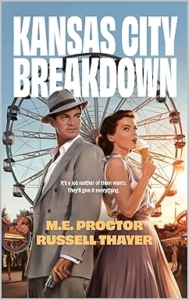
Virtual time travel is a lot safer. I’ll let my fictional characters deal with the turbulences. Tom and Vivian look pretty relaxed on the book cover of Kansas City Breakdown. Don’t let it fool you. These two are a pair of very cool customers.

Kansas City Breakdown

May 1952

Mobsters, molls, and muscle are meeting in Kansas City to carve out territory, make deals, assert influence. They come from Chicago, Dallas, New Orleans, Detroit … By plane, by car, and, in the case of mid-level heavy Mike Abati, by train from San Francisco. The FBI sees an opportunity. A chance to get close to the man, gather information, and have eyes and ears on the conference. A honey trap.

Tom Keegan, San Francisco PD homicide detective, knows the right woman for the job. She’s smart and cool. Seductive. Fearless. A rare and fiery combination of brass and sass. Would she agree to put her life on the line? If her cover is blown, she’s dead. Besides, Vivian Davis, aka professional assassin Gunselle, doesn’t do favors for cops. But Tom is doing the asking and it makes Vivian’s heart beat a little faster.

The job isn’t all it appears to be. It comes with a side of betrayal. Because, after all, a girl has to look out for herself.

Buy Link

~~~

M.E. Proctor was born in Brussels and lives in Texas. She’s the author of the Declan Shaw detective mysteries (Love You Till Tuesday and Catch Me on a Blue Day), two short story collections (Family and Other Ailments and A Book to Live By), and two co-authored retro-noirs with Russell Thayer (Bop City Swing and Kansas City Breakdown). Her fiction has appeared in various magazines and anthologies. She’s a Shamus Award and Derringer Award short story nominee. She can also be found on Substack.

Russell Thayer’s work has appeared in Tough, Roi Fainéant Press, Mystery Tribune, Bristol Noir, Shotgun Honey, Rock and a Hard Place Press, and Literary Garage among others. His novels include Bop City Swingand Kansas City Breakdown, co-written with M.E. Proctor. Russell received his BA in English from the University of Washington, worked for decades at large printing companies, and currently lives in Missoula, Montana. You can find him lurking on “X” @RussellThayer10.