
I Failed a Lie Detector Test
I’ve confessed this to only a couple of people, but I’m now making it public: I failed a lie detector lie detector (polygraph) test.
This happened in the early ’80s, when I was young and naïve—long before I began writing crime fiction. Back then, I believed lie detector tests were infallible. When I failed, I didn’t just feel embarrassed—I questioned my own sanity. Was I a chronic liar and didn’t know it?
Years later, as a mystery writer, I know better.
It started when a friend asked me to bartend Sunday nights at a pricey hotel in downtown Austin. Someone had quit without notice, and he was in a bind. I’d bartended in college, so I agreed to help.
There was just one catch: new employees had to take a lie detector test.
No problem, I thought. It might even be interesting.
It was—but not in the way I expected.
I was sent to a private company across town. My internal alarms went off the moment I saw the man who would administer the test. “Creepy” is putting it mildly. He had greasy, dyed-black hair, dirt under his fingernails, and a stained dress shirt unbuttoned halfway down, exposing a thicket of chest hair. Cheap rings crowded his fingers.

At the time, I didn’t yet have the instincts of a crime writer—but I had enough sense to feel uneasy.
When he took my hand to attach the sensors, I shivered.
The questions began.
Had I ever stolen from an employer? No.
Had I ever been convicted of a crime? No.
Had I ever taken illegal drugs? No.
Then he lingered on the drug question, circling back again and again, rephrasing it each time. Today, I’d recognize that tactic immediately—pressure the subject, unsettle them, look for physiological spikes. But at the time, I was simply confused.
Finally, he asked if I was currently using drugs. I said I’d recently taken antibiotics and occasionally used Motrin.
He moved on, then returned to the same line of questioning.
If I were writing this scene today, I’d have my detective note the repetition, the shifting language, the way the examiner controlled the rhythm of the interrogation. I’d build tension there—because that’s where it lives.
But back then, I was just irritated—and certain of one thing: I had told the truth.
The following Sunday, as I was getting ready for work, my friend called.
I had failed the test.
If this were fiction, that would be the inciting incident—the moment everything tilts. The innocent protagonist accused. The system revealed as flawed. The first crack in what’s supposed to be objective truth.
My friend told me not to worry, said I could come to work anyway, maybe even retake it later.
I told him not to bother. I wasn’t coming back.
Years later, after writing crime novels and researching investigative techniques, I learned what I wish I’d known then: lie detector tests don’t always detect lies. They detect stress.
And stress can come from many places:
- Anxiety
- Fatigue or illness
- Medication
- Confusing or manipulative questioning
- Even the examiner’s own bias
In other words, the very conditions designed to “find the truth” can distort it.
That realization changed the way I think about interrogation scenes. In fiction, a lie detector can be a powerful tool—but not because it reveals truth. Because it reveals vulnerability. Because it can be wrong.
And wrong can be dangerous.
I recently discovered that lie detector tests were actively used in courtrooms in the 1950s—the world of my Sydney Lockhart mysteries. Which raises a delicious possibility.
What happens when Sydney—sharp, observant, and far less naïve than I was—is strapped into that chair? When she knows the machine is flawed, but the people watching believe it isn’t?

That’s not just a test.
That’s a setup.
And in crime fiction, setups are where the real story begins. I can’t wait to put Sydney in this uncomfortable situation and then watch her wiggle out of it. She’d do a much better job than her creator.
Have you ever been falsely accused?

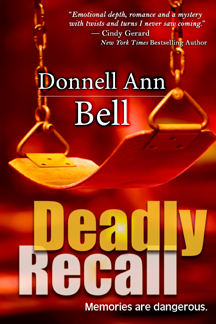
 What did he know? I remained steadfast in my belief I’d chosen the right antagonist for my story. Yet as my page count increased, reality intruded on my pipedream. I was a brand-new author; Donald Maass was an expert. I remember the precise moment I flipped the script and changed my killer’s identity. It was near the end of the book. To this day, I credit Donald Maass’s advice. Thanks to him Deadly Recall became a more cohesive and suspenseful story.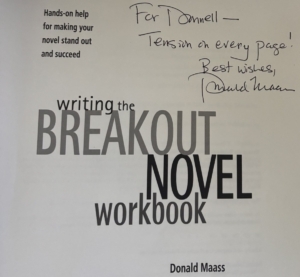

 Deadly Recall while you’re at it.” I’ll never forget when BelleBooks sent me an offer letter for both books. I had huge respect for Debra Dixon and Deborah Smith, both legends in publishing, and decided to accept. As a courtesy I wrote the New York editor with whom I’d submitted Walk Away Joe. All my rejection bruises seemed to fade when she wrote back, “Congratulations. This is our loss. I love Melanie and Joe.” FYI, Melanie and Joe are characters from the WAJ manuscript that BelleBooks/Bell Bridge Books subsequently renamed The Past Came Hunting.





 By Donnell Ann Bell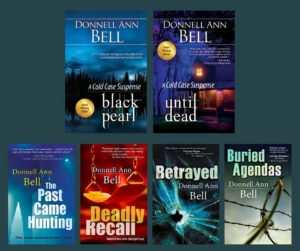
 Hanukah, when we’re all thrown together at friends’ parties and family reunions. Finding common ground where we can stand together may be difficult as we tiptoe around each other’s feelings after the election.
 I’ve recently heard that in Santa Fe, New Mexico there’s an annual Summer
  But what if we try to minimize the complaining and instead, focus on the positive things we can do to make life better for ourselves and others.
 We’re all in this together, come what may. Tomorrow is World Kindness Day. Maybe we could start with that.
 Gay Yellen is the author of the award-winning
 Last May, one barreled through two hundred miles of Texas, including our neighborhood. It tore through swaths of open landscape and mowed down houses and other buildings, leaving hundreds of thousands electricity customers in the dark.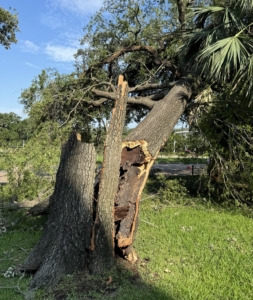

 Instead of wringing our hands over what is lost, or what may happen next, let’s celebrate the people and things that bring beauty to our lives today.
 By Donnell Ann Bell
 2019. My antagonist has escaped and he’s traveling on foot at night. Several issues crossed my mind while writing this scene, including: How will he get from Point A to his temporary objective of Point B when he faces all kinds of dangerous impediments? Namely, he doesn’t know the area or the terrain, all he’s wearing are the clothes on his back, law enforcement is in pursuit, he’s being tracked by a fellow escapee, and it’s dark!
 Before we jump in with our questions, Joel, please share a little bit about yourself.