
“Just One More Thing”
When you hear the phrase “just one more thing,” what comes to mind? If you were around in the 1970s, you probably remember Columbo, starring Peter Falk as Lieutenant Columbo of the Los Angeles Police Department. The series won 22 awards and received 68 nominations, with Falk earning four Primetime Emmy Awards. It aired on NBC from 1971 to 1978 and has since been rebroadcast on numerous networks.
What I liked most about the show was its structure: viewers knew the killer from the start and then watched Columbo patiently unravel the crime. Each episode featured a guest star as the murderer—Martin Landau, Janet Leigh, Ruth Gordon, Vincent Price, Roddy McDowall, Leonard Nimoy, even Johnny Cash, to name a few.
I recently rediscovered the series after making a practical—if slightly risky—decision: changing hairdressers after fifteen years. When I learned my husband’s barber had begun cutting women’s hair for less than half what I’d been paying, I decided to give her a try. I only needed a trim—no shampoo, no styling. The first visit took less than ten minutes, and I was pleased with the result.
On my most recent visit, I didn’t have an appointment. Four people were ahead of me, and I thought about leaving—until I noticed the television was tuned to Columbo. I stayed. The episode featured Ricardo Montalban as a matador in “A Matter of Honor.”
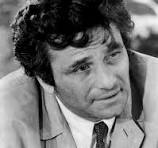
When Columbo arrives on a scene—hair rumpled, trench coat wrinkled, cigar in hand—he’s easy to underestimate. His suspects dismiss him as absentminded, even inept. But his polite, seemingly scattered questions are deliberate. Columbo is a meticulous strategist, noting every clue and quietly assembling the truth. He wears his suspects down with persistence, circling back again and again until—almost as an afterthought—he says, “Just one more thing.”
Alfred Hitchcock also used this technique in his movies Rope, Dial M for Murder, A Shadow of a Doubt, and Frenzy. His forte was suspense rather than surprise. The audience knows what happened as they watch the story unfold. Suspense builds tension, keeping the audience on the edge of their seats as they participate in solving the crime.
Back to my barber. I waited nearly an hour that day and didn’t mind at all. I was hooked as soon as Columbo began his investigation. I knew he’d solve the mystery, and I couldn’t wait to find out how he did it. Next time I need a trim, I may skip the appointment altogether. I’ll take a seat, request Columbo on TV, and bring my writing journal. I’ll study the master detective at work and take notes for the next mystery.
Have you ever written a reverse whodunnit?









Thanks for the nostalgia! I loved Colombo!
Columbo was is in a class of it’s own.
I haven’t, but it makes me think of Elsbeth
I haven’t watched Elsbeth, but I just checked it out. I’ll watch it tonight!
Thanks for the walk down Memory Lane, Kathleen! I haven’t seen Columbo since it originally stopped airing.
As for a reverse mystery, I think it would be quite the challenge in a cozy mystery. Making it even more so for me is that I write in first person. I’m not sure how that would work unless the opening scene was in omniscient or third person, and I don’t know how readers would feel about that.
I can see how it wouldn’t work writing it in 1st person.
I love Columbo and have the entire series on DVD (at our camp on the water, DVDs are about your only TV option). Peter Falk was brilliant in it — I cannot imagine anyone else in the role. Debra mentions Elsbeth, which I also enjoy (loved her in The Good Wife) though sometimes the show gets a little bit silly. Still Carrie Preston can “carry” it off.
I can’t imagine writing one like this, though.
I’m considering it, Judy. I haven’t decided yet.
Haven’t written suspense that way, yet. Thanks for bringing it up. Loved Columbo. What a character!
I think the series should be brought back. Who would play a great modern-day Columbo?
Such a fun reminder about Columbo, Kathleen! I haven’t watched it in a while but think I’ll see if I can find it. I’ve never done a reverse whodunnit but like Debra mentioned it did make me think about Elsbeth. Great post!
gd8kks