Guest Author Patricia Crisafulli

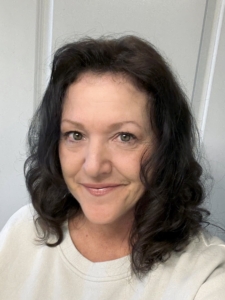
Today, we welcome bestselling and award-winning guest author Patricia Crisafulli. Her Ohnita Harbor Mystery Series launched in 2022 with The Secrets of Ohnita Harbor, followed in 2023 by The Secrets of Still Waters Chasm. Her latest in the series, The Secrets of the Old Post Cemetery, released last month. Find her at www.FaithHopeandFiction.com.

The Traitor’s Map: A Mysterious Artifact That Never Was

By Patricia Crisafulli

I can picture the scene so clearly: sitting in a sixth- or seventh-grade classroom in northern New York State and listening as the teacher told the story of a map dating from the American Revolution. It was a spy map, showing all the hiding places along the Lake Ontario shoreline.

The cartographer had carefully recorded every stream, creek, nook, cove, and marsh along a craggy beachfront. Here was where the Continental Army hid its boats; there was where they concealed a cache of weapons. But in an attack of conscience, the mapmaker changed his mind and altered the depiction of the landscape to make it worthless to the British.

From my preteen years until now, I’ve held onto the memory of the Traitor’s Map. When I began writing the third novel in my Ohnita Harbor Mystery Series, I couldn’t wait to research this map—to uncover its provenance, perhaps even find a picture of it.

Except it doesn’t seem to exist. No map matches the story I’d been told so many years ago. In fact, there’s no mention anywhere of a purposefully inaccurate spy map dating from the Revolution (though plenty of accurate ones). Every time I Google “Traitor’s Map” all I get are descriptions of my own novel—The Secrets of the Old Post Cemetery.

But trust me, the story of the Traitor’s Map feels like a memory of something so real, I can envision it clearly. And that’s a gift to me as a writer, making this artifact all the more authentic in my mind and I hope, in my novel.

The Story Behind the Artifact

As my protagonist, Gabriela Domenici—librarian, authenticator, and amateur sleuth—observes, artifacts are objects whose stories are waiting to be told. In fact, it’s the story that often makes an artifact valuable—who made it, owned it, cherished it, lost it, found it, stole it …

Each of my three mystery novels features an artifact. In the first book it’s a medieval cross; in the second, an early 19th century nautical schematic; and in the third, the Traitor’s Map. In the opening of The Secrets of the Old Post Cemetery, Gabriela, who is also teaching a class at the community college, takes a group of students to the local maritime museum for a first-hand look at this artifact that needs authentication:

She turned to the map, which had been drawn in ink on parchment the color of autumn leaves. A heavy line showed the shoreline, with indentations for coves and inlets, and a few spits of land that jutted out into the water … As Gabriela scanned the map, her chest swelled with excitement and longing, a feeling she associated with the most compelling artifacts and documents she’d handled throughout her career.

Given that the Traitor’s Map is apparently completely fictional, I needed to invent its backstory. And so I came up with the tale of two brothers—Colonel Jacob Thorsen, a commander during the American Revolution, and his brother, Henry, a mapmaker and spy for the British. When Henry was captured, it was Jacob who condemned him to death for spying—no matter that the map he handed over to the British was worthless. Henry escaped and faded into the footnotes of history. Jacob became an even bigger hero in the Revolution and then the War of 1812.

Conflict, political intrigue, betrayal—a story as old as time. And the Traitor’s Map stands as a symbol of that deceit and deception—through the centuries and the generations. And it’s mysteriously linked to the murder of one of Gabriela’s college students who had his heart set on unlocking its secrets. The fact alone leaves Gabriela inconsolable, with feelings of guilt that, had it not been for her assignment, the student never would have been killed.

And what of my own backstory of an old spy map that apparently never existed? Perhaps one day I’ll find evidence of the Traitor’s Map that substantiates what I heard (or at least think I heard) all those years ago. In the meantime, my fictional artifact can stand as a proxy.

The Secrets of the Old Post Cemetery

An Ohnita Harbor Mystery, Book 3

In this much-anticipated third book in the Ohnita Harbor Mystery Series, reuniting readers with beloved protagonist Gabriela Domenici, the smalltown librarian whose accidental sleuthing puts her on the frontlines of death and danger. At the heart of the mystery is the Traitor’s Map—a highly inaccurate spy map from the American Revolution. When Gabriela assigns the map as a research project to a group of college students, one of them is found murdered on the lakeshore—triggering a spiral of death and deceit that soon embroils Gabriela and the man she loves. The Secrets of the Old Post Cemetery tells a riveting story that explores love, betrayal, murder, and a chance for redemption.

Guest – Award-Winning Author – Catriona McPherson

Book Cover with Easter BasketToday we welcome back the lovely and uber-talented Catriona McPherson who has stopped by to share a bit about her soon to be released book, SCOT’S EGGS. Catriona is an Agatha, Anthony, Lefty, and Macavity Award-Winning Author.

And Kirkus Reviews says this book has it all: “a loopy, lovable Northern California crew … a baffling double murder … a brisk, clever whodunit

We can’t wait to hear about this latest book in the Lexy Campbell Last Ditch series. Take it away, Catriona! 

As Scot’s Eggs opens, it’s Easter morning and Lexy is finding out – yet again – that she’s not needed on the nest.

I love writing the Monster-of-the-Week plots, each one more ludicrous than the last, but even more than that I love writing the long arc of the character development for the Last Ditch Motel crew. Especially Lexy. I had her falling in love at Valentine’s and then marrying at the Midsummer Solstice, so it would have made sense to have her pregnant at Easter, season of fecundity, effulgence and general burgeoning.

But these are comedies, so instead I’ve made her beginning to worry that she’s left it a bit late and it might never happen. What’s funny about that, you might be asking. Well, for a start, Lexy’s best friend Todd has no boundaries. Here’s a scene from early in the book. Lexy is in the shower and Todd is . . . visiting:

‘And . . . don’t get all uppity and start telling me I’m overstepping,’ Todd said, ‘but I don’t think you should assume it’s you. I’ve seen Taylor’s underwear. I mean, I tried to block it out for crimes against style but also it’s not healthy. So I’ve put some super-drapey satin boxers in his top drawer and removed the offending items. But still, you should send him to have a sperm test.’

‘He’s twenty-nine,’ I said. ‘I’m thirty-seven. And what on earth made you think I’d see this as over-stepping?’

‘Oh,’ said Todd. ‘Well, good. I just never know with you. But to your main point. Investigating your fertility is invasive and expensive. Given that your cycle is regular and you’re tuned into it, and given that Taylor can find out how his guys are after ten fun minutes with a magazine, it makes sense to dot that i first.’

‘And you’re basing the notion that my cycle is regular on . . .’

‘The fact that I gave you a link to an ovulation app months ago and you would have told me if it wasn’t.’

‘Right,’ I said, turning off the water. ‘No overstepping there.’

Also, I’ve got a lot of experience of infertility, and black humour was essential to counteract the hormones and disappointment. My God, those hormones. There was a time when my dad and I were taking exactly the same cocktail, he to treat prostate cancer and I to get to a baseline and let the doctors start with a clean slate. We were each as touchy and weepy as the other. If my mum and my husband hadn’t been able to laugh they’d have beaten us to a pulp and gone out drinking. In the end the treatment kept my dad healthy for over twenty years. Me? Nine rounds of IUI/IVF after which I had no kids and no money. See? Black humour is the only way.

But the thing I really needed jokes for was to do battle with people’s cluelessness. Some of it was kindly meant. “Get yourself a great big rose quartz crystal” was one I’ll never forget. “Okay,” I said. “And do I still need Neil? Or will the crystal do everything?”

“Oh my God, I get pregnant if he looks at me across the room!” was harder to believe came from a helpful place. How did I deal with that one? Once I said, “Ah well, nobody gets everything.” And then left them wondering what I thought they lacked. Another time when I said nothing at all in response to a near stranger gloating about her good luck and my bad, she followed up with “Sorry. I just say whatever I’m thinking.” “Not me,” I told her. “I’m not saying anything close to what I’m thinking, right this minute.” Someone else at the party choked on their drink trying not to laugh, which helped.

Isn’t it weird? The only other thing I’ve come across that makes people boast about their superior fortune is insomnia. Ever noticed that? If someone says they have trouble sleeping, it’s the cue for someone else to say, “Oh I’m gone as soon as my head hits the pillow. I could sleep on a knife.” It’s a wonder no one ever asks them to prove it.

Imagine if that happened with breast cancer. “I’ve just had a double mastectomy.” “Ho-ho, not me. Look at these puppies!” To quote Bill Murray in Groundhog Day, “People eat blood sausage, Rita. People are morons.”

But the most frequent clueless remark encountered when you’re childless not by choice is . . . Can you guess? I’ll give a clue. I seriously considered writing a little etiquette book called Yes, We’ve Considered Adoption. It was wild the number of women – always women – who truly believed they’d solved a fertility problem for me, five minutes after meeting me at a party or other event. I composed a range of responses:

“Adoption? Oh my God! You’re a genius. Excuse me, I need to go and tell Neil.”

“We did adopt once but they were ugly so we sold them.”

“We failed the screening process.”

That last one was particularly ideal if their children were running around. And you know what really stewed my prunes? If there were men present, the subject never came up. In fact, Neil has never been asked a follow-up question to the “Do you have kids?” opener in his jammy wee life. Hmph.

Anyway, I found it just as much fun to write Lexy’s conception woes as I thought I would. All I need to do now is toss a coin and decide whether it’s going to work out for her or if she’s going to go down the same road as me. I must admit, it wasn’t fun and chuckles right to the end. Maybe I’ll knock her up. It’s nice to be in charge, I must say.

A bit more about the book:

It’s egg-hunt season, but Lexy’s spending Easter hunting a killer!

Not even Cuento’s Easter bonnet parade can distract Lexy Campbell from fertility woes and missing tourists Bill and Billie Miller. The Millers’ vintage Mustang has been abandoned, its interior covered in blood.

Is this a double murder, and if so, where are the bodies? Why were the Millers spending the night in their car? Did they pitch up at the Last Ditch Motel only to be turned away? Are they really dead? Trinity for Trouble are on the case!

As they start to identify the guests staying at the motel the weekend before Easter – including a Goth and a barbershop singer on stilts – disturbing evidence comes to light. Can Lexy see though all the deception to unmask the truth and save the Last Ditch?

Reminder: The book comes out December 2nd but is available for pre-order now. 

Photo author Catriona McPhersonAnd bit more about Catriona:

Catriona McPherson (she/her) was born in Scotland and immigrated to the US in 2010. A former linguistics professor, she is now a full-time fiction writer and has published: preposterous 1930s private-detective stories about a toff; realistic 1940s amateur-sleuth stories about an oik; and contemporary psychothriller standalones. These are all set in Scotland with a lot of Scottish weather. She also writes modern comic crime capers about a Scot-out-of-water in a “fictional” college town in Northern California sneezedavissneeze.

Catriona is a proud lifetime member and former national president of Sisters in Crime.

For more about her and her books, check out her website at:  www.catrionamcpherson.com


How a Real-Life “Diamond Dog” Sparked CB Wilson’s Next Cozy Dog Mystery Series

Guest post by CB Wilson

As the author of a long-running cozy dog mystery series, I’ve learned to keep my radar tuned for anything canine. I devour dog-related articles—not because I plan to use every tidbit, but because I know that one day, something will leap off the page and knock my socks off.

Sure enough, about a year ago, a reader emailed me a headline that stopped me in my tracks: Diamond Dogs. Real, live dogs trained to sniff out diamonds buried as deep as fifty feet underground. No kidding. My head nearly exploded with ideas.

The timing couldn’t have been better. Truth be told, I’m a bit of a blingaholic. Long before I started writing mysteries, I studied gemology and earned my degree from the Geological Society of America. I’ve always wanted to write about diamonds. I’d slipped a few into the Barkview Mysteries—lost stones popped up in books four, five, and six—but it never felt like enough sparkle.

Then came the article.

Imagine it: a dog that works like a living, wagging metal detector, sniffing out missing gemstones on a beach or in a park. Anyone who’s ever lost a diamond because of a broken prong knows the heartbreak. With a dog like that, you could make a fortune—or stumble into a world of secrets best left buried.

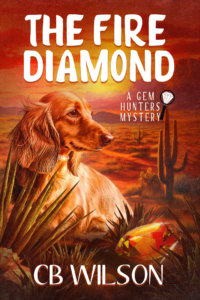
Within fifteen minutes, Glimmer the diamond-sniffing dachshund was born. Alongside her came a new heroine: a diamond investigator with a family history that includes a notorious jewel thief. Together, they stepped into a fictional Arizona mining town filled with danger, intrigue, and just the right amount of cozy charm.

That was the moment The Gem Hunters Mysteries took shape—a blend of sparkle, suspense, and of course, an unforgettable dog.

Because in my world, every diamond has a story … and some are worth killing for.

Glimmer, the Diamond Dog, is no ordinary dachshund. With her silky, long hair and sharp instincts, she has an extraordinary gift—she can sniff out diamonds buried deep underground. Serious and focused when on the job, Glimmer is the loyal partner of diamond investigator Taylor Hunter. Together, they unravel mysteries where every gem holds a dangerous secret. Fiercely devoted and brilliantly skilled, Glimmer proves that even the smallest detective can make the biggest discoveries.

Glimmer is an Influencer with her own social media on Facebook and Instagram. Follow Glimmer for a chance to win a signed book.

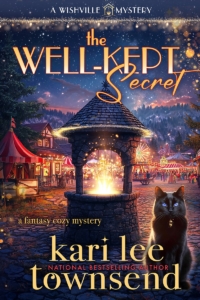
The Fire Diamond

Every diamond has a story… but some are worth killing for.

When Sunset Peak’s legendary Peak Diamond disappears during the town’s glittering centennial gala, Taylor Hunter knows one thing: this was no ordinary theft. As a renowned “Diamond Detective” and reluctant heir to a family legacy of jewel thieves, Taylor has solved high-profile cases around the globe—but this time, it’s personal.

The stakes spiral when a perfect replica of the diamond is found, a notorious diamond broker turns up dead, and her twin sister Hope’s fingerprints are discovered at the crime scene. With Sunset Peak’s future—and her sister’s freedom—on the line, Taylor must partner with the one man she swore she’d never trust: Police Chief Rocky Rockman, her ex-husband’s dangerously charming best friend.

Armed with her expertise, her sharp instincts, and Glimmer, her diamond-sniffing dachshund, Taylor races to unravel a tangled web of stolen gems, buried secrets, and hidden betrayals stretching far beyond her small Arizona town. But someone is willing to kill to keep the truth buried—and if Taylor’s not careful, she could be their next target.

Perfect for fans of Janet Evanovich, Ellery Adams, and Jenn McKinlay, The Fire Diamond is a fast-paced cozy adventure mystery where family secrets cut deep, small-town gossip hides deadly truths, and every diamond comes with a price.

~*~

Award-winning author CB Wilson began her writing journey with a childhood rebellion—after finishing a Nancy Drew mystery, she decided she could write a better ending.

A passionate animal advocate, she created the beloved Barkview Mysteries, blending her love of puzzles and pups. Her newest series, Gem Hunters, shines with adventure. Drawing on her Gemology degree from the prestigious Gemological Institute of America, CB weaves authentic sparkle into every page, featuring an extraordinary “Diamond Dog”—a clever Dachshund named Glitter who can sniff out diamonds fifty feet underground.

Her most creative ideas strike while horseback riding through Arizona’s desert trails. When she’s not plotting twists, CB enjoys pickleball and indulging her chocoholic side, convinced the best stories—like the best chocolate—are meant to be savored slowly.

Learn more about CB and her books at her website, where you’ll find links to her other social media.

What Do the Girls Have to Say About the Guy?

A Guest Post by Author M.E. Proctor

Ten years ago, when the character of Declan Shaw, a Houston PI, popped into my head, I didn’t give a second thought to the fact that I’d just committed myself to write, from a male perspective, what could become a series. It didn’t bother me. I wanted to try my hand at a detective story featuring in the main role a bruised romantic shamus, a classic updated for the 21st century.

I completed a first manuscript (full disclosure: that attempt will never be published; it was a trial run) and gave it to my husband. He’s a brilliant writer and my first beta reader. He said he enjoyed the story and proceeded to criticize it down to the bone. It’s good to have a fierce reviewer at home; once you’ve cleared that hurdle there’s nothing the world can throw at you that’ll make you flinch. He picked up two dialogue excerpts and commented: “A guy would never say that.”

Out of a 300-page story, I thought that was a pretty good score. It also made me aware of the stumbling blocks that our subconscious takes pleasure in throwing in our path. Note to self: Guys don’t giggle, unless they’re Tommy Udo and about to push a lady down the staircase. Not the mood I was going for … I fixed the dialogue and toughened it up.

We’re quite a few years later now. I have a ton of short stories under my belt, a retro-noir novella written in collaboration (Bop City Swing) where I take the part of the hardboiled cop and my writing partner, Russell Thayer, is in the female assassin’s head, and two Declan Shaw novels. Girls or guys, pumps or brogues, I’ll slip into the shoes the story calls for.

Except …

In Catch Me on a Blue Day, Book 2 of the Declan Shaw series, my PI gets very close and very personal with Isabel, a cute art gallery manager.

I’ve written quite a few seduction/sex scenes and I’m not new to the challenge, but the story required this one to jump higher in the temperature range than I’d gone before. I could have written it from Declan’s point of view—there’s another scene with Isabel in the book that gives him quite a kick—but for this particular one, I thought I could do more from the girl’s perspective. It’s a decision that changed the structure of the book.

The Declan stories are mostly told from his standpoint. Secondary points of view come into play, out of narrative necessity (for example, I put him in the ICU in Book 1, Love You Till Tuesday, and the plot couldn’t remain frozen for a week).

In this case, changing the angle to Isabel gave me an opportunity to put a different light on the main character, and reveal things about him that would never have surfaced otherwise. He’s a very controlled guy and she pushes his buttons so hard he loses his footing.

Next to Isabel’s star turn, I also gave voice to two other female characters who play a major role in the story. They form the other points of a triangle with Declan in the middle, in the crossbeams, and they balance the narrative.

The first one is Jean. She’s old enough to be his mother and would love to slip into a protective role. She does it, in a harrowing scene, and Declan accepts her help, but he remains reticent and unwilling to let her in too close. She sees herself as a nest builder, and he is a drifting soul. Their alliance can only be temporary.

The second one is Kate, close in age to Declan and Isabel. Fiercely independent, wary of emotional entanglements, and dealing with a troubled past. Her sister was murdered thirty years ago, a death that destroyed the family. Kate never knew the girl; she was only two at the time. She doesn’t open up to people easily, and her trust is hard to win. She’d like to see Declan as some noble defender, but he’s a bit wobbly.

Seen through the eyes of these three women, Declan’s character gains new dimensions.

I enjoyed trading his cowboy boots for Isabel’s sandals, Jean’s sensible shoes, and Kate’s wellies … for a little while.

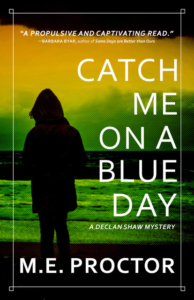
Catch Me on a Blue Day
A Declan Shaw Mystery, Book 2

“For Ella and all the innocents slain by soulless men.”

It’s the dedication of the book on the Salvadoran civil war retired reporter Carlton Marsh was writing before he committed suicide.

A shocking death. Marsh had asked Declan Shaw to come to Old Mapleton, Connecticut to help him with research. He looked forward to Declan’s visit: “See you at cocktail time, a fine whiskey’s waiting.” They talked on the phone a few hours before the man put a bullet in his brains.

Now Declan stands in the office of the local police chief. The cop would prefer to see him fly back to Houston. He’s never dealt with a private detective, but everybody knows they are trouble. If only there weren’t so many unanswered questions around Marsh’s death … the haunting first three chapters of his book, and that dedication to Ella, a girl whose murder thirty years ago brought the town to its knees.

In Catch Me on a Blue Day, Declan is far from his regular Texas stomping grounds. He’s off balance in more ways than one, and the crimes he uncovers are of a magnitude he could not foresee.

Between the sins of an old New England town and the violence of 1980s El Salvador. And the links between the two.

Buy links

paperback

ebook

~*~ 

M.E. Proctor was born in Brussels and lives in Texas. She’s the author of the Declan Shaw detective mysteries: Love You Till Tuesday and Catch Me on a Blue Day. She’s also the author of a short story collection, Family and Other Ailments, and the co-author of a retro-noir novella, Bop City Swing. Her fiction has appeared in anthologies and magazines like VautrinToughRock and a Hard PlaceBristol NoirMystery TribuneReckon Review, and Black Cat Weekly among others. She’s a Shamus and Derringer short story nominee.

Eight Things I Didn’t Realize About Starting a Second Series

Welcome guest blogger James M. Jackson! Jim is a terrific author, editor, publisher, teacher, and friend. Congratulations on your new series. May it rival Seamus McCree’s success! Best wishes, Paula Gail Benson 

By James M. Jackson

James M. Jackson

Tomorrow marks a milestone I’ve been working toward for months: the official publication of Niki Undercover, the first book in my new “Niki Undercover Thrillers” series.

After publishing eight novels and two novellas in my Seamus McCree series, I thought launching a second series would be straightforward. Back in May, the timeline seemed generous—Book 2 (Niki Unleashed) releases November 11, 2025, and Book 3 (Niki Unbound) follows in 2026. How hard could it be, given Book 1 just needed a final polish and Book 2 one more draft?

Turns out I should have consulted my fellow Stiletto Gang authors first. The non-writing work required to launch a new series caught me off guard. Here are eight lessons I learned the hard way.

  1. Your Brand Must Evolve (Whether You’re Ready or Not)

My tagline “Thrillers with a twist of financial crime” perfectly captured what made the Seamus McCree series unique. But Niki’s world doesn’t revolve around financial crime, which meant my carefully crafted brand had to go.

The visual brand needed an overhaul too. Seamus’s lighter colors and outdoor scenes reflected his good-guy nature and rural settings. Niki demanded something darker—she’s more domestic thriller territory.

After brainstorming with my newsletter readers, I landed on “Justice-driven thrillers with brains & bite.” The process was more emotionally challenging than I had expected. Letting go of a brand you’ve built over years feels like losing part of your author identity.

  1. Title Strategy Becomes a Chess Game

I’ve always called myself “the poor man’s Sue Grafton.” While she used the alphabet overtly (A is for Alibi, B is for Burglar), I took a subtler approach with Seamus: Ant Farm, Bad Policy, Cabin Fever. Readers loved the pattern.

For Niki, I wrestled with Niki Un________ as the framework. Should I continue with the alphabetical approach? It looks nice on a bookshelf by maintaining series order, but ultimately, I decided that constraint would box me in. Sometimes the best title strategy is the one that serves the story, not the shelf.

  1. Spinoff Series Are Continuity Nightmares

Here’s where things got complicated. My self-imposed rules created complications:

  • Stories occur in real-time and real places.
  • Characters age naturally.
  • Niki appears in several Seamus novels.
  • Shared characters cross between series.
  • The first two Niki novels happen before the most recent Seamus books.

This meant maintaining both internal consistency within the Niki series and external consistency with existing Seamus books. My ad hoc approach to creating a series bible meant I spent countless hours recreating character timelines and fact-checking details across both series.

The backstory challenge was equally tricky. Longtime readers know Niki well, but newcomers meet her fresh. I had to satisfy both audiences without confusing the new readers or boring the faithful fans.

  1. Established Characters Don’t Step Aside Gracefully

For over a decade, Seamus McCree has commanded center stage. Even in multi-POV novels, he dominated at least 75% of the narrative. But in Niki’s series, he’s supporting cast.

In early drafts, Seamus tried to steal every scene he entered. The man has presence; I’ll give him that. During rewrites, I had to establish new rules: no Seamus POV scenes, and he only appears when he can teach Niki something unique or raise stakes in ways only he can.

Learning to sideline your protagonist is harder than creating new characters from scratch.

  1. Beta Readers Need Fresh Eyes

For Seamus books, I recruited beta readers from my newsletter subscribers, mixing series veterans with newcomers. But since attracting new readers is a primary goal for Niki’s series, I needed predominantly fresh perspectives.

I partnered with Pigeonhole, paying them to provide an early draft of Niki Undercover to fifty readers who’d never encountered my work. Pigeonhole serialized the novel into ten daily segments, allowing real-time feedback and reader discussions.

I found the process very useful. Early feedback revealed that my opening scenes presented Niki as too harsh. While she can be tough, that’s only one facet of her personality. I rewrote those crucial first chapters to show her full complexity.

Unfortunately, Pigeonhole closed before Niki Unleashed. Fortunately, I could use newsletter subscribers who hadn’t read the first book to test whether the sequel stood alone.

  1. Your Website Architecture Crumbles

Adding another series to a Seamus-centric website wasn’t just about updating a book list. The entire user experience needed redesigning.

Potential readers interested in Niki needed different entry points, navigation paths, and information than Seamus fans. Reading order becomes crucial. Character introductions require separate approaches.

Since I hadn’t thoroughly updated the site in years, I simultaneously tackled modern web protocols. After countless hours, I’m finally approaching the finish line on the complete redesign.

  1. Cross-Promotion Is a Full-Time Job

Most readers never visit author websites. They discover new books through “Also By” pages in the books they’re already reading. For each new Seamus book, updating these pages was simple—add the new title to the end of the list.

Adding a second series required reformatting these pages. With eight novels, two novellas, four boxed sets, and multiple retailers, I’d forgotten how time-consuming it is to update and upload each version to the correct platform.

Each format (paperback, eBook, audiobook) needs updating across multiple retailers. Multiply that by ten books, and you’re looking at more than 100 uploads.

  1. Your Author Bio Lives Everywhere (And I Mean Everywhere)

I made the rookie mistake of not maintaining a master list of where my bio appears. Forgetting to update a few bios for a new Seamus book was annoying but survivable—at least people knew about the series.

But failing to mention the Niki series anywhere would be catastrophic.

Every book’s back matter needed updating. Each retail site has different word count requirements, necessitating multiple versions. My website, social media profiles, guest blog bios, and writing organization profiles all needed refreshing.

The scope was massive. Author bios lurk in more places than you realize until you’re frantically trying to update them all.

The Reality of Modern Publishing

In a mythical world, exceptional writing would be enough to attract readers. Quality would speak for itself, and much of these eight tasks would be unnecessary busywork.

In the real world, marketing isn’t optional. Every step I’ve outlined—and many more—is crucial for a series launch to succeed.

As Niki Undercover officially releases tomorrow, I’m both exhausted from the preparation and excited for readers to meet this complex, driven character I’ve grown to love.

Wish Niki and me luck.

Short Biography:

After earning earning a B.S. in Mathematics with minors in Education and Psychology, Jim worked for thirty years as a consulting actuary and earned an MBA from Boston University. He retired early to pursue fulltime writing. Among his work is a nonfiction book on bridge for intermediate players, One Trick at a Time: How to start winning at bridge; the Seamus McCree series that to date consists of eight novels (Ant FarmBad PolicyCabin FeverDoubtful RelationsEmpty PromisesFalse BottomGranite Oath, and Hijacked Legacy), two novellas—Furthermore and Low Tide at Tybee—and several short stories; and the Niki Undercover Thrillers, an offspring from the Seamus McCree novels. Characters in both series age in real time and the two series share some characters. The first two novels of the Niki Undercover Thrillers—Niki Undercover and Niki Unleashed—take place before Granite Oath, and the last, Niki Unbound, occurs after Hijacked Legacy. Jim blogs with WRITERS WHO KILL and his website is Home Page of Author James M Jackson.

Guest Author M.E. Proctor Bops into Historical Fiction Waters

Bopping in Historical Waters

By M.E. Proctor

When I was a kid, I wanted to be an archeologist. I had romantic notions about digging in the Valley of the Kings, excavating the ruins of Troy, or following Percy Fawcett in his search for the lost city of Z—David Grann’s book had not been published yet or I would have known that was a no-no … the critters … yikes.

Adventure books contributed to my vocabulary (quirky), grasp of world geography (off the beaten track), and crossword cracking (obscure). They also developed a long-lasting interest in history. To this day, these are the bookshop shelves I go to first. Logically, I should write historical fiction instead of contemporary crime.

I know why I don’t. The problem is twofold.

First, I’m an impatient obsessive. It’s not as contradictory as it sounds. A few months ago, I wrote a piece for an anthology. The story takes place in 1640 C.E. in Ireland. I spent two months hopping from one rabbit hole to the next, gathering documentation, deeper and deeper. All for what ended up being a 6,000 words story. That’s the obsessive in me. Imagine what would happen if I decided to write a book. My impatient self shivers at the thought. Forty months of research? Before writing the first line? The historical fiction writers reading this will probably say that it isn’t that bad, that once the material is assembled the sailing is smooth, or that I need to be more focused, more organized in the search.

That’s where my second problem kicks in. I’m curious. If something smells good in that rabbit hole, I’ll go for it. What happened in that place a hundred years before, or a hundred years later? What about this character? I don’t picture historical research as an academic pursuit. To me, it’s the most tempting of candy stores, a place of delights where I want to pitch my tent and stay. I might never put a line on paper.

And that’s why I will never write a historical fiction book.

Yet, Bop City Swing is out in the world.

I was tricked.

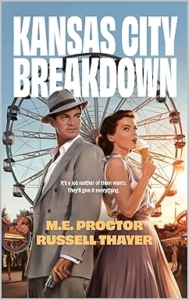
Russel Thayer contacted me last year and suggested we write a short story in collaboration. We had both published pieces set in California in the 1940s and 50s, classic crime, inspired by the ‘noir’ movies we both love. His recurrent character is gun-for-hire Vivian, nicknamed Gunselle, and I had stories with SFPD homicide detective, Tom Keegan. Let’s bring them together. We didn’t think it would turn into a book.

I didn’t consider 1951 ‘historical fiction’. It isn’t a hundred years old—the marker for antiques—and women’s skirts didn’t sweep the floor, a visual cue that says ‘costume drama’.

Russell and I talked about plot and locations, decided to build the story around a political assassination, didn’t know what would happen next, and started writing.

The need for research became obvious right away. We needed an election year in San Francisco. That set the date, 1951, when incumbent mayor Robinson ran for a second term. We also needed a realistic scene for the crime and chose the Palace Hotel, still standing downtown. A stroke of luck delivered period-accurate floor plans. We didn’t know it yet, but these plans would be critical for the plot. We also gathered city maps and photographs.

Compared to my excursion to the 17th century, none of the work done for Bop City Swing was time-consuming, and the rabbit holes were few. Because we let the plot and the characters dictate the story. When we bumped into an anachronism or a historical impossibility, we adjusted the narrative. Minor modifications: change of address, different music selection. Ironically, the trickier part was shedding some of the language flotsam movies left behind. In the final draft, period slang and hardboiled expressions that leaned too much into Chandlerian back alleys were cut. They’re period-correct, but 2025 readers might blink.

Bop City Swing is neither an homage nor a pastiche, its ambition is just to be a damn good crime story. Historical? Maybe.

Bop City Swing

San Francisco. 1951.

Jazz is alive. On radios and turntables. In the electrifying Fillmore clubs, where hepcats bring their bebop brilliance to attentive audiences. In the posh downtown venues where big bands swing in the marble ballrooms of luxury hotels.

There the story begins, with the assassination of a campaigning politician during a fundraiser.

Homicide detective, Tom Keegan, is first on the scene. He’s eager, impatient, hot on the heels of the gunman. Gunselle, killer for hire, flew the coop, swept away in the rush of panicked guests. They both want to crack the case. Tom, because he’s never seen a puzzle he didn’t want to solve, no matter what the rules say. Gunselle, because she was hired to take out the candidate and somebody beat her to it. It was a big paycheck. It hurts. In her professional pride and wallet.

Buy links

M.E. Proctor was born in Brussels and lives in Texas. The first book in her Declan Shaw PI series, Love You Till Tuesday, came out from Shotgun Honey, with the follow up, Catch Me on a Blue Day, scheduled for 2025. She’s the author of a short story collection, Family and Other Ailments, and the co-author of a retro-noir novella, Bop City Swing. Her fiction has appeared in VautrinToughRock and a Hard PlaceBristol NoirMystery TribuneShotgun HoneyReckon Review, and Black Cat Weekly among others. She’s a Derringer nominee.

Website: www.shawmystery.com

Substack: https://meproctor.substack.com


Russell Thayer’s work has appeared in Tough, Roi Fainéant Press, Mystery Tribune, Close to the Bone, Bristol Noir, Cowboy Jamboree Press, Shotgun Honey, Rock and a Hard Place Press, Revolution John, Punk Noir Magazine, Expat Press, The Yard Crime Blog, and Outcast Press. He received his BA in English from the University of Washington, worked for decades at large printing companies, and lives in Missoula, Montana.

The Secret to Her Success

I’m delighted to welcome a remarkably prolific author to the Gang as our guest today. Pamela Fagan Hutchins and I met early in our writing careers. Since then, she has published upwards of 30 books, mostly novels (award-winning romantic mysteries, a couple of children’s books, and some non-fiction, too). Lately, she’s been turning out some modern tales of Western adventure.

The secret to her success? To my mind, it’s that she spins new tales faster than a bullet train, and that her stories engage readers with heart and humor.

Here is her latest OMG work schedule, in her own words:

I’m lucky that I write fast, type fast, and no longer have kids at home or a job outside of writing. I also believe that writing is something you can get more efficient at over time.

After thirty-two novels and seven nonfiction books, I’ve had a lot of practice!

But I am firm about sticking to set writing hours and setting word and page count goals to keep me focused. I eliminate most distractions, and I reward myself frequently… lots of snacks!

Way back in 2020, my agent challenged me to write Big Horn, the Jenn Herrington Wyoming mystery that ultimately won me a publishing contract with Hachette UK’s Bookouture. But my editor wanted me to change it substantially or write a different book. I was happy with Big Horn just how it was. I opted to publish it myself and write a Detective Delaney Pace novel for Bookouture.

Two things happened. First, Big Horn slayed and kept slaying for two solid years. Meanwhile had to write three Delaney Pace books and one Patrick Flint family adventure mystery during the year after Big Horn came out. And move to Denmark for my husband’s work. Then Bakersfield. Then France. Have two foot surgeries. Welcome my first two grandkids.

Ya know—life stuff.

Despite Big Horn having had the best release of any book I’d ever written—better than Delaney Pace did, originally, although it’s picked up a lot of steam!—I did not get the follow-up book out for 18 months. In indie publishing terms, that’s a century. And I had a heck of a time pulling myself out of Delaney’s and Patrick’s worlds and back into Jenn’s.

But I’d already outlined five follow-up books while I was writing Big Horn. So, the book I rolled out next was Walker Prairie. It had the planned plots and subplots and the same gritty-but-kinda-cozy feel which some people love.

Between the time I outlined Walker Prairie (2021) and when I wrote it (2024), I acquired two Alaskan Malamute sled dogs, Willett and Sibley! They seemed like the perfect lighthearted addition to Jenn and Aaron’s world, so I wrote them in, and just like in real life, they proceeded to WOO and HOWL and JUMP AROUND until they’d pretty much hijacked the book. The plot remained the same, but the adventure elements surrounding the climactic scenes changed to feature two beautiful, often-naughty, and occasionally terrifying FLOOFS (my term for fluffy goofs.)

So, whether you pick up Walker Prairie because you’re dying to read about or continue with Jenn, her veterinarian husband Aaron, her legal associate Kid James, and Jeremiah Johnson (the loveable skunk), or because you love gritty-cozy romantic legal thrillers, or Wyoming mysteries, or just love books with FLOOFS, I am delighted that the wait is over and Walker Prairie is finally here.

And I love the book! You can get your copy here:

USA Today bestselling author of the Detective Delaney Pace series / Host of Crime & Wine / Silver Falchion Best Mystery Winner

Published by Bookouture/Hachette UK and SkipJack Publishing

Thanks for stopping by, Pamela!

Gay Yellen’s writing career began in magazine journalism. She served as the co-writer/editor for the international thriller, Five Minutes to Midnight (Delacorte), a New York Times “New & Notable.” The success of that book led to her first romantic mystery, The Body Business, Book 1 of the Samantha Newman Mystery Series. The Body Next Door soon followed, and The Body in the News in 2023. The series has won multiple awards, including a Readers’ Favorite Mystery / Chanticleer Mystery & Mayhem 1st Place / InD’Tale Crowned Heart for Excellence / Silver Falchion Finalist/ and an American Legacy Best Cozy Award. https//:GayYellen.com

What I Learned When My House Burned Down

I had a post all ready for this month’s blog. Then I opened my friend’s newsletter. After I read something that I consider much more poignant and timely, I asked if I could share. Please welcome Barbara Nickless to The Stiletto Gang. ~ Donnell

Author Barbara Nickless

Friends have called to ask if I’ve been triggered by the fires in Los Angeles. In short, yes. It’s an unsettling fact that more people than ever live in fire-prone areas known as wildland urban interfaces. With L.A. on everyone’s mind, I want to share what I learned when my home of twenty-two years burned down in a wildfire.

When I lost my home in Colorado’s Waldo Canyon Fire of 2012, I went—in the space of hours—from being a middle-class, tax-paying suburbanite to one of the shell-shocked homeless. Overnight, I found myself needy, helpless and so bone-deep tired I suspected a solid year of sleep wouldn’t fix it. Like anyone grieving or in pain or simply raw from the public weight of it all, what I wanted was the one impossible thing: to go home.

I passed through the classic stages of grief: denial, anger, bargaining, depression and acceptance. Some stages, like anger, were brief. Others lingered for years, depression and bargaining looping back in unwelcome refrains. Denial reappeared, too, a kid poking her tongue in the place where there used to be a tooth, surprised by the emptiness.

But tragedy’s sharp-edged gift is that it brings unexpected growth. Pain reshapes us, expanding our capacity for understanding and wisdom. Here are a few things I’ve learned—and am still learning—about loss.

  1. Losing your home isn’t about karma or offending God or not packing well or living in the wrong place. It’s just life, and life is capricious.
  2. Do your best to eat regularly. Exercise. Go to bed at a reasonable time. As soon as you can, resume your regular pleasures—TV shows, books, coffee with friends, NPR on the radio. If you don’t yet have a TV or books or a radio, go to a friend’s house.
  3. When you start to run down that mental list of everything you lost, stop.
  4. Take comfort in knowing you may go the rest of your life without having to purge your closets. In a land where public storage is a multi-billion-dollar business, this is no small thing.
  5. When a friend complains about his junk drawer, smile and ask, “What’s a junk drawer?”
  6. Aunt Matilda’s bean pot. You hated it. Now it’s gone. And you don’t even have to lie about it.
  7. You have more friends than you realize. The ones who show up at the door of your hotel/rental/friend’s house/car (God bless you) with hiking boots or plates or a set of towels might not be the ones you expected. Tell them you love them.
  8. In fact, tell all your friends you love them. Life is capricious (see above). Don’t wait.
  9. You cared more about those stupid love letters and track ribbons and dorky high school pictures of yourself in big hair and platform shoes than you realized. That says wonderful things about your capacity for humor and self-love.
  10. Your mother will forgive you for losing her mother’s pearls. Your father will forgive you for losing his WWII pilot’s jacket.
  11. A home—not a house—is about emotional resiliency. Put your energy there. Have dinner with your family as often as you can. Kiss your loved ones morning and night. Listen to your kids when they want to talk. And if you are lucky enough to still have a mother, return her phone calls.
  12. It’s okay that you’re not okay. One day you’ll catch yourself laughing, and you’ll realize you’ve made it through the worst.

My heart goes out to everyone who lost their homes in L.A. If you want to take action, here’s how you can help:

  • Give to World Central Kitchen, which is providing meals to communities in Southern California.
  • From the Red Cross: “Help people affected by wildfires in California in 2025 by visiting redcross.org, calling 1-800-RED CROSS (800-733-2767) or texting the word CAWILDFIRES to 90999 to make a donation.”

About Barbara’s latest release: 

The Drowning Game has been named Best Book of 2024 by WRBH Reading Radio. “Although a difficult decision with so many good books, the winner of the 2024 WRBH Writers’ Forum Book of the Year Award is Barbara Nickless for The Drowning Game.” A huge thank you to the Writers’ Forum on WRBH!

“Ms. Nickless continues to be one of our best action/mystery writers. Her deep dives into her subject matter and smooth narratives always guarantee a great experience. Following Nadia down the twists and turns of international industrial espionage and spy craft is a thrilling ride, made more enjoyable by the interior monologues and richly drawn characters. More, please.”

–Amazon Reviewer

Special Guest: Winter Austin

by Sparkle Abbey

Today we welcome our friend and fellow Iowa author, Winter Austin! We have some questions for her but before we get started with those, Winter, please share with our readers a little bit about yourself. 

photo of author Winter Austin

I wear many hats; Author, Veteran’s Wife, NG-Army Mom, Awesomest Aunt Ever, Goat & Cattle Wrangler, Fluffy Velociraptor Herder, Dog Mom, and All-Around Butt-Kicker. I’m a long-time resident of the Midwest, mostly living in Iowa, with a decidedly strong lilt to Southern. I’m a self-taught sous chef and darn good customer service representative with a tight hold on my need to be sarcastic or blunt—it’s a struggle, let me tell you. My husband and myself both grew up farm kids, but the military consumed most of our married lives. We had four kids who are all in their twenties now and doing us proud. We’re now settled into the empty nester lifestyle, but I’m trying to drag my husband back into the farming life.

Thanks, Winter. And now to our questions…

What started you on your writing journey? Have you always wanted to write? 

I’ve known from an early age I wanted to be an author. The book and author that cemented it was The Black Stallion by Walter Farley. When I read Farley’s bio and learned he was published in his early twenties, I wanted to do that. I couldn’t get published during my twenties, but my thirties saw it come to fruition. I wrote all the time, nonsense stories, a full western by hand in pencil, and a lot of fan fiction. I leaned toward mystery and suspense in my stories. After the birth of my twins, I got serious about being published. Spent many years learning the craft, how to create plot and conflict, and eventually had to learn how to balance suspense with romance—something I was never very strong at writing but managed to pull off. It’s been nearly 12 years since my very first book was published, and now I’m crafting some long desired storylines.

What types of books do you write? And why did you choose that genre or sub-genre? 

I’m writing in the mystery/suspense genres in the sub-genres of police procedurals/crime fiction.

These genres have been my schtick for decades, going back to my first story that landed me a coveted spot to go a young writer’s conference in fourth grade—a mystery. I do think I can blame my parents for always having some crime/cop/mystery show on while I was growing up that fed into my wild imagination and stories.

What’s your favorite part of writing? 

Creating the characters. I love making people so opposite of myself. I do find I layer in my favorite personalities and characteristics of some of my closest friends and family members into secondary characters in my books, but I always make my female leads women I sometimes wish I could be.

And what’s your least favorite part? 

The actual writing, especially on days when I just don’t want to write. I love writing, I love the whole process, but when the words and the ideas just refuse to come, it makes me wonder why I ever thought this was a good idea.

How much planning do you do before you start a book? 

My process would drive the majority of writers and authors crazy. They claim there are no true pantsers, but I beg to differ, I’m the shining star of a true pantser. I start with the germ of an idea, but it’s so riddled with holes, I don’t know if it’ll ever work. In the last 6 books I’ve written, I have had no clue who the actual antagonist is and what their motivations for committing their despicable acts. Then comes the agony of getting the opening scene down, the inciting incident to propel the story forward. After that, it’s a free-for-all, no kidding.

Where do your very best ideas come from? 

The shower or driving. No kidding. The very places I can’t use a computer to get the scenes and dialogues down, but where the best ideas come. Sometimes I’ll take a break from whatever I’m in the middle of and catch a nap. There have been times where I’ve come awake and realized how things tie in, or why something in a scene I just wrote gave me the final piece of the puzzle I’ve been scratching my head to figure out.

But the plot ideas tend to come from real life events. I just have to find a way to put my own spin on them.

What part of writing is the most difficult for you? Characters? Conflict? Emotion? Something else…? 

Action scenes. No kidding. I always have to rewrite those scenes 3 to 4 times before I get them just right. The actions of the characters and the reactions to situations have to make sense and have to work right. I don’t think I’ve written a novel yet without a fight scene or a gun battle of some kind. If I shoot or injure my main characters, I must make sure it’s not something that in real life would actually be fatal, and that’s hard. You can only get away with shooting your MC in the fleshy part of their leg before it gets old.

What’s next for you? Tell us about your next book and when it will be out. 

I’m finishing up the first and roughest draft for the first book in my newest suspense series. My publisher and I finalized a title and series title recently and The Stiletto Gang readers get the honor of being the first to know. The series will be called A Bounty of Shadows. Book 1 is Ride a Dark Trail. I get to play around in a modern take on an Old West style of story with my ever-present strong female lead. This book is set to release August of 2025 and I can’t wait. Neither can my editor. When I pitched her the idea of a female bounty hunter she jumped all over it. It took us a bit before we nailed down a story idea that my publisher Tule liked and here we are. Beta readers are already singing praises and they’re getting the worst draft ever on it.

That sounds awesome! Can’t wait to read it.  Thanks for stopping by and sharing your story with us and the Stiletto Gang readers. 

book cover for A Requiem for the Dead

Here’s Winter’s most recent release A Requiem for the Dead, a Benoit and Dayne Mystery. 

And readers if you want to know more about Winter and her books, please visit her website: Author Winter Austin

You can also find her on social media in these spots:

Facebook

Instagram

BookBub

Goodreads

Special Guest – Barbara Barrett

by Sparkle Abbey

Today we welcome long-time friend and fellow mystery author, Barbara Barrett to the blog. She is chatting about her latest release, Murder on the Court, which is the second book in her Unscripted Detective series. But first she shares a bit about the television series Parenthood and why she found it to be a great study in character development.  Take it away, Barbara…

Author photo of Barbara BarrettComments on Parenthood

I watch a lot of television. Even while I’m writing. Bad habit I developed as a teen doing homework. I don’t apologize. I learn a lot from the medium. Recently, I binged Parenthood, which originally aired from 2010-2015. I’m hooked on the Braverman family: the Baby Boomer parents, their four kids and significant others and their offspring. They spoke their minds, sometimes on top of each other; they meddled in each other’s lives; and their love for each other got them through the worst life had to offer.

Fortunately, I was by myself when I watched the finale in the sixth season. It tore me up.

Each character was well-defined and different from the others. Some were likeable. A couple (the father and one of the daughters) I wanted to shake some sense into when they inserted their opinions into the others’ lives. One experienced breast cancer, and her story took me back twenty-two years to my own experience, especially the part about losing her hair.

I’ve been justifying the time spent with this family by telling myself it was an incredible study in character development, which a writer can always use

What have I learned that I can share with you?

  1. Even the characters I considered most likeable had their down days, their weak points.

This is probably the most powerful lesson learned because it challenges the reader to revise the opinion they’ve already formed about a character. It can be jolting, because we all like our heroes. We don’t like to see them do or say anything negative, but these are the actions and qualities that make them human. And that is the bottom line in character development.

  1. Conflict occurs when a character assumes.

Some characters didn’t even realize they were stepping out of bounds when they assumed they knew best what another character should do. Assumptions were further ramped up when the character doesn’t even realize they were interfering. For the writer, though, situations like this are ripe for exploiting human problems dealing with each other.

  1. Conflict occurs when a character acts unilaterally.

Sometimes a character not only assumed they knew best, they acted on that opinion without asking permission or checking with those affected. In these instances, as the reader we know trouble is on the horizon. These situations raise the suspense as we wait for the next shoe to fall.

  1. Even the less likeable characters had their good points, and when those emerged, the story became all the more compelling.

Just as I was ready to write off a character that didn’t appeal to me, they did something nice, something I didn’t expect. That surprise forced me to reevaluate how I felt about that character. Readers like to pigeonhole characters because that helps understand those characters, and positive actions we weren’t expecting for us to reconsider those pigeonholes.

  1. The most everyday, innocuous event or condition generates different responses.

The husband came home from work early because he wanted to surprise his wife recovering from breast cancer with a gift. But all he succeeded in doing was to throw her off her routine, catching her in her most vulnerable moment when she thought she was alone. So she took offense at the gift and he didn’t understand. He came home early. She wasn’t ready to see him. And out of the best of intentions came conflict. And conflict builds interesting, memorable characters.

Great character insights! And here’s a little bit about Barbara’s background and an overview of Murder on the Court, Barbara’s latest book. 

Barbara Barrett writes the Unscripted Detective Mystery series. Murder on the Court, which is out now, is the second book in the series. She has previously written the Nailed It Home Reno Mysteries series (seven books) and the Mah Jongg Mystery series (nine books). She has also published eleven contemporary romance novels and two novellas. Degrees include a BA from the University of Iowa and an MA from Drake University. She previously worked for the State of Iowa HR system. She resides in Iowa and Minnesota. Married, she has two adult children, eight grandchildren and two great grandchildren.

Cover for Murder on the CourtMurder on the Court

No good deed goes unpunished, as television star Marla Dane learns the hard way. The recently fired TV detective, trying to figure out her next move at her sister’s Minnesota condo, reluctantly agrees to sub as Water Girl at a weekend pickleball match. Which makes her the first suspect of many when the team captain turns up dead.

Eloise Wallace, owner of a local PR company, will never receive the title Boss of the Year. She’s dragged her staff, her old college roommate, and even her ex-husband and ex-employees onto her pickleball team. No wonder their success on the court is so sad. They all have reasons for wanting her dead, and Marla and former cop Rex Alcorn are enlisted to figure out who poisoned her.

As Marla’s sister Kitty distracts them with a new obsession, pie baking, Marla and Rex find their suspects crusty and evasive. The victim excelled at making everyone around her miserable, so what did the killer have to gain by staying in her life — or ensuring her death? The answer may be more toxic than either of them bargained for.

Murder on the Court is available at

Amazon

Kindle

BN

Kobo

Google Play

Apple Books

Thanks for joining us today, Barbara. We loved Murder on the Court and we look forward to reading the next installment and finding out what Marla is up to next!