
Figures of Speech
Figures of Speech
by Saralyn Richard
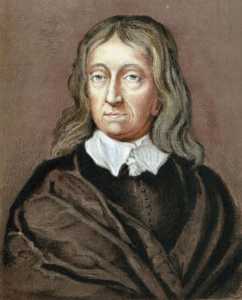

An English major in college, I was required to take courses in Chaucer/medieval lit, Shakespeare, Milton, 18th and 19th century literature, and American literature, among others. Of these, the dreaded subject was Milton, mainly because the brilliant poet and author of Paradise Lost took full advantage of the vast body of history, philosophy, religion, politics, and literary criticism of the day, and analyzing and interpreting even a few lines of his work could send a person down a rabbit hole for eons.
I had read excerpts from Milton’s works in high school, and I’d found them dry and uninteresting, but when I arrived in my Milton class junior year in college, I had a whole different experience. Call it an awakening, a challenge, a puzzle—whatever—I delighted in the intrigue and purpose of Milton’s language, and I couldn’t get enough.
After the semester, I decided to continue studying Milton by undertaking two semesters of work, researching and writing an honor’s thesis. My focus of study was figures of speech.
Most people understand the function of figurative language and can identify and explain similes, metaphors, personifications, and analogies. Few, however, realize that these represented only a miniscule number of the figures of speech available for Milton and other writers of the Elizabethan and Puritan eras.
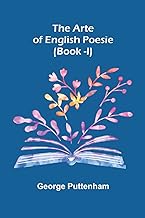
I could write treatises—or an honors thesis—about what I learned from books, such as George Puttenham’s The Arte of English Poesie, or Henry Peacham’s The Compleat Gentleman, but for this blogpost, I’ll say that I was astounded by the more than 456 figures of speech used by Renaissance writers of poetry and prose.
The literary devices included repetitions, inversions, comparisons, and rhetorical devices to tickle the ear and tempt the mind. Some of the more obscure, but popular, figures of speech were anastrophe, litotes, and anadiplosis.
Once I learned about them, I had fun hunting for them in Milton’s verse. Each find unlocked a bit of the magic that made Milton’s writing so memorable.
Fast forward to the 21st century, and I was teaching creative writing to students aged 55 and older at the Osher Lifelong Learning Institute. I introduced a unit in figures of speech, and we dug into definitions and examples of a variety of the lesser-used devices. I challenged learners to use some, like synecdoche and metonymy in their writing, and the results were amazing.
Also, when I read a work of fiction by an author like Poe, Tartt, Kingsolver, or Irving, and I find a turn of phrase that is particularly appealing, I love to deconstruct the language. Do you do the same? What is your favorite figure of speech, and which author do you think is especially adept at using figurative language?
Saralyn Richard writes award-winning humor- and romance-tinged mysteries that pull back the curtain on people in settings as diverse as elite country manor houses and disadvantaged urban high schools. Her works include the Detective Parrott mystery series, two standalone mysteries, a children’s book, and various short stories published in anthologies. She also edited the nonfiction book, Burn Survivors. An active member of International Thriller Writers and Mystery Writers of America, Saralyn teaches creative writing and literature. Her favorite thing about being an author is interacting with readers like you. If you would like to subscribe to Saralyn’s monthly newsletter and receive information, giveaways, opportunities, surveys, freebies, and more, sign up at https://saralynrichard.com.
 I first pondered this when I helped write the thriller Five Minutes to Midnight. The author was an international expert on terrorism, and not a native English speaker. To start with, he asked for help in naming the main character, who plied the same profession as he did. The hero was bold and dangerous. After playing with possibilities, I came up with Sartain. To my ears, it sounded like a good cross between the word “certain” and the ultimate tough guy, Satan. The author loved it.
 By Donnell Ann Bell
 By Lois Winston
 Following a Character into a Book by Linda Rodriguez
 By Lois Winston
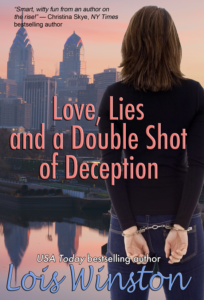 Years ago, I knew a woman who went to great lengths to project the ideal marriage. She constantly bragged about how much her husband loved her and what a perfect marriage they had. Then I learned the secrets behind the lies. She was carrying on an affair that her husband discovered when he tapped his own phone. Mr. and Mrs. Perfect Marriage were anything but. Although Love, Lies and a Double Shot of Deception isn’t about that marriage, it got me thinking about public persona versus private reality.
 Ten years after I first had that dream, after attending countless monthly writers’ meetings and numerous workshops and conferences, I eventually got enough of a clue to sell my first book.
 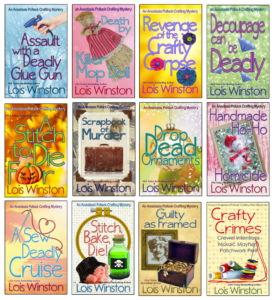 USA Today and Amazon bestselling and award-winning author Lois Winston writes mystery, romance, romantic suspense, chick lit, women’s fiction, children’s chapter books, and nonfiction under her own name and her Emma Carlyle pen name. Kirkus Reviews dubbed her critically acclaimed
  By Lois Winston
 Not every book I read is worth mentioning. Several fell way short of expectations. However, there were two books that I thoroughly enjoyed:
 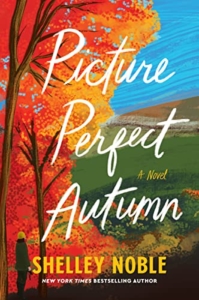 One of the perks of being a published author is getting to read some books before they hit bookstore shelves. I had the absolute pleasure of losing myself in advance reading copies of two books that I highly recommend. If you enjoy women’s fiction, you won’t want to miss the recently released
 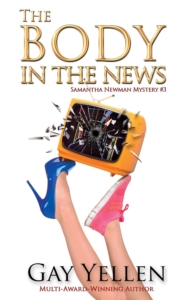 If romantic amateur sleuth mysteries are more your speed, you’ll want to read
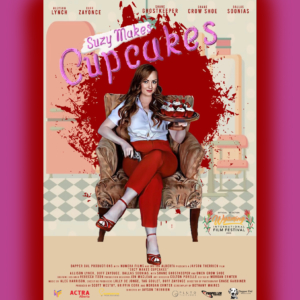 Let’s Make a Movie!
 Successes so Far
 Bethany Maines is the award-winning author of action-adventure and fantasy tales that focus on women who know when to apply lipstick and when to apply a foot to someone’s hind end. She participates in many activities including swearing, karate, art, and yelling at the news. She can usually be found chasing after her daughter, or glued to the computer working on her next novel (or screenplay). You can also catch up with her on