by Gay Yellen
Recently, our local newspaper devoted an entire page of articles with disturbing headlines on the subject. The lead essay announced this: AI-HUMAN HYBRID EYED TO PREVENT ROGUE AI. My mind’s eye instantly conjured up the scary image of a human-robot cyborg. Hard to say what form it might actually take, but there’s no comfort in this quote from a co-founder of the tech start-up behind the idea: “I think we still have a lot to learn from humans.” Gee, thanks.
The second headline felt like a slap in the face:
AI COMPANIES DESTROYING MORE BOOKS THAN YOU THINK. People who write for a living are painfully aware of the literary larceny perpetrated by e-book pirate sites that secretly clone our books for their own profit. But this topic goes beyond the personal.
Scott Brown, a seller of rare books in Portland, Oregon, is up in arms against AI companies that slice off a book’s bindings before scanning the pages and dumping what’s left. The majority of those tomes may result from the glut of over-ordered, unsold “best-sellers,” but too often, rare books are also turned into mulch, despite alternate scanning methods that do not harm the original. I’m currently researching a subject that reaches back centuries, and it’s already hard enough to find original accounts from those years. The thought of losing even one rare resource is… well, I don’t want to think about it.
Old-fashioned copycat plagiarism still happens, too.
It happened to me when I was the editor of a national monthly magazine. The perpetrator was a freelancer from Australia who was looking for assignments in the U.S. He dropped off a few work samples with his resume and asked to return the next day to see if I would hire him.
Looking through his material, I spied an article on a topic I’d covered months earlier, so I pulled that one out to read first. By the end of the second paragraph, the words seemed eerily familiar. Long story short, he had blatantly copied—word for word and comma for comma—a piece I’d written for an issue we’d published months before. The only difference was his name in the byline instead of mine.
Now that literary larceny has gone digital, it’s much more common. Thank goodness for sites like Writer Beware and professional groups like The Authors Guild and Sisters in Crime to spread the word to help writers fend the off the hoodlums.
We’re told that AI benefits myriad of professions, and it’s true. Even for a writer, it’s useful for quick fact-checking. But too often, the information it spits out is just plain wrong.
I’ve heard that some publishers use AI to flag the increasing number of bot-written submissions in their over-burdened slush piles. Sounds good. But apparently, an AI weed-eater cannot always distinguish between AI-slop and a truly original manuscript from a human author. It is known to have flagged a legitimate writer’s work for using an em-dash instead of a period or a comma or some other grammatical styling. Almost every author I know employs an em-dash when it’s needed, including me.
Distractions like these can seep into the creative process, leading some authors to second-guess their choices at every turn. Currently, my focus is on the way-back-when, and I rely on sources from centuries ago. Instead of leading me to a list of possible sources, the web often offers up AI summaries in reply to my query. And too often, the bot gets it wrong.
Will human creativity be erased from history?
Will the same happen to humans? An article in the New Yorker some months back contained this quote from the Nobel prize-winning “godfather” of AI, Geoffrey Hinton. “Unless you can be very sure that it’s not going to want to kill you when it grows up, you should worry.”
So, will AI be a benefit to humankind, or be a threat to our existence?
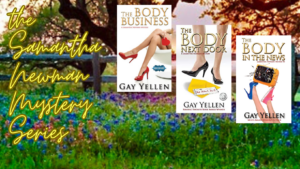 Gay Yellen’s award-winning writing career began in magazine journalism. She also was the contributing editor for the international thriller, Five Minutes to Midnight (Delacorte), which debuted as a New York Times “Notable.” Her Samantha Newman Mystery Series is packed with suspense and laced with touches of romance, heart, and humor. On Amazon , or to order from your favorite bookseller.
Creative Process
/in Inspiration, Writing and the Arts/by Bethany MainesEmbracing the Process
Recently, someone asked me about my inspiration for one of my books, and I hesitated to answer. Investigating the creative process can be fascinating, but also a little bit terrifying. Exploring how my brain processes and generates ideas can help guide my process toward fresh ideas. Or it could make me realize that the entire thing is built on a scaffolding of matchsticks. Perhaps it’s better not to look into what made this happen? And if I do look, will it make the entire thing grind to a halt? Like Schrödinger’s cat, as long as we don’t look into the box, we can assume everything is fine, and no one has to know we killed a cat to make this story happen.
The Truth
Because the truth behind what causes a story inspiration to flourish into a plot is deeply personal and delves into my philosophical and political opinions, my romantic kinks, my thoughts on how to get away with murder, and what I feel about my relatives. But in another—but equally valid—way, the answer can also be boiled down to… I saw this movie in 2005, and then I talked to this one guy at a networking social last year, and then one morning in April my brain connected the two. I think that the second answer is the one readers are more interested in, but as a writer, I’m more interested in the first. Which is why I’ve been enjoying my latest adventure as a Podcast Bro.
The OtherWorlds Podcast
The OtherWorlds Podcast from Authors on the Air Global Radio Network focuses on all things fantasy, magical, supernatural and maybe even a bit speculative. And with me as the new host, I’m diving into my special interests — crime and romance — and how they interact with all the magic each author brings to the table. It’s been so much fun to ask each author about their inspiration and take a look under the hood to learn more about their creative process. From Ben Shepherd who turned from politics and diplomatic service to writing about vampires and crime in London with “Blood Drunk” to Emily Krempholtz who has been helping other authors with their own journey of creativity and her upcoming novel “Prudence Marsh is Not a Nobody Anymore,” it’s been a treat to see how other writers chase down their ideas and pin them to the page.
We’re All Fine Here
And what I’ve learned in my brief foray into interviewing is that I’m perfectly normal as long as I stand next to the right people. If I tell someone that my inspiration for my upcoming book CurseLocked is the movie Psycho, Harrison Ford, the comic book character Venom, and Miss Havisham from Great Expectations there are lot of people who will look at me a little oddly. But if I sit at the paranormal author table, then I’m doing just fine because they’re also exploring their own mish-mash of inspirations.
But what do you think?
Do you think it’s better to thoroughly understand the creative process? Or do you like to trust the magic and not know how the machine works?
**
Learn more about CurseLocked: https://amzn.to/4cm1FLn
Learn more about The OtherWorlds Podcast: bethanymaines.com/otherworlds
**
Bethany Maines is an award-winning author, graphic designer, and sixth-degree black belt, who brings a fierce sense of adventure—and humor—to everything she does, from world travel for the snacks to Cerberus cosplay and baking for the plot. Bethany is the Mystery Writers of America Northwest Chapter Treasurer, the co-runner of The Stiletto Gang blog, new host of The OtherWorlds podcast, and writes under the names Bethany Maines and Sirena Corbeau. You can find her at: bethanymaines.com or catch up with her on Facebook, Instagram, and BookBub.
Learn more about the Stiletto Gang: Our Books
Artificial Intelligence, a Friend… or a Foe?
/in Artificial Intelligence, cozy mystery books, Plagiarism, Romantic Suspense, Samantha Newman Romantic Mystery series, writing life/by Gay Yellenby Gay Yellen
Recently, our local newspaper devoted an entire page of articles with disturbing headlines on the subject. The lead essay announced this: AI-HUMAN HYBRID EYED TO PREVENT ROGUE AI. My mind’s eye instantly conjured up the scary image of a human-robot cyborg. Hard to say what form it might actually take, but there’s no comfort in this quote from a co-founder of the tech start-up behind the idea: “I think we still have a lot to learn from humans.” Gee, thanks.
The second headline felt like a slap in the face:
AI COMPANIES DESTROYING MORE BOOKS THAN YOU THINK. People who write for a living are painfully aware of the literary larceny perpetrated by e-book pirate sites that secretly clone our books for their own profit. But this topic goes beyond the personal.
Scott Brown, a seller of rare books in Portland, Oregon, is up in arms against AI companies that slice off a book’s bindings before scanning the pages and dumping what’s left. The majority of those tomes may result from the glut of over-ordered, unsold “best-sellers,” but too often, rare books are also turned into mulch, despite alternate scanning methods that do not harm the original. I’m currently researching a subject that reaches back centuries, and it’s already hard enough to find original accounts from those years. The thought of losing even one rare resource is… well, I don’t want to think about it.
Old-fashioned copycat plagiarism still happens, too.
It happened to me when I was the editor of a national monthly magazine. The perpetrator was a freelancer from Australia who was looking for assignments in the U.S. He dropped off a few work samples with his resume and asked to return the next day to see if I would hire him.
Looking through his material, I spied an article on a topic I’d covered months earlier, so I pulled that one out to read first. By the end of the second paragraph, the words seemed eerily familiar. Long story short, he had blatantly copied—word for word and comma for comma—a piece I’d written for an issue we’d published months before. The only difference was his name in the byline instead of mine.
Now that literary larceny has gone digital, it’s much more common. Thank goodness for sites like Writer Beware and professional groups like The Authors Guild and Sisters in Crime to spread the word to help writers fend the off the hoodlums.
We’re told that AI benefits myriad of professions, and it’s true. Even for a writer, it’s useful for quick fact-checking. But too often, the information it spits out is just plain wrong.
I’ve heard that some publishers use AI to flag the increasing number of bot-written submissions in their over-burdened slush piles. Sounds good. But apparently, an AI weed-eater cannot always distinguish between AI-slop and a truly original manuscript from a human author. It is known to have flagged a legitimate writer’s work for using an em-dash instead of a period or a comma or some other grammatical styling. Almost every author I know employs an em-dash when it’s needed, including me.
Distractions like these can seep into the creative process, leading some authors to second-guess their choices at every turn. Currently, my focus is on the way-back-when, and I rely on sources from centuries ago. Instead of leading me to a list of possible sources, the web often offers up AI summaries in reply to my query. And too often, the bot gets it wrong.
Will human creativity be erased from history?
Will the same happen to humans? An article in the New Yorker some months back contained this quote from the Nobel prize-winning “godfather” of AI, Geoffrey Hinton. “Unless you can be very sure that it’s not going to want to kill you when it grows up, you should worry.”
So, will AI be a benefit to humankind, or be a threat to our existence?
Author Photos
/in Judy Penz Sheluk, A Fatal Affair/by Judy Penz ShelukBack when I was young and dewy-eyed, ca. 1980s, aka, the “decade for big hair.” This photo was taken at a Sears portrait studio. I wasn’t an author at the time, but I was living out of town and my mom wanted a nice photo of me.
I’m going to let you in on a little secret: unless you’re young and dewy-eyed OR spectacularly gorgeous, most female authors approach getting new professional author photos with the same dread that might be reserved for bathing suit shopping (I can’t speak for male authors vis-a-vis bathing suit shopping, so I’m not even going to try).
Anyway, my last author photo was taken a few years back, though I’ve had a couple taken for newspapers. These tend to fall into the “not-that-great, but they’re free” category. And with the impending launch of A FATAL AFFAIR: THE MURDER OF HELEN GRIER coming October 28th, and with my co-author, Amanda Capper, in the same leaky boat is me, we decided to bite the bullet.
We started by researching local photographers and settled on Anna Pelletier Doble of Kevanna Studios in Sault Ste. Marie. She came recommended, we liked her online portfolio, and even better, she insisted on a meet-and-greet before setting up a photo shoot. The initial idea was to get a few pix, plus headshots, but Anna fractured her foot a few days before so…headshot for the book, any other author photos down the road.
One of the things you notice when it comes to author photos is the passage of time (a nice way of saying “aging”). Back in the day, I wore contact lenses, but dry eyes (prescription eye drops) make them an impossibility. Reading up on the “rules” of author photos, apparently if you wear glasses on a daily basis, you should be wearing them for your author photo(s)– (the hope being that readers can recognize you).
And yes, of course I bought new glasses! I may be older, but I’m not entirely without vanity.
And now, without further ado, my Author Photo Lineup.
2004 First photo taken as I ventured into editing and writing for magazines.
2010 Freelance writer and journalist / magazine editor.
First official author photo, 2015, taken for THE HANGED MAN’S NOOSE, my debut novel.
2023 (For The Sault Star)
2026, Kevanna Studios. Official author photo for A FATAL AFFAIR: THE MURDER OF HELEN GRIER.
Enough about me…here’s more about me
A former journalist and magazine editor, Judy Penz Sheluk is the multiple award-winning author of seven bestselling mystery novels, two books on publishing, and several short stories. She is also the founder and owner of Superior Shores Press, which she established in February 2018.
Judy is a member of International Thriller Writers, the Short Mystery Fiction Society, and Crime Writers of Canada, where she served on the Board of Directors, most recently as Chair. A native Torontonian, Judy now splits her time between Goulais River and Sault Ste. Marie, Ontario, with her husband, Mike, and their golden retriever, Enzo. Find her at judypenzsheluk.com.
What’s your favorite thing about September?
/in Author Life, Mysteries/by Mary Lee AshfordSo we’re not going to talk about football games and fall leaves. Or cool evenings and cozy sweaters. We just aren’t feeling it yet. We’ll get there but in the meantime, we’re thinking about one of the other things we love about September.
September means the kickoff to a new season of some of our favorite murder mystery shows. Two of our favorites will be returning. First the Marlow Murder Club, with retired archeologist Judith Potts and her friends Suzie and Becks. Also coming back is Madame Blanc, with antique expert Jean White and the entertaining residents of Saint Victoire.
Plus there will be a final installment in Anthony Horowitz’s Susan Ryeland series with the Marble Hall Murders. Such a brilliant storyline blending real life murder with fictional detective, Atticus Pund. And though it doesn’t look as if we’ll see Season 2 until October, we’re also looking forward to the return of Ludwig, which is already airing in the U.K. This one features a brilliant puzzle master twin. We don’t want to ruin it for you if you’ve not seen the show so we’ll just say – you really need to watch season 1 first.
What’s your favorite thing about September? Do you have a show you’re looking forward to watching? Or is there something else that’s your favorite thing about September?
Sparkle Abbey is actually two people, Mary Lee Ashford and Anita Carter, who write the national best-selling Pampered Pets cozy mystery series. They are friends as well as neighbors so they often get together and plot ways to commit murder. (But don’t tell the other neighbors.)
They love to hear from readers and can be found on Facebook, Twitter, and Pinterest, their favorite social media sites. Also, if you want to make sure you get updates, sign up for their newsletter via the SparkleAbbey.com website.
And if you’d like to know more about Mary Lee’s books, visit her website at MaryLeeAshford.com
Clicking Our Heels – Anything Personal Incorporated Into Your Writing?
/in Clicking Our Heels/by DebraFor fun, we asked each member of The Stiletto Gang if there was anything personal they do (sing, exercise, etc.) that they have incorporated into their writings?
Donnell Ann Bell: I play the piano by ear and incorporated it into Deadly Recall.
Donalee Moulton: I love to do yoga, and a yoga studio is the foundation for the friendship that springs up in Bind and deepens in Melt. My friends and family do not share my enthusiasm for a downward dog. I hope readers do.
Mary Lee Ashford: I wish I could sing, but sadly no. Also, I wish I loved exercise, but again no. However, in recent years, I’ve developed an interest in genealogy, though I’m careful to limit the time I spend on it. Talk about a rabbit hole. In several of the Sugar & Spice books, I have incorporated some of what I’ve learned. Mostly as it relates to Sugar and how little she knows about her father and her search for more information about that part of her family.
Gay Yellen: Eat yummy food!
Bethany Maines: As a long-time karate student and instructor I feel like I would be remiss if my self-defense techniques on the page weren’t possible. Not to say that I don’t ever have super hero moments, but the punches and kicks should definitely be plausible.
Lois Winston: I’ve imbued Anastasia Pollack, the reluctant amateur sleuth of my Anastasia Pollack Crafting Mysteries, with many of my favorite pastimes—like her love of musical theater, anything chocolate, and the NY Mets.
Debra H. Goldstein: I personally find the kitchen terrifying, so I decreed that Sarah Blair, the protagonist of Kensington’s Sarah Blair mysteries, would find the kitchen more frightening than murder. I do enjoy playing Mah Jongg, so I put that into Should Have Played Poker: a Carrie Martin and the Mah Jongg Players mystery.
Judy Penz Sheluk: Golf. The third book in my Glass Dolphin Series (A Hole in One) is about a murder on a golf course. The actual scene of the crime was inspired by the third hole of Silver Lakes Golf Course in Holland Landing, Ontario.
Kathleen Kaska: In my Sydney Lockhart series, Sydney enjoys birdwatching.
Saralyn Richard: I like to plan parties and entertain friends. (I even worked with a wedding consultant at one time.) The over-the-top birthday party in Murder in the One Percent was so much fun to write.
T.K. Thorne: Rose, my police officer witch is a martial arts practitioner in her trilogy, House of Rose, House of Stone, and House of Iron. It’s lots of fun to employ her skills!
Africa! —T.K. Thorne
/in T.K. Thorne, Uncategorized/by TK ThorneI didn’t know that I needed to go to Africa.
When a friend asked if my husband and I wanted to go, I started to respond, “No,” but the word caught somewhere between apprehension and . . . something else:
SEE MORE
Author Lois Winston on the Battle of Author Versus Character
/in Author Life/by Lois WinstonImage created from graphics courtesy of Depositphotos and Pixabay
By Lois Winston
It’s Their Story, not Ours
There’s a battle going on where author versus character. Authors often talk about how their characters sometimes blindside them. We think we know where our story is going when suddenly, a character refuses to do what we want her to do.
Authors think we’re the ones in charge. Characters know they’re really the ones in charge. It’s their story, not ours. We’re only documenting it.
Ignore Your Characters at Your Own Risk
At first, we reluctantly ignore those voices in our head, otherwise known as our characters. We try to power through the plot, holding fast in our belief that we’re the ones who know how to write and know the direction the story should take. After all, when it comes to author versus character, we’re the ones who have studied and honed our craft.
We’ve mastered goal, motivation, and conflict. We’ve learned about The Hero’s Journey and plot arcs. If we’re writing a murder mystery, we know we need means, method, and opportunity. Then, much to our surprise, we hit a brick wall. We discover our characters have joined forces with our muse. And much to our horror, they’ve unionized and called a strike!
They’re making demands! And threats! If we hold firm and don’t give in, we suddenly find ourselves suffering through a massive case of writer’s block. Those wonderful characters that sprang from our imagination have us over the proverbial barrel. We reluctantly realize we have no other recourse than to negotiate.
This Battle of Author Versus Character is a Battle the Author Can’t Win
However, they refuse to negotiate. We’re forced to accept that when it comes to author versus character, we can’t win. Have our creations taken over? Or were they always in charge, but we never realized it? Does writer’s block occurred because authors try to force square pegs into a round holes, but our characters refuse all our attempts?
Acceptance is not Defeat
I now have fifteen novels and three novellas in my Anastasia Pollack Crafting Mystery series. When I wrote the first book in the early years of this century, I never expected the journey to last this long or take me to the places it has. I’ve learned to listen to my sleuth. She’s forced me to take risks with my writing and travel to literary places I never expected. She continually kicks my butt if I try to take the easy way out. So, I’ve learned to let her lead, and I follow. It’s a humbling experience to accept that you’re not in charge of your own creations, but in the end, I’ve found it to be a huge win.
Whether you’re a writer or a reader, have you ever had a similar experience in life where you’ve had to accept that maybe you weren’t right about the way you were doing something? Post a comment for a chance to win a promo code for a free audiobook of one of my Anastasia Pollack Crafting Mysteries or Empty Nest Mysteries.
~*~
Sisterhood of the Traveling Book – Game of Scones
/in Author Life, Cozy Mysteries, cozy mystery, cozy mystery books, cozy mystery sale, Sisterhood of the Traveling Book, The Stiletto Gang/by Mary Lee AshfordI’ve been to the Twin Cities umpteen times but had never actually spent time in downtown St. Paul. It’s the capital of Minnesota and sits at the confluence of the Mississippi and Minnesota Rivers. The Mississippi isn’t as wide there as it is where it runs along the side of Iowa but it offers some high bluffs and great views.
The Cathedral of Saint Paul sits on Cathedral Hill and overlooks downtown. The cornerstone was laid in 1907 and the first mass was held in 1915. It’s the third largest Catholic cathedral and the sixth largest church in the United States. The only National Shrine dedicated to the Apostle Paul in North America, a stone relic from the tomb of Saint Paul was given to the cathedral in 2009.
We stayed at the beautiful and historic Saint Paul Hotel which was both beautiful and charming. And with its downtown location, there were so many fun restaurants within walking distance as well as a park nearby with whimsical sculptures of Charles Schultz characters.
Charles Schultz was born in Minneapolis but grew up in St. Paul. I’ve included Schroeder and Lucy here but there were also statues of Charlie Brown, Snoopy, Marcie and Woodstock, and Peppermint Patty.
The conference itself was amazing and as it focused on cozy mysteries there were lots of great discussions among the attending authors. So I have returned home with a ton of knowledge and an extensive list of books to add to my to-be-read pile. Though “pile’ may be underselling it a bit…
While St. Paul itself was amazing, my favorite part of the get-together was the people. And thankfully there were lots of breaks with opportunities to get to know each other and share our individual author journeys. It was good to get home and get back to finishing up the next book in the Sugar and Spice series, but it also felt like we could have kept going another three days.
And I’m definitely stealing that idea for the next party I host. Who knows, maybe it will even end up in a book. Speaking of which…
I’m excited to share book five in the Sugar and Spice series with you, but in the meantime Game of Scones is currently free in all ebook formats so if you haven’t read it please check it out and then it can add to its travels. And if you’ve already read it, please share the special offer with a friend! Here’s the link: GAME OF SCONES
Mary Lee Ashford is the author of Game of Scones, Risky Biscuits, Quiche of Death, and Night of the Living Bread from Oliver Heber Books. She is also half of the Sparkle Abbey writing team. Mary Lee is a lifelong bibliophile, an avid reader, and a public library champion. Prior to publishing she won the Daphne du Maurier Award for Excellence in Mystery/Suspense. She is the founding president of Sisters in Crime -Iowa, a member of MWA, and Novelists, Inc. She lives in Iowa with her family and her feline coworker, Zoey.
She loves to hear from readers and can be found on Facebook, Instagram, and BookBub.
Or if you want to be sure you know about events, specials, and that next book, sign up for her newsletter.
Rising From the Dead – Book Wise That Is
/in Uncategorized/by DebraDuring the past few years, more than seventy of my short stories have been traditionally published. Twenty-two of those that won or for finalists for major awards were made into a collection, With Our Bellies Full and the Fire Dying, published by White City Press in February 2025. These stories all deal with family and friends, their sins, and their sometimes redemption.
Unfortunately, several of my stories and those by other authors were published in anthologies whose publishers went out of business. In this kind of situation, the story often fades into nonexistence. Recently, several publishers agreed to re-issue many of these orphaned books.
The music is playing loudly for five books edited by Josh Pachter. Two of those books, Paranoia Blues: Crime Fiction Inspired by the Songs of Paul Simon and Cryin’ Shame: Crime Fiction Inspired by the Songs of Lyle Lovett, are scheduled to be available for pre-order on October 26.
The Great Filling Station Holdup: Crime Fiction Inspired by the Songs of Jimmy Buffett, Happiness Is a Warm Gun: Crime Fiction Inspired by the Songs of the Beatles, and Friend of the Devil: Crime Fiction Inspired by the Songs of the Grateful Dead are all scheduled to go up for pre-order on August 25.
Of the five Pachter books, I only have a story in the Paul Simon book. At the same time, I also have stories in two other recently re-released books Sleuths Just Wanna Have Fun (edited by Michael Bracken) and In Too Deep (edited by Adam Meyer). These books are already available to be purchased.
Do you believe in giving books second chances when publishers go under? Here’s hoping you take the opportunity to pick up any of these books you might have missed.
Getting serious about writing a series
/in Uncategorized, writing a mystery novel/by donalee MoultonBy donalee Moulton
About a year ago I had a new book come out — and with the publication of Melt, I officially had something else. My first series: the Lotus Detective Agency. Melt is the second book to feature Charlene, Lexie, and Woo Woo, three women who meet in a yoga studio and go on to discover they have a penchant for more than downward dogs.
When I wrote Bind, the first book that brought these women together, I knew it would be a series. I do not know why I knew that, but it was a feeling I didn’t question. That feeling also shaped how the first book unfolded, knowing a second would soon be in the works. I could give some things away; I couldn’t give everything away. What happened in the first book had to be the reality on which the second book would be founded.
While each book must stand on its own, they are indelibly interconnected. The women grow as detectives. They refine their skills, and their collaboration. Their friendship deepens. There’s also a romance that blossoms in the pages of Bind and is more firmly rooted in Melt. And there is a dog whom I’ve become quite fond of.
I realized that the style and tone of the first book, my voice, must also be the same in book two. Readers expect consistency, within reason. What resonated with them in the first book should be found in the second, third, and subsequent books. Personalities do not abruptly change unless this is part of the plot and clearly spelled out. Lighthearted stories do not suddenly become dark without buildup and explanation.
That said, sequels cannot be mere reproductions of the original. There must be growth, there must be new challenges, there must be hiccups, stumbles, and imperfections that will further be explored in future books.
Logic must also prevail. My three women are not in law enforcement and have no background in crime solving. As I result, I didn’t feel they could realistically help to solve a murder in book one, or book two. Their credibility and expertise had to develop over several hundreds of pages. Now they’re ready.
The real question is: Am I? I’ve discovered the joy of writing a series also comes with angst. I feel an obligation to get it “right” for readers who have embraced Bind and Melt. I also feel an obligation to Charlene, Lexie, and Woo Woo.
And, of course, I’ll need another one-word title that reflects what goes on inside a yoga studio and what happens outside that studio when a crime has been committed.
Lotus Detective Series #1
Lotus Detective Series #2