Where Has All the Good Spam Gone?
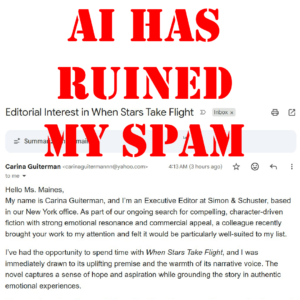
We’re all familiar with spam emails. I doubt there’s an adult in America who hasn’t received an email from someone letting us know that THERE ARE SINGLES LOOKING FOR SEX NEAR YOU. However, since the rise of AI I’ve noticed a shift in my inbox. Gone are the days of Nigerian princes, IRS agents demanding gift cards, and fake invoices for an iPhone you never ordered (Quick! Click on that link!! It’s so, so urgent!). Now I get personalized emails talking about my books in breathless terms and low-key requests to contact them if I’m interested. It’s so clear that someone has had AI scan my website or Amazon page to create personalized content that I can delete the emails without getting through the first paragraph.
Isn’t AI Personalized Spam Better?
Like a lot of AI slop, personalized spam is not better than good old-fashioned crap. The compliments, syntax, and tone are entirely lacking in authenticity. And while I suppose it’s possible to feel complimented by a machine, the platitudes carry all the heft of Pete Hegseth’s compliments on leadership—I don’t believe them, and they devalue the speaker for their blatant lack of any real knowledge on the subject. And aside from simply sounding implausible and obviously lacking in sincerity, since AI, authors have become a specifically targeted group. Where once we were hard to pin down or gather information on, AI has turned mass data consumption and website scanning into a breeze. The scammers no longer have to put in effort to learn about us or our books and can pump out email after email promising things that authors want (reviews, sales, readers). But that lack of effort shows, and frankly, it’s insulting. Scammers need to do better.
I took a brief poll of the Stiletto Gang, and we all agree that the spam rate increased to a deluge once AI took off. And of course, we’re worried about deleting that one real person who emails, but many of us are deleting as fast as our fingers can click. As Lois Winston said, “I always trash them and empty my trash immediately.” And while we all understand that the end goal is always money, many of us are puzzled by their low-pressure techniques. Why do you want me to tell you where to leave a review? Why are you wasting my time telling me that you love my work, but don’t want to leave a review without permission. No one in the history of reviews has ever had this worry.
So What Does the Spam Look Like?
Here are just a smattering of examples that I and other members of the Stiletto Gang have received:
Example 1: I can help you!
“I recently came across Eye Contact and it’s a gripping contemporary novel that blends science, mystery, and authentic representation. Following Lexi Byrne, a neurodivergent graduate student developing cutting edge bionic eye technology, the story explores her challenges with relationships, friendship, and ethics, all while navigating a high-stakes theft that puts her work and loved ones at risk. With its mix of science driven intrigue, relatable character dynamics, and emotional depth, Eye Contact has strong discovery potential through Goodreads Listopia lists such as Mystery & Thriller, Contemporary Fiction, Science & Technology Fiction, and Neurodivergent Protagonists.”
TRANSLATION: They want me to pay to get my book on a list on Goodreads which is something I can do for free. (And if they made you interested in Eye Contact – you can check it out on Amazon and all major retailers.)
Example 2: We’re big & famous, so of course we’re emailing YOU!
“At Simon & Schuster, we are committed to publishing fiction that resonates with readers while delivering a strong and memorable narrative experience. Based on what I’ve read, I would be very interested in exploring whether there might be an opportunity to work together.”
“As one of the most influential literary platforms globally, The New York Times Book Review reaches a vast and engaged readership of book lovers, critics, publishers, and industry professionals… If you are interested, kindly respond by [date], and I will provide the next steps and scheduling options.” (Thanks to Judy Penz Sheluk for this gem!)
TRANSLATION: We’re going to ask for money to include you in this very special offer. But pro-tip: Simon & Schuster doesn’t use Yahoo email accounts and the NY Times Book Review doesn’t solicit out of print books or forget to include the [date].
Example 3: Visit Our Book Club for Free!
“How are you doing ? I’m reaching out because of how strongly your book has resonated with readers in our community. As we read and discussed it together, one thing became very clear to us. This is a story that was written to be felt, reflected on, discussed, and shared, not simply read and put aside.”
“Readers will enjoy dissecting the layers of suspense, from the stolen SUV with a dead body to the cache of jewelry and the ongoing threats Anastasia faces, while also appreciating the lighthearted elements that make the series so engaging.” (Kind of makes you want to read the Anastasia Pollack mysteries, doesn’t it? Learn more at LoisWinston.com)
“Based on your catalog, I would be very interested to know which of your books you feel would create the most compelling and thought-provoking discussion among a community of dedicated readers like ours. Would you be open to having one of your preferred titles considered for this upcoming Networx London – Connect & Grow feature and allowing our members to explore and discuss it together?”
TRANSLATION: We failed to realize that we’re emailing about the third book in a mystery series but we’re going to talk about how it’s SO IMPACTFUL and later probably ask you to pay for the venue on a virtual book club.
Example 4: Authors like other authors, right?
“I recently came across your work, and I was really struck by the honesty in your storytelling and the way you blend personal experience with universal truth. As a fellow author, I deeply appreciate writing that challenges and moves readers the way yours does. I just wanted to reach out to say how much I admired your work. It’s inspiring to see writing that’s both fearless and artful.”
TRANSLATION: I’m looking for someone who has too much time on their hands and will email me back which means they’re probably a sucker.
Example 5: Errors Detected!
“I spotted a few issues that could be impacting your website’s performance. I captured screenshots for clarity. Reply “OK – SEND” if you’d like to see them.”
TRANSLATION: We know you’re a creative and don’t know much about websites and we’re depending on that to bilk you out of money (oh, and also… click on this link).
Spam for All
I think for many of us in the writing community, the new downpour of spam is shocking. Perhaps there are other groups who are being similarly targeted now that new tools are available, but this seems like a new development in the scammer landscape. And the truth is that I’m not falling for anymore scams now than I used to, but now I have to have someone blowing smoke up my skirt while I delete them. It’s infuriating. How about you? Are you seeing a new rise in of junk mail and in your inbox? And do you find the insincere adulation as annoying as I do?
**
 Bethany Maines is the award-winning author of action-adventure and fantasy tales that focus on women who know when to apply lipstick and when to apply a foot to someone’s hind end. She participates in many activities, including swearing, karate, art, and yelling at the news. She can usually be found chasing after her daughter or glued to the computer working on her next novel (or screenplay). You can also catch up with her on Twitter, Facebook, Instagram, and BookBub. She has also writes under the pen name Sirena Corbeau for spicier paranormal romance novels. Learn more at: bethanymaines.com or sirenacorbeau.com
See more books from the Stiletto Gang: BOOKS
Are We Looking Up?
/in amateur sleuth mysteries, Gay Yellen, Romantic Suspense, Samantha Newman Romantic Mystery series, Stress relief, Suspense/by Gay YellenToday is National Look Up at the Sky Day, and the timing couldn’t be better.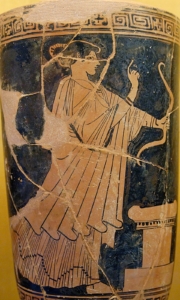
I can’t think of a more perfect time to celebrate this day as we try to maintain our equilibrium in what feels like a very troubled world. The proponents of this special Day suggest that we take a moment to go outside and contemplate the clouds as they roll by, kind of a Zen approach to relaxing the mind.
This date also marks another National designation. It’s Reach as High as You Can Day, which encourages us to create a new goal, share our goals, or encourage others to reach for theirs. While these two notable suggestions may provide encouragement for some, I think we can find an even better third one:
The Artemis Moon Mission
Prior to launch on April 1, I heard arguments, both pro and con, about going back to the moon. The two camps seemed to be equally divided as to whether the country should be spending so much money just to fly around the moon instead of fixing more urgent needs here on earth. I could understand and sympathize with both positions, until I watched the press conference with the four astronauts, who had returned to earth less than 24 hours before.
Seriously, watch the video. You’ll be glad you did.
Initially, I wan’t keen to sit through what I expected to be just one more bloated, self-congratulatory press conference full of the usual blah-blahl rhetoric. But that wasn’t what it was.
Afterward, I wanted to renew my half-forgotten knowledge of what Artemis, the mission’s Olympian namesake, stood for. Twin sister of the Greek god Apollo, Artemis was known as the goddess of the hunt, a protector of children and nature, and a patron of the healing arts. She was a lover and a warrior. One of the most venerated divinities, she had two sides: one nurturing and the other, brutal.
In short, Artemis was an avatar for the best and worst human traits.
And so, my thoughts today are on Artemis the goddess, her namesake mission, and the heartfelt comments from our latest space explorers, words that, while simple, illustrate how qualities like integrity and love can lead to a life worth living.
Whatever anxiety people may be feeling these days, we can still look up to the sky, reach as high as we can, create new goals and give love to those near and far. Perhaps in this way, we can still achieve heaven on earth together.
#ArtemisII #ReachAsHighAsYouCanDay #LookUpAtTheSkyDay
Gay Yellen’s award-winning writing career began in magazine journalism. She later served as the contributing editor for the international thriller, Five Minutes to Midnight (Delacorte), which debuted on the New York Times New & Notable list. Ms. Yellen’s Samantha Newman Mystery Series is packed with suspense and laced with touches of romance, heart, and humor. Available on Amazon or to order through your favorite bookseller.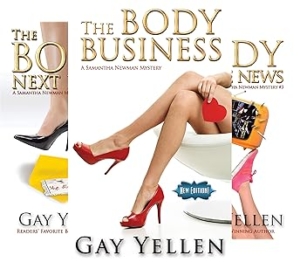
What’s the big idea?
/in Donnell Ann Bell, Inspiration, memories, The Stiletto Gang, Writing and the Arts, writing life/by Donnell Ann BellOne of my favorite lines from a film is during The Trouble with Angels when Hayley Mills who plays a troublemaker teenager says, “I have a scathingly brilliant idea!”
Mine may not be scathingly brilliant but for many a spark or an idea can be a figurative pot of gold. I got my idea for The Past Came Hunting after listening to Trisha Yearwood and Don Henley’s country song “Walk Away Joe.” The lyrics surround a seventeen-year-old girl who refuses to listen to her mother and runs off with her bad-news boyfriend. As the song goes, the girl waits in the car while the young man robs a gas station.
During a police ride-along, I asked the officer I was riding with what would happen to the girl?
“Seventeen. In the commission of a felony,” he replied. “She might be charged as an accessory—might even be tried as an adult and go to prison.” My kids were near that age at the time and I was appalled.
Later I asked him, “What’s the worst thing that could happen to you as a police officer?” Without hesitation, he answered, “If an ex-con moved next door to me.”
Boom! I had my story.
I researched how some authors came up with ideas and discovered:
J.K. Rowling got her idea for Harry Potter from a delayed train journey.
J.R.R. Tolkein, creator of the Hobbit and Lord of the Rings, got the idea for the Hobbit from a random sentence he wrote while grading papers.
Suzanne Collins, Hunger Games, was channel surfing and watching young people compete for a million-dollar contest.
Still, ideas can be nebulous and are often fleeting. Author Hank Phillippi Ryan and I discussed this during an interview. She said her muse show up at a restaurant. She reached for a napkin, then her pen and started writing. All I can say is if an idea or inspiration strikes, be ready to focus and find a way to jot it down.
Finally, my favorite anecdote about ideas and inspiration has to be from musician John Tesh who shared his backstory when he created Roundball Rock, the Chicago Bulls theme song, which in 2025 became the overall theme song for the NBA. The story as well as the score is breathtaking. Here’s the Youtube link and well worth a listen:
https://youtu.be/V_h7Lm7C9Nk?si=L-qVONhk5fTx3ej1
How about you? Got any goldmine ideas you’ve encountered to write a book or otherwise? Where do you get your ideas?
A Voice That Resonates
/in Author Life, crafting mystery, First lines in novels, How to Write, Inspiration, Kathleen Kaska, Voice/by Kathleen KaskaA Voice That Resonates
If asked to name writers with a distinct voice, I could rattle off a list: F. Scott Fitzgerald, Karen Blixen, Raymond Chandler, Jane Austen, Harper Lee, Stephen King, John Irving, Anne Rice. Defining “voice,” however, is far more elusive.
When I first started writing fiction, I went to a writers’ conference where the presenter described voice as the emotional connection between the writer and the reader. That idea stayed with me—and clarified something I had experienced but hadn’t named.
Early on, I focused on plot because I didn’t know how to build one. Voice barely registered until I picked up a novel by an unfamiliar author. It was his fourth book—and a bestseller. The characters carried me through more than four hundred pages. I immediately bought his earlier novels and struggled through them, finishing out of curiosity. The difference was unmistakable. In the fourth book, I could hear the characters’ voices. In the first three, I couldn’t. He hadn’t found it yet—or hadn’t learned how to sustain it. Since then, I’ve read everything he’s written. He’s now a favorite.
Voice isn’t plot, character, or setting—though it brings all three to life. It’s the writer’s way of seeing and presenting the world on the page.
Consider The Great Gatsby. From its opening lines, Nick Carraway speaks with an intimate, reflective ease, as if confiding across a café table. That conversational authority draws the reader in and keeps them engaged.
In To Kill a Mockingbird, Scout Finch views injustice through a child’s honest, questioning perspective. Her voice not only narrates the story— it amplifies its moral impact.
And in the novel Rebecca the narrator—the second Mrs. de Winter—voice carries a quiet melancholy that settles over the entire novel, shaping how we experience Manderley before we fully see it.
Last night I dreamt I went to Manderley again. It seemed to me I stood by the iron gate leading to the drive, and for a while I could not enter, for the way was barred to me. There was a padlock and a chain on the gate. I called in my dream to the lodge-keeper and had no answering and peering closer to the rusted spokes of the gate I saw that the lodge was uninhabited.
A strong plot, character, and setting are essential. But voice is what makes a story personal—what transforms pages into an experience. It’s the difference between a book we finish and one we remember. It’s the icing on the cake.
What are your favorite books with strong voices that speak to you?
https://kathleenkaska.com/
AI Ruined My Spam
/in Artificial Intelligence, Author Life, author promotion, humor/by Bethany MainesWhere Has All the Good Spam Gone?
We’re all familiar with spam emails. I doubt there’s an adult in America who hasn’t received an email from someone letting us know that THERE ARE SINGLES LOOKING FOR SEX NEAR YOU. However, since the rise of AI I’ve noticed a shift in my inbox. Gone are the days of Nigerian princes, IRS agents demanding gift cards, and fake invoices for an iPhone you never ordered (Quick! Click on that link!! It’s so, so urgent!). Now I get personalized emails talking about my books in breathless terms and low-key requests to contact them if I’m interested. It’s so clear that someone has had AI scan my website or Amazon page to create personalized content that I can delete the emails without getting through the first paragraph.
Isn’t AI Personalized Spam Better?
Like a lot of AI slop, personalized spam is not better than good old-fashioned crap. The compliments, syntax, and tone are entirely lacking in authenticity. And while I suppose it’s possible to feel complimented by a machine, the platitudes carry all the heft of Pete Hegseth’s compliments on leadership—I don’t believe them, and they devalue the speaker for their blatant lack of any real knowledge on the subject. And aside from simply sounding implausible and obviously lacking in sincerity, since AI, authors have become a specifically targeted group. Where once we were hard to pin down or gather information on, AI has turned mass data consumption and website scanning into a breeze. The scammers no longer have to put in effort to learn about us or our books and can pump out email after email promising things that authors want (reviews, sales, readers). But that lack of effort shows, and frankly, it’s insulting. Scammers need to do better.
I took a brief poll of the Stiletto Gang, and we all agree that the spam rate increased to a deluge once AI took off. And of course, we’re worried about deleting that one real person who emails, but many of us are deleting as fast as our fingers can click. As Lois Winston said, “I always trash them and empty my trash immediately.” And while we all understand that the end goal is always money, many of us are puzzled by their low-pressure techniques. Why do you want me to tell you where to leave a review? Why are you wasting my time telling me that you love my work, but don’t want to leave a review without permission. No one in the history of reviews has ever had this worry.
So What Does the Spam Look Like?
Here are just a smattering of examples that I and other members of the Stiletto Gang have received:
Example 1: I can help you!
“I recently came across Eye Contact and it’s a gripping contemporary novel that blends science, mystery, and authentic representation. Following Lexi Byrne, a neurodivergent graduate student developing cutting edge bionic eye technology, the story explores her challenges with relationships, friendship, and ethics, all while navigating a high-stakes theft that puts her work and loved ones at risk. With its mix of science driven intrigue, relatable character dynamics, and emotional depth, Eye Contact has strong discovery potential through Goodreads Listopia lists such as Mystery & Thriller, Contemporary Fiction, Science & Technology Fiction, and Neurodivergent Protagonists.”
TRANSLATION: They want me to pay to get my book on a list on Goodreads which is something I can do for free. (And if they made you interested in Eye Contact – you can check it out on Amazon and all major retailers.)
Example 2: We’re big & famous, so of course we’re emailing YOU!
“At Simon & Schuster, we are committed to publishing fiction that resonates with readers while delivering a strong and memorable narrative experience. Based on what I’ve read, I would be very interested in exploring whether there might be an opportunity to work together.”
“As one of the most influential literary platforms globally, The New York Times Book Review reaches a vast and engaged readership of book lovers, critics, publishers, and industry professionals… If you are interested, kindly respond by [date], and I will provide the next steps and scheduling options.” (Thanks to Judy Penz Sheluk for this gem!)
TRANSLATION: We’re going to ask for money to include you in this very special offer. But pro-tip: Simon & Schuster doesn’t use Yahoo email accounts and the NY Times Book Review doesn’t solicit out of print books or forget to include the [date].
Example 3: Visit Our Book Club for Free!
“How are you doing ? I’m reaching out because of how strongly your book has resonated with readers in our community. As we read and discussed it together, one thing became very clear to us. This is a story that was written to be felt, reflected on, discussed, and shared, not simply read and put aside.”
“Readers will enjoy dissecting the layers of suspense, from the stolen SUV with a dead body to the cache of jewelry and the ongoing threats Anastasia faces, while also appreciating the lighthearted elements that make the series so engaging.” (Kind of makes you want to read the Anastasia Pollack mysteries, doesn’t it? Learn more at LoisWinston.com)
“Based on your catalog, I would be very interested to know which of your books you feel would create the most compelling and thought-provoking discussion among a community of dedicated readers like ours. Would you be open to having one of your preferred titles considered for this upcoming Networx London – Connect & Grow feature and allowing our members to explore and discuss it together?”
TRANSLATION: We failed to realize that we’re emailing about the third book in a mystery series but we’re going to talk about how it’s SO IMPACTFUL and later probably ask you to pay for the venue on a virtual book club.
Example 4: Authors like other authors, right?
“I recently came across your work, and I was really struck by the honesty in your storytelling and the way you blend personal experience with universal truth. As a fellow author, I deeply appreciate writing that challenges and moves readers the way yours does. I just wanted to reach out to say how much I admired your work. It’s inspiring to see writing that’s both fearless and artful.”
TRANSLATION: I’m looking for someone who has too much time on their hands and will email me back which means they’re probably a sucker.
Example 5: Errors Detected!
“I spotted a few issues that could be impacting your website’s performance. I captured screenshots for clarity. Reply “OK – SEND” if you’d like to see them.”
TRANSLATION: We know you’re a creative and don’t know much about websites and we’re depending on that to bilk you out of money (oh, and also… click on this link).
Spam for All
I think for many of us in the writing community, the new downpour of spam is shocking. Perhaps there are other groups who are being similarly targeted now that new tools are available, but this seems like a new development in the scammer landscape. And the truth is that I’m not falling for anymore scams now than I used to, but now I have to have someone blowing smoke up my skirt while I delete them. It’s infuriating. How about you? Are you seeing a new rise in of junk mail and in your inbox? And do you find the insincere adulation as annoying as I do?
**
See more books from the Stiletto Gang: BOOKS
Authors Helping Authors: A Full Circle Moment
/in Judy Penz Sheluk, New Release, Romance, writing life/by Judy Penz ShelukI’d been published a little over a year, maybe two, when I first met Emily Wood. I’d been approached by a regional library to talk about writing and getting published. As I recall, it was loosely related to the now defunct National Novel Writing Month (NaNoWriMo) held each November. Anyway, Emily was there, and at the time she was the Editor of the Base Borden newspaper, and worked part-time at the library.
I remember her sitting there, earnest, notebook in hand, dreams in her eyes. She asked a lot of questions. Good questions. Relevant questions. I answered them honestly, but I hoped, with cautious optimism. Yes, getting published was tough, but it could be done. And the one thing I believed in was authors helping authors. Emily might not have been a published author — yet — but in my mind, she was still an author. I seem to recall she was writing something dystopian. The Handmaid’s Tale was big at the time, which may or may not have had something to do with it.
I went on to do a few other library events and presentations, mostly at my then-local library. Emily attended each and every one of them. I think, the first time, she was surprised that I remembered her, but I had been really impressed by her enthusiasm and ambition. I’d been her, once. Part of me still was, even if I’d become just a little more jaded. By 2018, after being “orphaned” twice, I gave up on traditional publishers (except for the odd short story) and had started my own imprint.
STEP-BY-STEP PUBLISHING GUIDES
Then I remembered editor and aspiring author Emily Wood. I contacted her, and we came to an agreement whereby I’d pay her a fair hourly wage, and she’d return edited chapters to me on a weekly basis. It was a partnership made in heaven. Emily’s much more youthful perspective, and her recent efforts to find an agent, added meat to FINDING YOUR PATH TO PUBLICATION: A STEP-BY-STEP GUIDE, that otherwise would not have been included. That book went on to win the 2024 Killer Nashville Silver Falchion Award for Best Nonfiction AND the 2024 Writer’s Digest Award for Best Prescriptive Nonfiction (that one was nice because it came with a $1,000 prize). I followed up PATH with SELF-PUBLISHING: THE INS & OUTS OF GOING INDIE. Here, Emily’s lack of knowledge was instrumental in how I would explain the process that virtually anyone could follow.
A FULL CIRCLE MOMENT
Another fast forward, this time in 2024, when Emily was hired fulltime at the library AND informed me she’d landed an agent and they were shopping her book (a romance, which is what she loves to read). She signed a contract soon after and the book JUST MY LUCK, released in February 2026. You can find it on Amazon and other retailers. And then, one day in March, a parcel arrived from Emily. Her debut novel, signed and personalized. A matching bookmark. A lovely thank you card.
And that’s what you call “a full circle moment.”
ABOUT JUST MY LUCK (by Emily Wood)
Community, the Plot Twist We Really Need!
/in Cozy Mysteries/by Sparkle Abbeyby Sparkle Abbey
There’s something to be said about the welcoming world of a cozy mystery. While the sleuth is almost always someone we can root for and the stakes are high (murder anyone?), a cozy community can feel like home.
In cozy mysteries, the community is its own character. The sleuth is surrounded by friends, neighbors, and familiar faces who play a role in the unfolding story. The community is what moves the plot forward and develops relationships. It should pull in the reader and keep them invested. Not just in solving the mystery, but in the lives of the characters.
And perhaps that’s why cozy mysteries resonate so strongly with readers. They reflect something we all crave in our own lives: a sense of belonging.
Community can also raise the emotional stakes. When something goes wrong, and it always does, it doesn’t happen to strangers. It’s someone close to the sleuth, or at least in their circle. It’s the motivation to solve the puzzle.
In real life, community plays a similar role. It’s the network of people we rely on: friends, family, colleagues, neighbors. Those who care and support us.
A community gives us a place to share our pain, celebrate our victories, and navigate life’s challenges. It reminds us that we’re not alone.
At their core, cozy mysteries are more than just an engaging puzzle. They are a reflection of a world where people care about each other and look out for one another.
Or maybe, it’s the world we want to know.
And maybe that’s the real magic.
Sparkle Abbey is actually two people, Mary Lee Ashford and Anita Carter, who write the national best-selling Pampered Pets cozy mystery series.
They are friends as well as neighbors so they often get together and plot ways to commit murder. (But don’t tell the other neighbors.)
They love to hear from readers and can be found on social media or contacted via their websites:
Sparkle Abbey: Facebook Website
Mary Lee Ashford: Facebook Instagram Website
Clicking Our Heels – Have You Ever Killed a Real Person Off in Your Books?
/in Clicking Our Heels/by DebraTeresa Thorne – Not yet, but watch out!
Saralyn Richard – I haven’t exactly killed off a real person, but in A Murder of Principal a maverick principal comes to an urban high school with an unpopular student-centered agenda and is victimized. Because I worked as an administrator at urban high schools, and one, in particular, for many years, I knew people would try to match up the murder victim with one of the real-live people in the school. I went to him before I wrote the book and made sure he was okay with the book’s premise and whatever assumptions people might make about his being the model for the character. His reply was, “I would be honored to be represented in your book, even if you kill me off.”
Donalee Moulton – All the deaths in my books are fictional, both interestingly by hanging. In Hung Out to Die, the victim’s death was intended to look like a suicide. In Conflagration!, the enslaved Black woman accused of burning down the entire lower town of Montreal in 1734 was sentenced to death by hanging. She was then burned at the stake. Reality can be so much more brutal that fiction.
Kathleen Kaska – No.
Donnell Ann Bell – No. But I have had people contact me and request to be the murderer in my books. I use their name (with permission) and they for some reason are delighted! 🙂
Debra H. Goldstein – Yes, but I’ll never tell because I’d have to kill you, too.
Judy Penz Sheluk – Gosh, no, though I will say I’ve been sorely tempted. I have managed to exact revenge in a two of my short stories. ‘Live Free or Die’ (included in Live Free or Tri) and ‘The Last Chance Coalition’ (in Midnight Schemers & Daydream Believers) were both inspired by true events. It was very cathartic to get even all these many years later, if only on paper.
Lois Winston – Yes, but I held no animosity toward the person in real life and didn’t use his real name. He was a neighbor from about twenty-five years ago. I write humorous mysteries and couldn’t pass up the chance to immortalize his quirkiness in Seams Like the Perfect Crime, the 14th book in my Anastasia Pollack Crafting Mysteries. When I began the book, I didn’t intend to kill him, but as I wrote, it became evident that he’d be the perfect victim for the book.
Bethany Maines – I don’t think I’ve actually killed anyone off, but I have made several real people be the butt of a joke or made them look stupid. One was an English teacher who said I wasn’t very creative.
/Gay Yellen – All victims from my mystery series are fictional, though some have characteristics of people I’ve known: a young woman from a small town who couldn’t cope with a highstakes
job in the big city, an egotistic journalist, and a male chauvinist.
Mary Lee Ashford – I have not killed a real person off. I’ve considered auctioning off an opportunity to be a victim but in the end decided against it. Though when I first started writing mystery, I was working on a project where the first line was, “It was a regular day at City Hall, except for the dead body in the lobby.” And I have to say the victim varied depending on who was behaving badly that day. Of course, none of that made it into the actual book. And my lips are sealed.
Is There Another Way?
/in T.K. Thorne/by TK ThorneWe are at war. Again.
I am old enough to remember the 1970 song “War” and its iconic refrain: “War, huh! What is it good for? Absolutely nothing!” And yet—here we are. Again and again and again.
I have lived through the Vietnam War, the Gulf War, and the post‑9/11 “Forever Wars” in Afghanistan and Iraq, along with numerous interventions in Lebanon, Grenada, Panama, Somalia, Bosnia, and Syria, and now Iran—another moment in a long, familiar pattern.
And those are just the ones involving my lifetime and my country.
This is not a simple or comfortable question—but it’s one we avoid at our peril.
What compels men to violence?
SEE MORE
#1 Favorite Book of All Time
/in favorite book of all time/by Lois WinstonIllustration from Pixabay
By Lois Winston
“Grandma, what’s your #1 favorite book of all time?”
My #1 favorite book of all time?
As part of a Readathon at his elementary school, my nine-year-old grandson recently asked me this question. You might think this is a simple question with an even simpler answer. Not for me. I’ve been impacted throughout the years by different books at different points in my life. The ones that have left the biggest impressions are the ones that educated me the most. Picking one book out of a lifetime of reading would be impossible.
Unlike what’s happening at many libraries across the country today, my local library didn’t ban books, nor did they prevent children from using the adult section. It was from the library, not the classroom, where I gained a greater understanding of life and history, reading many books that are currently being banned in schools and libraries.
In the classroom, I was forced to memorize dates of battles and names of generals. By reading James Mitchner, Leon Uris, and The Diary of Anne Frank, I learned of the atrocities perpetrated by many of those generals at the direction of their leaders here and abroad, whether in the name of Manifest Destiny or the “superiority” of the white race.
In school, we had mandatory air raid drills where we sat in the hall, facing the wall and covering our heads to protect us from possible nuclear attack. On the Beach by Nevil Shute taught me the futility of such an exercise. Yet no teacher in any of my AP US History classes ever mentioned anything about what would really happen should the Soviets launch a nuclear missile at us. Nuclear winter? The term was never mentioned in the classroom. And we certainly were never shown the images of the aftermath of Hiroshima and Nagasaki.
School taught me useless facts that would only benefit me if I ever went on Jeopardy! The historical fiction, biographies, and autobiographies, I borrowed from the library, humanized those famous names rather than lionizing them. It showed me that no issue should ever be viewed entirely in black and white. There are always subtle shades of gray involved. History, unfortunately, has and will continue to repeat itself when we don’t learn from our mistakes. Books taught me that, not my history teachers.
Long after graduating, I’ve continued reading and gaining a deeper understanding of humanity. Roots by Alex Haley and The Underground Railroad by Colson Whitehead, although both novels, brought the horrors of slavery to light in a way no high school study of the Civil War, nor reading Gone with the Wind, ever did. As did Ron Chernow’s massive biography of Alexander Hamilton, regarding our founding fathers and the Revolutionary War.
From Ariana Franklin’s Mistress of the Art of Death series, I learned more about the Middle Ages than I ever did in my high school course on European History. Most recently, Marie Benedict’s The Mitford Affair, based on the lives of real people in England before and during World War II, showed me how insidiously fascism took hold of many of the English elite.
As I read these books, I often became angry over the inhumane treatment perpetrated by one group against another, but at the same time I remained hopeful, knowing people are capable of change. As Anne Frank wrote in her diary, “In spite of everything, I still believe that people are really good at heart.” Although, lately, that’s becoming increasingly difficult. I also worry that if these books and others are denied to us and future generations, no one will have the opportunity to learn about all the shades of gray.
Of course, I couldn’t convey any of this to my nine-year-old grandson. I needed to give him the title of my favorite book. In the end, I settled on Louisa May Alcott’s Little Women, also a book about hope and believing in the goodness of others.
What’s your #1 favorite book of all time? Post a comment for a chance to win a promo code for a free audiobook download of any of the available Anastasia Pollack Crafting Mysteries or Empty Nest Mysteries.
~*~
Sisterhood of the Traveling Book
/in Sisterhood of the Traveling Book/by donalee Moultonby donalee Moulton
headstone at Catherine McIntosh’s gravesite
It is worth the drive. Catherine’s gravestone seems unravaged by time. It sits near the road surrounded by flowers, cards, dolls, and other gifts all a tribute to a young girl who never lived to celebrate her ninth birthday. Some kind soul has draped lights above the headstone. I wonder what it would look like at night. I wonder if I have the nerve.
We bring gifts, a small angelic ceramic candle holder from Lynn and miniature bouquet of artificial flowers from me. We make our way to the headstone wondering if, like many others, we will feel Catherine’s presence. We do not. And we should know better.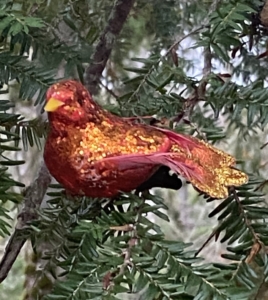
I place the small vase at the foot of the headstone, and I introduce myself. I tell Catherine I have written about her. She is an important part of my book. I hope she will be happy to know that. As I start to lift my head from the treasure trove of gifts, a red bird looks back at me. A cardinal. Plastic, but nonetheless a cardinal. So, Catherine knew we were coming.
I’m not moving. “Lynnie, there’s a cardinal in the tree.” Lynn turns to look in my direction. Her head sweeps over the small, forested area. “No,” she says. “They are all over the place.”
Someone has festooned branches with red birds, not all cardinals, but all red and all close enough to the title of this book. We thank Catherine, and we leave.
Off the dirt road and back on pavement, we breathe. We realize we have time for a coffee and a walk around a nearby town on our way to a weekend yoga retreat. We park, grab a hot drink, and make our way to the first gift shop. I open the door. A table chock-a-block with lovely toys, trinkets, and treasures holds centre stage. In the middle of this table, a large cardinal. I turn and walk out.
There are forces at work that surround Cardinal. I don’t know what they are, but I am grateful for them.
Get a copy of Cardinal here.