Benefits of Contributing to an Anthology
by Paula Gail Benson
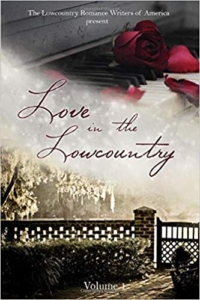
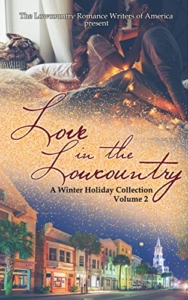
Robin Hillyer-Miles and I, two blogging partners here at The Stiletto Gang, also are members of the Lowcountry Romance Writers (LRWA), a chapter of Romance Writers of America based in Charleston, South Carolina. Since 2019, LRWA has organized and published two anthologies, titled Love in the Lowcountry: A Winter Holiday Collection and Love in the Lowcountry, Volume Two: A Winter Holiday Collection Book 2. Both are available through Amazon.
LRWA is now in the process of creating its third anthology, which again requires that stories take place in South Carolina. For this anthology, they also must involve a vacation. Contributors must participate in two rounds of beta reading, work with a professional editor, and develop and circulate promotional materials. Learning and using these skills is invaluable experience for both debut and seasoned authors. We continue to have a lot of fun putting these anthologies together.
Robin and I have both written several messages about how these anthologies benefited us as writers: from Robin, “Musings on a Tuesday” and “No Regrets,” and from me “Love in the Air,” “A New Anthology,” and “The Meet Cute.”
These anthologies also provide some virtual vacations and insightful information for readers who visit in person and/or virtually. Bookstores in Charleston, South Carolina, often have customers seeking fiction about the city. Most of our anthologies’ romances describe historical or cultural backgrounds in a very engaging format, meeting the bookstores’ customers’ requests. Robin Hillyer-Miles, a certified tourism professional, has assisted all the participating writers in confirming the accuracy of the details in their work.
In addition to giving authors a writing credit, contributing to the anthology allows the opportunity for learning new writing skills, trying out new genres, and developing different characters. Not all writers enjoy crafting short stories, but the attempts demonstrate how to be more economical with word usage and narrative. Except for hints at relationships, I had not written romances prior to my stories in the anthologies. They also represent my first efforts at exploring time travel, which allow me to involve modern day characters with historical figures and events, something I find fascinating.
One author in the first anthology used her story as part of a trilogy. She offered the prequel in her newsletter to entice readers to try her work. That gave me the idea to consider how two characters I developed for my story in the first anthology (the two rejected by the main love interests) might appear subsequently. (Note: it continues to be a challenge to find those two less desirable characters’ more likable qualities.)
In the second anthology, my story had three potential romantic couples, one that became predominant. Determining how to resolve the characters’ interacting plotlines became a fascinating puzzle that led me to contemplate writing a more expansive account, featuring each couple independently.
Even if you don’t ordinarily read or write short stories, try dipping into an anthology or two. They offer some great examples of craft and compiling material by theme, not to mention some excellent reading.
 A New Beginning that Feels Like Groundhog Day by Debra H. Goldstein
 By Donnell Ann Bell
 2019. My antagonist has escaped and he’s traveling on foot at night. Several issues crossed my mind while writing this scene, including: How will he get from Point A to his temporary objective of Point B when he faces all kinds of dangerous impediments? Namely, he doesn’t know the area or the terrain, all he’s wearing are the clothes on his back, law enforcement is in pursuit, he’s being tracked by a fellow escapee, and it’s dark!
 This time, I was expected to say something. My mind still reeling over actually winning, I stepped up to the mic and thanked whoever it was who’d determined that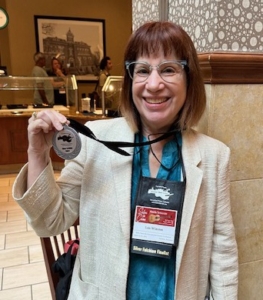
 Pens by Debra H. Goldstein
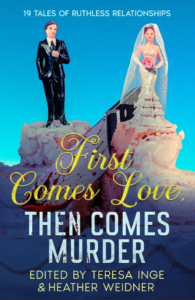 June is Here – And I’m Excited! by Debra H Goldstein
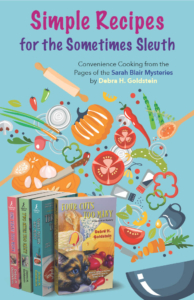 and whatever); and, finally, once again, embracing my love of writing.
 hether or not I want to spend the time, I always read it aloud. And actually, I find so many things that need to be fixed that I’m pretty happy that I’ve read it aloud. Other writers say to let it sit awhile before you do that. I know I should wait awhile, but, actually, I don’t always wait awhile to read it. Whether or not you read your manuscript aloud, or print it out like we did in the old days, let it sit awhile, and then read it, I urge you to do one or the other, so you’ll be pretty happy, too.
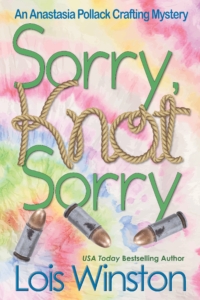 By Lois Winston