
A Voice That Resonates
A Voice That Resonates
If asked to name writers with a distinct voice, I could rattle off a list: F. Scott Fitzgerald, Karen Blixen, Raymond Chandler, Jane Austen, Harper Lee, Stephen King, John Irving, Anne Rice. Defining “voice,” however, is far more elusive.
When I first started writing fiction, I went to a writers’ conference where the presenter described voice as the emotional connection between the writer and the reader. That idea stayed with me—and clarified something I had experienced but hadn’t named.
Early on, I focused on plot because I didn’t know how to build one. Voice barely registered until I picked up a novel by an unfamiliar author. It was his fourth book—and a bestseller. The characters carried me through more than four hundred pages. I immediately bought his earlier novels and struggled through them, finishing out of curiosity. The difference was unmistakable. In the fourth book, I could hear the characters’ voices. In the first three, I couldn’t. He hadn’t found it yet—or hadn’t learned how to sustain it. Since then, I’ve read everything he’s written. He’s now a favorite.
Voice isn’t plot, character, or setting—though it brings all three to life. It’s the writer’s way of seeing and presenting the world on the page.
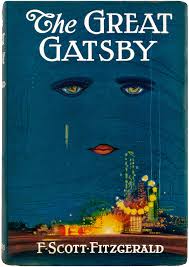
Consider The Great Gatsby. From its opening lines, Nick Carraway speaks with an intimate, reflective ease, as if confiding across a café table. That conversational authority draws the reader in and keeps them engaged.
In To Kill a Mockingbird, Scout Finch views injustice through a child’s honest, questioning perspective. Her voice not only narrates the story— it amplifies its moral impact.
And in the novel Rebecca the narrator—the second Mrs. de Winter—voice carries a quiet melancholy that settles over the entire novel, shaping how we experience Manderley before we fully see it.
Last night I dreamt I went to Manderley again. It seemed to me I stood by the iron gate leading to the drive, and for a while I could not enter, for the way was barred to me. There was a padlock and a chain on the gate. I called in my dream to the lodge-keeper and had no answering and peering closer to the rusted spokes of the gate I saw that the lodge was uninhabited.
A strong plot, character, and setting are essential. But voice is what makes a story personal—what transforms pages into an experience. It’s the difference between a book we finish and one we remember. It’s the icing on the cake.
What are your favorite books with strong voices that speak to you?


 And if you’re a fan of songs that have lived on long after you’ve forgotten the artist who recorded them, then Lunatic Fringe is the anthology for you! Enjoy contributions that mix the best of music and crime from Steve Liskow, Vicki Erwin, Kaye George, John M. Floyd, Linda Kay Hardie, Sandra Murphy, Karen Keeley, Teresa Inge, Michael Bracken, Mary Dutta, Nikki Knight, Judy Penz Sheluk (that’s me!) and Adam Meyer.

 Clicking Our Heels
 By Donnell Ann Bell
 In my continued slog through what remains from my mother’s storage unit, I came across a boxful of her college yearbooks, plus one from her high school, and one from my father’s high school, too. Together, they weighed fifteen pounds, and were large enough to overwhelm my already over-burdened bookshelves. So I wondered…
 I pored over the pages of Mom’s books, looking for her familiar young face and checking out her class activities. Most of them were familiar to me: French club, a campus play or two, a modeling job, a social club, etc.
 I finally decided to call our city library to ask if they had any interest in old school yearbooks. Yes, they replied, but only if they didn’t already have them in their collection. So I took them there, and just as I was about to hand them over, I had a last minute urge to check them again.
 He was a Dad who shared his love of the sport with this lucky little girl. He taught me the rules of the game, and how to throw and catch and bat. Took me to local community games, where he coached a local team. And he was among the first to buy season tickets when our town got a pro baseball franchise.


 ink pen. Over the years, several pages became unglued. But they were all accounted for, and chock-full of the kind of mind games that define unhealthy interpersonal transactions (or, in non-psychobabble: toxic relationships).
 Speaking of more pleasant games, my favorite is the one I play with my husband almost every day at lunch, when I take a break from writing. As I wind down the morning, he’s making a delicious chopped salad which we share over a backgammon table. We’re pretty evenly matched at this game, and the competition’s friendly. Afterward, I’m refreshed for the rest of the afternoon.
 Any kind of healthy game can serve as an antidote to any toxic thought gremlins that invade our tranquility. Lots of people I know play Wordle or some variation of it to relieve stress. Group games like Bridge, Poker, and Mahjong are popular again, too.

 So deep am I into the research for my next book that I lost track of time. Which is to say, I almost forgot to write this post.




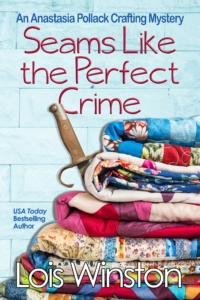 By Lois Winston
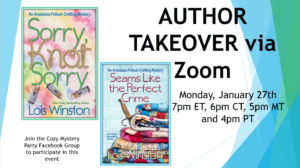 P.S.: On Monday evening, January 27th at 7pm ET (6pm CT, 5pm MT, and 4pm PT), I’ll be the guest of the Cozy Mystery Party Facebook Group, hosted by Heather Harrisson and Shawn Stevens. If you’d like to join in for a fun hour + of all things murder, mayhem, and cozy mysteries (there will be prizes and surprises!), join the group at


