
Listening is Also Research by Saralyn Richard
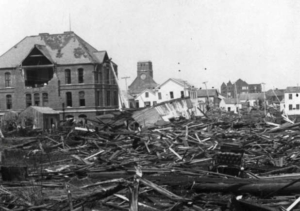
I first started researching the 1900 Storm, the deadliest natural disaster ever to hit American soil, when I was 15 years old. In those pre-Internet days, research meant going to the library, reading books and other primary source materials (some of which was on microfilm and microfiche), and taking copious notes in spiral notebooks.
At the time I was burning to write about a family secret that I knew would be book-worthy, and I would be the best person to tell it. I thought of the premise as MY STORY, and I nursed and nurtured it over the years. In the 1980’s when I got my first computer (a tiny-screened Mackintosh), I began writing, but 100 pages into the manuscript, the computer died, taking the story with it.
Fast forwarded past a very busy career in education and eight books written and published, and I decided it was time to return to this story. By now, so many wonderful books were written about the 1900 Storm, that I decided to set the novel five years later. Turned out that the Galveston of 1905 was an exciting time, filled with optimism and state-of-the-art science and engineering, and a wave of immigration that brought energetic, clean-living workers to the island to help with rebuilding.
I spent time in person and online with the Galveston and Texas History Center at the Rosenberg Library, and I read lots of books and journals about the building of the seawall, digging of canals, raising of the grade, and building of boardwalks to give people access to the houses being raised.
I happened to include something in my monthly newsletter, asking subscribers to send me names of family members who lived in 1905, as well as any storm survivor stories they knew. The response was incredible! Within days I had more than fifty vignettes and names of real people to go with them.
Often, when I went to a restaurant in town or a public event, people would stop me to tell me another storm survivor story, and I realized I had opened a channel for people to share. The stories were tragic and uplifting at the same time. The grief and loss were excruciating, but the rebound extraordinary. A friend’s grandparents had two babies swept from their arms in the rushing tidewater, never to be seen again. But the babies’ parents went on to rebuild their lives and have three more children.
I found that listening to the stories immersed me in the time and place in a way that “book research” never could. And I included a lot of the stories in the manuscript of PORT OF DESTINY: A Victorian History, Mystery, & Romance.
The book was released on September 1, and I realized that, rather than being my book, it is OUR book. The story of three immigrants could be the story of every family in America, unless it is descended from indigenous people. The book’s little stories add more than local color to the story. They tell the tales of resilient and brave people, and the forward-thinking island that wouldn’t be destroyed.
Listening to stories made our book much more authentic. I’m really glad I did it!
Do you have a storm survivor story to share? It’s not too late to add to the collection. Sign up for my newsletter at https://saralynrichard.com, and I promise I’ll listen.
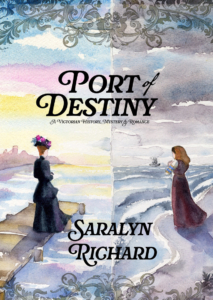
Three immigrants. Two disappearances. One murder. And a love story that defines them all.
When Rosa’s brother vanishes from hurricane-ravaged Galveston, she turns to his best friend, Nathan, to help her uncover the truth. Together they are swept into the mystery that swirls around her immigrant family in a city rebuilding after the devastating 1900 storm. Just as Nathan’s feelings for Rosa blossom, Chana enters the picture. Bold, resilient, and with a conflicting love interest of her own, she forces them to make the most important decisions of their lives.



 By
By  USA Today and Amazon bestselling and award-winning author Lois Winston writes mystery, romance, romantic suspense, chick lit, women’s fiction, children’s chapter books, and nonfiction. Kirkus Reviews dubbed her critically acclaimed Anastasia Pollack Crafting Mystery series, “North Jersey’s more mature answer to Stephanie Plum.” In addition, Lois is a former literary agent and an award-winning craft and needlework designer who often draws much of her source material for both her characters and plots from her experiences in the crafts industry. Her most recent book is
 USA Today and Amazon bestselling author Lois Winston began her award-winning writing career with
  What do trolls have to do with writing suspects and antagonists in mysteries?
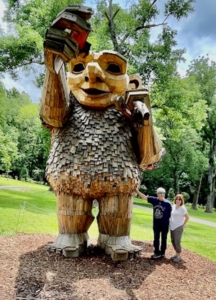 I first learned of Thomas Dambo’s work when I saw a news story about him and his art installations made of recycled materials. He’s considered the world’s leading recycling artist with his work appearing throughout the United States, Europe, and Asia. His more than 125 larger-than-life trolls were created to share his environmental message throughout the world in outdoor installations that use trash to create art within nature.
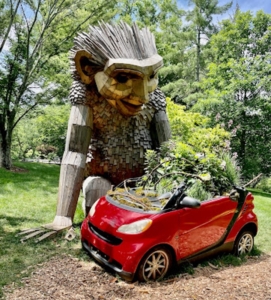 Six of Dambo’s trolls took up residence within the gardens, trees, and wooded areas of the Cheekwood Estate & Gardens in Nashville during this past spring and summer. I was lucky enough to have the chance to visit with them. They’ve since moved on to spend time at the Virginia Aquarium & Marine Science Center in Virginia Beach, VA through Jan 20, 2025. If you have a chance to visit with them, tell them I said hi.
 Also, the best villains or antagonists are multi-layered. If they weren’t, they’d be caricatures rather than characters, and no author should be writing Snidely Whiplash-type cardboard villains. That’s why it’s so important to spend as much time developing the goals, motivations, and conflicts of our suspects in our mysteries as we do our protagonists.
 Lately, I’ve felt the urge to rant at car manufacturers for hurting my eyes the way my singing had hurt my son’s ears. Have you noticed the garish colors of so many new cars? Some are the equivalent of chalk on a blackboard, shrieking and shrill, while others can only be described as homages to the scatological. What were they thinking? We’re living in a world that bombards us 24/7, causing us to yearn for anything soothing, whether it’s soft clothing, comfort foods, or escapist fiction.
 Has psychology done an about-face? If the screaming oranges, greens, and yellows aren’t bad enough, the other group is awful in another way. I really don’t want to drive around in a vehicle that reminds me of the last time I changed a diaper or hovered over the porcelain throne with stomach flu.
 By Lois Winston
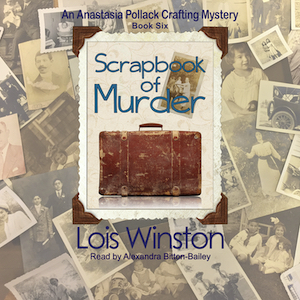 Scrapbook of Murder, the sixth book in my Anastasia Pollack Crafting Mystery Series, is now available as an audiobook. Post a comment for a chance to win a promo code for a free download.